

Dr. Matthias Niedenführ in the Interculture Journal: The Relational Paradigm and Cultural Complexity in China
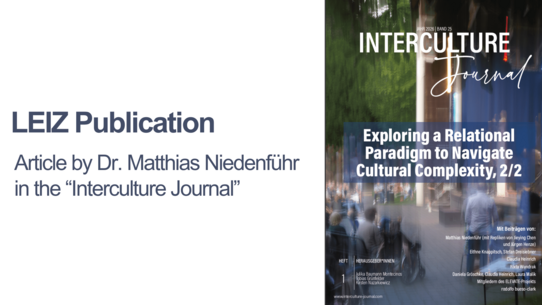
How can companies successfully navigate cultural complexity in a globally connected world? The current special issue of the Interculture Journalon the theme “Exploring a Relational Paradigm to Navigate Cultural Complexity” takes up this question and discusses relational perspectives as an alternative to individualistic or purely collectivistic ways of thinking. At its core lies the idea that economic action, leadership and cooperation are essentially shaped by relationships.
The issue opens with a lead article by Matthias Niedenführ, Senior Research Fellow at the Leadership Excellence Institute Zeppelin. In the article, he connects current approaches of the relational paradigm with Confucian, Daoist and other Chinese traditions of thought. Under the concept of relational rationality, the contribution shows how trust, long-term relationships, moral leadership and mutual responsibility can shape social practice and corporate governance in China. Empirical examples of Chinese companies make clear how traditional values are translated into modern management and leadership approaches.
Particularly noteworthy is the subsequent academic conversation in the form of two replies. The sinologist Jürgen Henze deepens the significance of Face and Guanxi as central elements of Chinese relationship orientation, while the management consultant Jieying Chen analyses the practical relevance of relational leadership approaches for German-Chinese business cooperation. Both contributions show how relational perspectives can help to shape cultural differences productively and to develop viable forms of transcultural cooperation.
The publication is directly connected with LEIZ research on Relational Economics, responsible leadership and transcultural cooperation. It makes clear how cultural diversity can be a resource for shared learning, trust and sustainable value creation.