

WÜRTH Chair of Cultural Production
News
-

JCMCP Launch Event | “Transformations and Upheavals: The Effects of Crises and Conflicts on the Arts”
This issue looks at the effects political upheavals and processes of social transformation have on the conditions for cultural production, dissemination, education, ... -

New Release: Places of Excellence – How Master’s Programs Build Reputability
This book investigates how excellence and reputability are formed, performed, and perceived at well renowned international higher education institutions. Along six ... -
Journal of Cultural Management and Cultural Politics | Launch Event: Museum – Politics – Management
What could 21st-century museums be? In light of the global pandemic, environmental degradation, and racial justice crises, the contributions in this issue offer ...


Profile
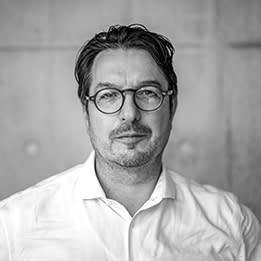
The WÜRTH Chair of Cultural Production was established in 2015 as an endowed chair with the help of the WÜRTH Foundation and the Stifterverband der Deutschen Wissenschaft. Martin Tröndle has been holding the chair since then.
The chair’s research and teaching activities focus on cultural organisations and their visitors as well as non-visitors, cultural policies and funding, as well as on the effect different performance and exhibition formats have on their audiences. The close integration of research, teaching and practice is central to this work and at the core of the national and international research projects Martin Tröndle is carrying out with various teams and practice partners. These include:
- Martin Tröndle has been the principal investigator of “eMotion – mapping museum experience,” funded by the Swiss National Science Foundation and others.
- He is a principal investigator of “ECR – Experimental Concert Research,” funded by the Volkswagen Foundation and others.
- Since 2014, Martin Tröndle has been editor-in-chief (together with Steffen Höhne and Constance DeVereaux) of the peer-reviewed Journal of Cultural Management and Cultural Policy.
Topics and Activities

The research of the chair focuses on the following topics: Concert and museum studies, visitor and non-visitor research, cultural management and cultural policy research as well as artistic research.

The chair is hosting a range of dissertation projects and post-doctoral projects that explore the various thematic fields of the chair. The chair is also part of the doctoral programme "FEINART.
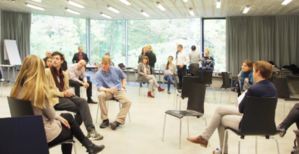
Throughout the courses offered by the chair, the approach of research-based learning is applied to encourage independent thinking and enthusiasm for scientific problem solving among students.

With the concept of research-based teaching, teaching is hybridised, with the keyword ‘transfer’ we aim to hybridise research. In order to make science effective, the designs and results of scientific research must move closer to society.
Participations and Additional Formats
The WÜRTH Chair of Cultural Production is part of the Center for Cultural Production at Zeppelin University, which also includes the Zeppelin University’s artsprogram and the Laboratory for Implicit and Artistic Knowledge (LIKWI).

Martin Tröndle is a beneficiary of “FEINART – The Future of European Independent Art Spaces in a Period of Socially Engaged Art”, funded by the Marie Skłodowska-Curie Programme within the framework of Horizon 2020.
Team
Former Team Members
- Weining, Christian MA |Experimental Concert Research (ECR)
- Hüser, Charlotte MA | Student assistant
- Hofste, Emma-Charlotte BA | Undergraduate assistant WÜRTH Chair of Cultural Production / Experimental Concert Research
- Stockmann, Nico BA | Graduate assistant
- Research Cluster “Arts Production and Cultural Policy in Transformation” & WÜRTH Chair of Cultural Production
- Weden, Victoria BA | Graduate assistant, WÜRTH Chair of Cultural Production
- Vildosola, Alexandra Student assistant at the "Digital Concert Experience" project
- Stockmann, Nico BA | Graduate assistant
- Mamrud, Noa MA | PhD candidate, “FEINART” project
- Schindler, Johanna Dr Phil | Research fellow
- Stielow, Sophie BA | Undergraduate research assistant at the research project “Digital Concert Experience”
- Schmitz, Jana BA | Undergraduate assistant
- Steigerwald, Claudia Dr phil | Research fellow
- Storch, Carolin BA | Undergraduate assistant