Program & news 

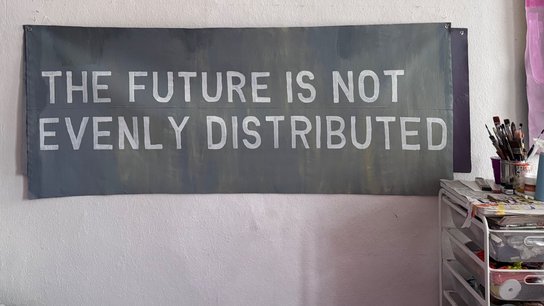
Marina Naprushkina, The future is not evenly distributed, 2025 Acryl auf Leinwand, 80 x 200cm

Next exhibition in the White Box

The exhibition ‘Die Zeit danach – Friedrichshafen 1946’ (The Time After – Friedrichshafen 1946) will open at the White Box on Friedrichshafen Art Friday on 27 March. The aim is to create a growing participatory archive in which documents, images, objects and statements from contemporary witnesses on various topics are displayed. The exhibition draws on private and public archives and new media exceptions. The thematic areas include life in ruins, architecture and infrastructure during the transition, memory and shame. The exhibition will feature photographs, architectural blueprints and development plans for the city, documents and narratives that illustrate how people envisioned the future in the immediate post-war period and how their relationship to the totalitarian Nazi regime developed. Belarusian artist Marina Naprushkina, who has been bringing people together through her artistic practice for many years and encouraging them to create their own social and cultural spaces and infrastructures – most recently a lido abandoned by the state of Berlin, which has now been reopened as a cultural venue – was commissioned to develop the exhibition display. Naprushkina will create her exhibition display together with students using ropes, shelves and banners.

Annual topic 2026 - The Time After

The starting point for the annual theme of the artrogram and the Arts & Humanities LAB is the observation that we are living in a time in which many things that were taken for granted in liberal societies have been irretrievably lost. A long period of political stability and reliable economic and international legal assumptions seems to be over.


There is talk of the “end of the West”. Geopolitically, planetarily and ecologically, but also in our individual experience, we are entering a new phase.


Against this backdrop, under the title “The Time After”, we want to examine historical and biographical constellations following significant historical or traumatic events that involved similar upheavals.


This refers to the post-war period, times after revolutions, major natural disasters and civilisational ruptures, or after the abrupt end of certain forms of rule and ways of life, such as after the fall of the Berlin Wall.


On the one hand, we want to ask how history is processed or repressed in these phases and how new visions of the future emerge at the same time. Is the future in ‘the time after’ only thought of as a phase in which everything bad is hopefully over and forgotten, or everything good is considered lost and mourned? What does it mean to speak of the zero hour?


What does it mean for our view of the future when the present is understood as a break with the past? We would like to address these questions using very different, but also very concrete historical examples. To this end, we are planning a lecture series, a symposium and an exhibition with a growing participatory archive on Friedrichshafen in 1946.


Lecture series and symposium


In the lecture series, sociologists, cultural scientists and philosophers will discuss in eight lectures and a symposium how, after traumatic biographical experiences, wars, revolutions and natural disasters, recourse to the past takes shape and how the future can be conceived under such circumstances.


Lecture topics include ‘The Art of the Zero Hour. Pathologies of a War Generation’(Karen van den Berg), ‘2046: One Year After Technological Singularity’ (Jan Söffner), and ‘Cultural Policy after the Arab Spring’ (Meike Lettau).


The lecture series will conclude with a symposium in cooperation with the Kunsthaus Bregenz, in which philosopher Armen Avanessian, sociologist Dirk Baecker and sociologist Eva Illouz will discuss how thinking and feeling can change after drastic, sometimes even traumatic historical events.

Jewish star scientist Eva Illouz will speak about her book ‘The 8th of October’, Dirk Baecker will talk about the ‘noise of information’ and thinking without subjects, and Armen Avanessian will discuss ‘vibe shifts’.


Lecture series and symposium

In the lecture series, sociologists, cultural scientists and philosophers will discuss in eight lectures and a symposium how, after traumatic biographical experiences, wars, revolutions and natural disasters, recourse to the past takes shape and how the future can be conceived under such circumstances.


Lecture topics include ‘The Art of the Zero Hour. Pathologies of a War Generation’(Karen van den Berg), ‘2046: One Year After Technological Singularity’ (Jan Söffner), and ‘Cultural Policy after the Arab Spring’ (Meike Lettau).


The lecture series will conclude with a symposium in cooperation with the Kunsthaus Bregenz, in which philosopher Armen Avanessian, sociologist Dirk Baecker and sociologist Eva Illouz will discuss how thinking and feeling can change after drastic, sometimes even traumatic historical events.


Jewish star scientist Eva Illouz will speak about her book ‘The 8th of October’, Dirk Baecker will talk about the ‘noise of information’ and thinking without subjects, and Armen Avanessian will discuss ‘vibe shifts’.


Lecture series:


Tue, 03/02/2026, 7:15 p.m. - 9:00 p.m.

Karen van den Berg: The Art of the Zero Hour. Pathologies of a War Generation


Tue, 10 February 2026, 7:15 p.m. – 9:00 p.m.

Joachim Landkammer: From Expulsion to Termination Without Notice – A Brief Typology of Expulsion


Tue, 17 February 2026, 7:15 p.m. – 9:00 p.m.

Jan Söffner: 2046. One Year After Technological Singularity


Tue, 24 February 2026, 7:15 p.m. – 9:00 p.m.

Udo Göttlich: Unsustainability


Tue, 03 March 2026   7:15 pm  - 9:00 pm

Maren Lehmann: When you realise it, it wasn't the end. On the incomprehensibility of time


Tue, 10 March 2026   7:15 p.m.  - 9:00 p.m.

Meike Lettau: Cultural policy after the ‘Arab Spring’


Symposium organised by Zeppelin University and KUB:

The time after – A symposium on contemporary issues

21 March 2026, 2:00 p.m. – 6:30 p.m.

Location: Kunsthaus Bregenz (KUB), Karl-Tizian-Platz, A-6900 Bregenz


Responsible:

Prof. Dr. Karen van den Berg, Scientific Director of the artsprogram

Prof. Dr. Armen Avanessian, Chair of Media Theory


Time to decide

This website uses external media, such as maps and videos, as well as external analytics tools – all of which may be used to collect data about your online behavior. Cookies are also stored when you visit our website. You can adjust or revoke your consent to the use of cookies and extensions at any time.

For an explanation of how our privacy settings work and an overview of the analytics/marketing tools and external media we use, please see our privacy policy.