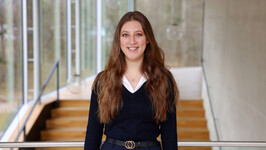

Hannah Hartenstein: In Tune with a Culture of Empowerment
For just under three years, Hannah Hartenstein worked behind the counter at the student café “Beton & Bohne”. Together with her co-manager, she shared responsibility for the team, operations, and budget—and learned what leadership truly means in everyday life. At the same time, through stints in the central emergency room and internships in counseling and hospital management, a unique interest began to take shape: an interest in the economic side of the healthcare system.
Although Hannah Hartenstein was born in Backnang, her family moved to Esslingen—located southeast of Stuttgart—when she was just one year old. Since her parents run their own healthcare practice together, daily life at the practice has always been an integral part of the family’s routine. “For a while, I even toyed with the idea of studying medicine myself. Even though my parents gave me complete freedom and left all options open for me to find and pursue my own path,” notes Hartenstein. And that’s exactly what she did. Running her own medical practice brought another aspect to light. “I was particularly fascinated by the economic aspects of self-employment,” explains Hartenstein, who further developed her interest in economics in high school: by participating in the “School as a State” project and, as a result, co-founding a company; by taking economics as an advanced course in high school.
From Healthcare to Communication Studies to a Bachelor’s Degree in CME
But her decision about what to do after graduating from high school was far from set in stone. “On top of that came the COVID-19 pandemic, which completely upended plans that had been made earlier and felt right, leaving one not only feeling uncertain but sometimes even frightened,” Hartenstein recalls. But she was only briefly intimidated and deterred by this; her choice of next step turned out to be more than courageous: She completed a voluntary social year (FSJ) in the central emergency room of a hospital in Nürtingen. “I deliberately chose the central emergency room because I wanted to step out of my comfort zone,” notes Hartenstein, who primarily handled patient transport and nursing duties and kept a cool head even in challenging situations—such as when she had to manage difficult medical emergencies alongside what were sometimes severe COVID-19 cases. “During that time, I learned a lot about how to deal with stress. It’s indescribable what people accomplish day in and day out in nursing,” Hartenstein emphasizes. After half a year in this fast-paced environment, she completed the FSJ, which was scheduled for that period, followed by another half year in hospitals in Konstanz and Stuttgart, where she shadowed staff in various departments.
After her time in the healthcare sector, Hannah Hartenstein initially decided to study communication sciences at the University of Hohenheim before changing universities after two semesters. “That academic year was still instructive. It showed me what’s important to me in a degree program: that theory and practice are in balance. I also missed business, which had never really left my mind,” explains Hartenstein. She discovered this combination of communication and management in the CME bachelor’s program at ZU. “And after an information day, one phrase really stuck with me: ‘culture of empowerment’—in the sense of, ‘If you want to do something, find the right people and do it,’” says Hartenstein.
Particularly impressed by the Student Café “Beton & Bohne”
From the very beginning, Hannah Hartenstein was particularly impressed by the unique atmosphere at the student café “Beton & Bohne”—the bustling activity and lively interactions. “Even though I didn’t have a clue how to operate a portafilter machine, I applied for a job as a barista,” Hartenstein says. After spending her first few months behind the counter—serving up various coffees and cakes, among other things—the time drew near when the management duo was nearing the end of their studies and looking for a successor. “Of course, I was thrilled that I was asked and that they trusted me to take over,” Hartenstein notes.
Things are usually hectic at the start of a semester when the ten-person student team has to be partially restructured. Together with her respective co-manager, Hannah Hartenstein was responsible for the entire process: from posting job openings to selecting new team members through interviews and training them. Only once the team is in place do we move on to ordering food and beverages, before finally assigning shifts. “During the semester, we also post on social media to share our hours of operation, upcoming events like bar nights, or new additions to our menu,” adds Hartenstein, who, in addition to the café, also led the baking team, which regularly bakes the well-known and infamous banana bread.
With the exception of a semester abroad in Copenhagen, Hannah Hartenstein served as manager of the student café from her third through eighth semesters. “The main reason I stayed on for so long is that the work never got boring, and I never shied away from taking on responsibility or working in ever-changing teams,” explains Hartenstein, who, together with her team, constantly worked to organize bar nights or handle catering orders.
Focus on Course Diversity in the CME Program
Hannah Hartenstein made a conscious effort to take advantage of the interdisciplinary course selection that the CME program offers starting in a certain semester. “While many of my classmates settled on a minor, the variety of courses allowed me to explore a wider range of topics. The main thing is that the practical component—whether field trips or concrete case studies—was never neglected,” Hartenstein reports. As her studies progressed, she took more and more management courses—including during her semester abroad at Copenhagen Business School. “The strength of the CME bachelor’s program lies precisely in training us to become responsible and creative leaders. My goal is now clear: In the future, I want to work in a management position myself,” Hartenstein reveals.
Hannah Hartenstein was particularly impressed by the course “Management of Innovation and Transformation” taught by Professor Dr. Matthias Weiss, which explores how to sustainably strengthen the potential for innovation in digital transformation within companies. “Even while taking the course, I knew I wanted to write my bachelor’s thesis on this topic; I just hadn’t settled on a specific subject yet,” Hartenstein explains.
Bachelor's Thesis on Digital Innovations in Hospitals
It wasn’t until she did an internship in the executive office of a clinic in Zurich that she came up with the topic for her thesis. “Together with the managing director at the time, I talked a lot about digital innovations in clinics—from telemedicine to artificial intelligence to robotics—and about why they often aren’t implemented,”explains Hartenstein, who first conducted a literature review on digital innovations in the hospital context for her bachelor’s thesis and then compared the factors influencing digital innovations at two hospitals. “In the process, I discovered that it’s not the technological component but the human one that prevents certain digital innovations from being implemented,” she says. “Compounding the issue, in addition to skepticism and fear of new technologies, are the entrenched structures and processes in hospitals,” Hartenstein explains.
The bachelor’s thesis has been submitted; all that’s left is the graduation ceremony this fall. By then, Hannah Hartenstein will have returned to Copenhagen to pursue a master’s degree in Business Administration and Innovation in Health Care. With the submission of her bachelor’s thesis, her work at the student café also came to an end. She worked her last shift in May. “The good thing is that I found a great successor and the handover went off without a hitch,” explains Hartenstein. “And here’s another plus: If all else fails, at least I now know what it’s like to run my own café.”
More articles
 10/22/2026PeoplePioneer of the Month
Helena Waldhier: A Designer with an Eye for the Big Picture
For a long time, Helena Waldhier saw management as an opportunity to rethink existing systems. But now that she’s halfway through her bachelor’s degree, her perspective has changed.- 09/30/2026PeoplePioneer of the Month
Ferhat Cicek: With Foresight into the Wide World
With an inquisitive nature and an extensive network, Ferhat Cicek set out from Lake Constance into the wider world—to Singapore, Doha, Istanbul, New York, and Washington, D.C.  07/15/2026PeoplePioneer of the month
Leon Löchle: Life in a Highly Frequented Area
For Leon Löchle, getting involved is as much a part of life as the air he breathes. It means a great deal to him to stand up for others or to help them have a good time.- 06/18/2026PeoplePioneer of the month
Julia Sonntag: Always One Step Ahead of Stagnation
Julia Sonntag is what people generally call a loyal soul. She feels a deep connection not only to the Lake Constance region, but also to the initiatives and jobs she’s involved in.