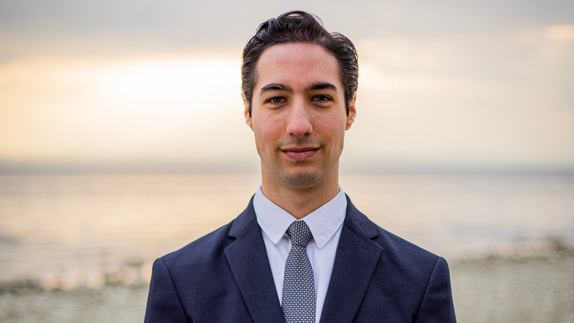
Ferhat Cicek: With Foresight into the Wide World
By nature, Ferhat Cicek is someone who is always ready to discover the unknown, champion values, and grow into new roles and responsibilities. At ZU, he is part of a network where people support one another, learn from one another, and motivate one another. Armed with both of these qualities, he set out from Lake Constance into the wider world—for internships and exchange programs in Singapore, Doha, Istanbul, New York, and Washington, D.C.
Ferhat Cicek was born and raised just a stone’s throw away from ZU’s two campuses—it’s only about ten kilometers from his Kurdish family home in Markdorf to ZU’s ZF Campus in Fallenbrunnen. “Our parents constantly encouraged me and my three siblings to seize the educational opportunities available in Germany,” says Cicek. “They were also the ones who—despite my being recommended for the Realschule—made it possible for me to attend the Gymnasium because they firmly believed in me and my potential.”
To understand why Ferhat Cicek developed an interest in international relations and international law in the first place, one must look at his family’s recent history. In the 1990s, his parents were the only ones in their entire extended family to have fled from southeastern Turkey to Germany. “I can still clearly remember a visit to relatives in Turkey. I had just turned eleven when the fighting between the Turkish army and Kurdish militias escalated. The conflict shook my family deeply, especially because large parts of our hometown were razed to the ground in the process,” says Cicek. “Ever since then, it has been firmly planted in my mind that I do not want to live in a world where children become the victims of wars and conflicts.”
Early commitment to international law and human rights
Not long after, Ferhat Cicek began actively seeking out projects and initiatives that introduce young people to international law and human rights—with the aim of getting involved in them. Shortly thereafter, he became a member of the organizing team for the Deutsche Model United Nations (DMUN) e.V. and was jointly responsible for ensuring the smooth operation of several large MUN conferences in Stuttgart and Kiel, each with more than 300 participating students. “As a committee advisor, I also helped the delegates figure out how to position themselves in a debate to achieve a specific goal,” adds Cicek, who last year had the opportunity to represent the organization at the United Nations Commission on Social Development (CSOCD) in New York and at the World Social Summit in Doha. “It was particularly exciting to meet with actual representatives from NGOs, aid organizations, and governments at side events and learn more about their perspectives on social developments around the world,” reports Cicek.
Even before graduating from high school, Ferhat Cicek got to know ZU from the inside. During his summer break, he attended the Student Academy and took a course on the topic “The Rule of Law: A Complement or an Obstacle to Politics?” “Ultimately, however, it wasn’t just the intensive small-group discussions that convinced me, but also the family-like atmosphere and the interdisciplinary learning environment,” explains Cicek. The latter reason was decisive when he chose the PAIR bachelor’s program, which combines politics, international relations, and public administration into a single degree program. “For me, the PAIR program represents another important step on the path toward advocating for international law and human rights in the future,” explains Cicek.
Initial meetings and discussions with politicians and diplomats
The fact that, from the very beginning, his focus was not only on his studies but also on student initiatives is evident from his statement of purpose, in which he expressed his desire to play an active role in the Club of International Politics (CIP) e.V. No sooner had he started his studies than he was nominated for the executive board. After being successfully elected as a board member, his first term began in the second semester; a year later, he was elected vice president. “One of the board’s first tasks is to reach out to figures from politics and diplomacy and invite them to the university for a talk,” Cicek notes. He himself drew on his personal connection to the U.S. Consulate General in Düsseldorf, where he had completed a pre-internship in trade policy. “And so, just a few weeks later, I had the opportunity to moderate a discussion with the then U.S. Consul General in Frankfurt, Norman Thatcher Scharpf, at ZU,” Cicek recalls. Further inspiring encounters and conversations followed when some CIP members traveled to Munich and Berlin to meet with politicians and diplomats—including meetings at the Turkish and U.S. embassies in the German capital.
Clinical rotations on three different continents
An internship at the Federal Ministry for Economic Cooperation and Development (BMZ), however, took him to Bonn, the former federal capital. “The internship was very challenging because I dealt primarily with procedures related to financial and technical cooperation, but also with practical issues such as the conclusion of an international treaty between Germany and Iraq,” Cicek explains. The following summer, he went to Singapore for an internship as part of the Konrad Adenauer Foundation’s Regional Program for Political Dialogue in Asia. “There, I was able to write reports for the German public on economic and security policy developments in Southeast Asia, such as the situation in Myanmar or China’s actions in the South China Sea,” Cicek explains. His next internship was with the German Business Delegation in Washington, D.C.—this time on a part-time basis, however, because the internship is a required component of a semester abroad at American University, which is based there. “That was the most exciting internship so far because the delegation supports small and medium-sized German companies in the Washington metropolitan area, through which about 70 percent of global internet and data traffic is routed and processed in massive data centers,” says Cicek.
Economic policy is increasingly taking center stage
What stands out is that, in addition to politics, the economy plays a central role in his internships: “I realized early on that the economy is a key lever for combating unemployment, improving people’s quality of life, and achieving the Sustainable Development Goals set by the United Nations—all without exploiting people or nature.”
As his PAIR program progressed, his focus also shifted increasingly toward economic policy, particularly the financial sector. With his awareness heightened, he encountered a topic during his semester abroad whose scope he hadn’t fully grasped before. “Unlike in many countries, prediction markets play a significant role in the U.S. The issue of insider trading on these platforms, in particular, was the subject of heated debate in Washington, D.C. For example, in the past, military personnel have used information about military operations to place bets on the occurrence of geopolitical events and profit from them,” explains Cicek. How well prediction markets predict geopolitical events and to what extent they endanger a country’s national security: these are questions he hopes to explore in depth in his Humboldt project and likely in his bachelor’s thesis as well.
Meanwhile, and thus in the midst of the Humboldt Project, Ferhat Cicek is living and working in Singapore again. He is currently doing an internship there in the Corporate Banking Team at Landesbank Baden-Württemberg (LBBW) for the Asia-Pacific region. “It’s not ideal that my internship and the fall semester overlap. Fortunately, however, ZU is flexible and offers the option to participate in hybrid courses from abroad,” explains Cicek—and adds: “Just like in past semesters, this period will once again present me with many tasks and challenges, but I hope to continue growing through them.”
More articles
 08/21/2025PeoplePioneer of the month
Ezgi Gülistan Gül: With focus against forgetting
Ezgi Gülistan Gül is not above stating uncomfortable facts. Her aim is to put knowledge into the world that is never instructive, but always enriching. 02/26/2025PeoplePioneer of the month
Luca Julie Kuhlmann: Building bridges for international cooperation
To strengthen international cooperation and make the world a more peaceful place: Luca Julie Kuhlmann is well on the way to achieving her goals. 06/20/2024PeoplePioneer of the Month Arved Friese
Much more than a spectacle
As an actor, Arved Friese has played various roles in film and television. He now puts his energy into various projects that are close to his heart. 08/26/2026PeoplePioneer of the month
Hannah Hartenstein: In Tune with a Culture of Empowerment
For years, Hannah Hartenstein worked behind the counter at the student café “Beton & Bohne”. At the same time, a unique interest began to take shape: an interest in the economic side of the healthcare system.