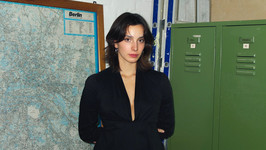
Ezgi Gülistan Gül: With focus against forgetting
Ezgi Gülistan Gül doesn't let herself get rattled. Despite opinions to the contrary, she graduated from high school and went to university - and now encourages others to believe in themselves and follow their own path. Ezgi Gülistan Gül also remains consistent and powerful in that she is not afraid to state uncomfortable facts. Her aim is to put knowledge into the world that is never instructive, but always enriching.
More than 30 years or two generations after her grandfather came to Germany from Turkey as a Kurdish guest worker, Ezgi Gülistan Gül saw the light of day - in the middle of the Swabian Alb in a suburb of Tübingen with a population of 3,000. She then moved to Balingen, where she spent her youth. "As a child and teenager, I never had any fear of contact or problems making friends in a community. At grammar school, however, I encountered teachers who didn't think I could do the Abitur," reports Gül, who didn't let this get her down and switched to a business grammar school after the tenth grade, leaving with the Abitur in her pocket.
Even though it was important to her parents not to place too much emphasis on the family's political background, Ezgi Gülistan Gül could not help but gradually become more involved with Kurdish life and culture. What's more, she became involved in the Alevi community early on and carried out educational work there. "Aside from political issues, it was primarily about strengthening the self-confidence of people with a migration background and showing them ways and means of asserting themselves and achieving their goals," adds Gül.
This also applies to her path to ZU. "It was always clear to me that I wanted to study the topics that have accompanied me so far: society, politics and business. And at a place that supports and challenges me. The SPE Bachelor's degree and ZU were exactly what I had in mind and what I wanted."
From sociology to political sociology
Ezgi Gülistan Gül felt thrown in at the deep end when she was required to read Max Weber or Émile Durkheim in her first sociology course. But she was not put off by this. On the contrary: "I was particularly fascinated by sociology. It has the unique ability not only to analyze existing power relations, but also to ask how power works and how it affects the lives of different people," explains Gül. The discovery that sociological theories can be ideally combined with political questions led her to focus on political sociology - and in particular on stateless and marginalized groups in the MENA region (Middle East and North Africa). "I am particularly interested in the relationship between states and societies and how state-sanctioned violence is produced and used in a targeted manner," Gül mentions.
To deepen her focus, she took part in a Kurdish Studies Conference at the London School of Economics and Political Science (LSE) and spent a semester abroad at the American University of Armenia. "Attending the conference in particular was an enlightening moment, because I saw how much the field of research has grown in recent years and decades," explains Gül. In Armenia, in turn, she experienced first-hand how society deals with the legacy of genocide.
Ezgi Gülistan Gül still remembers the stories of her grandparents, which revealed how Kurds once lived together with Armenians in various regions of present-day Turkey. While the latter were expelled from the country in 1915/16, the former were spared expulsion. "Knowing that the historical violence against some is not detached from the current violence against others, I have always tried to establish connections in the respective histories of oppression," Gül describes, "whereby I have repeatedly encountered the concept of denial." In her Humboldt thesis, she examined speeches by Turkish politicians and Turkish legal texts to see how they not only legitimize new violence through denial, but also produce it. "As long as genocide is not recognized, the cycle of violence cannot be broken," Gül states. In her bachelor's thesis, she conceptualized the politics of denial so that her findings can be applied to other cases of post-genocide and post-conflict regions.
In the meantime, Ezgi Gülistan Gül has written a term paper on artistic interventions in the context of conflict and violence, specifically how Kurdish artists and collectives draw attention to the current problems of Kurds in north-eastern Syria. "Art can be a form of coping with trauma and inform a large public about the complex realities behind attacks on the freedom of Kurds," notes Gül. The special thing about it: with the support of junior professor Dr. Meike Lettau, the term paper was turned into a paper that was published on the knowledge platform KULTURELLE BILDUNG ONLINE.
Focus on foreign policy and human rights
Foreign policy and human rights are topics that Ezgi Gülistan Gül not only wanted to learn about in theory during her bachelor's degree, but also experience in practice. Her first internship therefore took her to the European Affairs Division in the German Bundestag - at a time when the Russian war of aggression against Ukraine had only been going on for a few months. "At that time, the focus was still on which sanctions packages should be put together and how humanitarian aid should be provided," explains Gül. She switched to a different perspective for her second internship, which she completed at Amnesty International Germany - this time focusing on the MENA region and Asia. "My job was to prepare reports on human rights violations, brief my supervisor on them and accompany her to meetings in the German Bundestag or the Federal Foreign Office or to protests in front of the Federal Chancellery," says Gül, who gained shocking insights into human rights violations against women and the Kurdish minority in Iran.
Ezgi Gülistan Gül is currently conducting research as a Humanity in Action Fellow in the Bosnian capital Sarajevo. In seminars, workshops and project work, she is once again focusing on topics such as denial, reconciliation and the culture of remembrance. Next fall, she will start a Master's degree in Political Sociology: "I want to produce new knowledge, but not with the aim of lecturing the current academic world, but rather to enrich it with my perspectives," says Gül.
Role model for young people
What particularly distinguishes Ezgi Gülistan Gül is that she does not hide what she has achieved and accomplished. As a values ambassador for the educational movement GermanDream and inteGREATer e.V., she regularly visits schools to discuss human rights issues such as racism and anti-Semitism in values dialogues or to share her own educational path with pupils: "It is so important that young people have role models they can identify with and look up to, and who show them what is possible if you just believe in yourself."
More articles
 09/30/2026PeoplePioneer of the Month
Ferhat Cicek: With Foresight into the Wide World
With an inquisitive nature and an extensive network, Ferhat Cicek set out from Lake Constance into the wider world—to Singapore, Doha, Istanbul, New York, and Washington, D.C. 10/16/2025PeoplePioneer of the month
Jil Tischer: Do it yourself - but together
The dynamic and energetic environment at ZU encouraged Jil Tischer to think big and realize even bigger projects.- 09/25/2025PeoplePioneer of the month
Augustin Renz: Juggler with three standing legs
Augustin Renz likes the roles of the lobbyist in university politics, the bachelor student between sociology, politics and economics and the qualitative and quantitative researcher. - 06/26/2025PeoplePioneer of the month
Lara-Maria Mixdorf: On the path from plate carrier to sustainable entrepreneur
Studying sociology, politics and economics has given Lara-Maria Mixdorf every opportunity to pursue her dream of becoming a sustainable entrepreneur.