
Starting a business is a matter of practice
If artificial intelligence is making companies smaller, flatter, and faster—what skills do founders actually still need? At this year’s Village Hub, experts from the startup scene—including many alumni—will provide a clear answer. And it has less to do with technology than you might think.
A billion-dollar company with just ten employees: It sounds far-fetched, but for Maximilian Dekorsy, it’s no longer a distant vision of the future. “We’re not that far from it,” says the founder and CEO of ecoplanet right at the start of his keynote address. Dekorsy himself studied at Zeppelin University; today, his startup develops AI-powered software that helps medium-sized companies manage their energy consumption. He explains how traditional job titles and hierarchies are becoming less and less important in startups. Instead, everyone pitches in on the operational side—including himself as the founder. In his sales team, AI now handles the research and preparation. As a result, he now has 120 minutes—instead of 90—to spend in meetings with the right customers.
But what, then, is left for human workers to do? Dekorsy believes: “Building a cool model isn’t smart anymore. Anyone can do that.” What makes the difference is having a clear goal in mind. Only those who have actually produced a result by hand themselves know how to write good prompts. Even more important is the ability to explain complexity in such a simple way that everyone understands it.

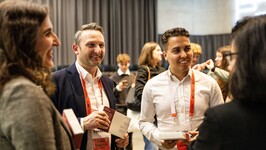
Dekorsy is one of fourteen speakers the Village Hub team has invited to Zeppelin University’s SeeCampus this afternoon. For the third year in a row, the event is being organized by the student initiative “Startup Village by Tatendrang.” About 175 participants are spread out across the foyer, seminar rooms, and the cafeteria in the sunshine. The audience consists mainly of students—including some freshmen—but also alumni, professors, and lecturers.
The founder gene is not a decisive factor
Alongside the keynote, participants in the “Prompt to Pitch” workshop—hosted by PioneerPort and the move+ Accelerator—will learn how to use AI as a “co-founder.” Working in teams, they’ll develop their own ideas into three-minute pitches, with the other participants serving as the jury. ZU alumnus Vincent Koch, founder of klarx and Frans Health, also reports that AI agents can make his work five to ten times faster in some cases—provided, of course, that they’re used correctly.
So AI changes the tools, but not what really matters when starting a business. And that’s not innate talent or a “founder’s gene,” but almost entirely a matter of practice. Mark Kugel, founder of, among other things, the space biotech startup Yuri, explains what inspired him personally: a comparison with a slightly older, successful founder. That person was definitely smarter than him, “but maybe not twice as smart—perhaps only about 30 percent.” His statement sticks with you because it narrows the gap to the supposedly great geniuses.

University is a good time to start a business
Charlotte Schmid shows just how early you can start practicing. The ZU alumna met Lucia Fuchs during her first semester—and then immediately co-founded a company with her. Their startup, habitus.art, combines paint-by-numbers with works by real artists. Her advice to the students in the audience: “Just do it and don’t overthink it!”
Jennifer Hintz, now Chief of Staff at the Munich-based startup incubator UnternehmerTUM, met her co-founder at a startup conference and spent six years building the fintech company finway as co-CEO. As different as their paths may be, they are in complete agreement on one point: university is a good time to launch your first startup—fixed costs are low, responsibilities are manageable, and the mistakes from which you learn the most are the ones you have to make yourself anyway.

The fact that this approach works is evident not only on stage: When broken down by student enrollment, Zeppelin University consistently ranks among the universities in Germany with the highest number of startups. So it’s no coincidence that so many alumni are among the speakers.
Village Hub shows: no one is born a founder
For the final talk, the foyer at the SeeCampus is nearly full. When Kilian Strobl takes the stage, the audience applauds loudly. Everyone knows him. He has just completed his CCM degree at Zeppelin University. Together with Arved Friese, he founded the student beer Züffl during his second semester; it has since become a staple of student parties both on and off campus. It is brewed by Meckatzer. Constantin Weiss, Strobl’s panel discussion partner, is the fifth-generation head of marketing at the family-owned brewery. What began as a whimsical idea has since sold over 21,000 units at the university, with a new label each semester chosen from a design competition among the students.

This semester, for the first time, the label remains blank. Strobl and Friese symbolically pass the brand on to the students. Beer crates and colorful markers are set out in front of the stage—even while the talk is still going on, some people in the audience begin designing their own bottles. “Züffl is about participation,” says Strobl.
What this year’s Village Hub makes abundantly clear is that no one is born a founder. Founding a business is a mindset that can be cultivated—and at Zeppelin University, students often start doing just that as early as their first semester. Perhaps that’s why the blank label is the most fitting image for this day. What ends up on it is now up to the students themselves. The alumni on stage have shown how it can be done.
More articles
 08/17/2026LifeInvestor Summit Bodensee
Why Good Ideas Need the Right Connections
For founders seeking funding, the Investor Summit Bodensee is about much more than just a pitch on stage. After all, the most valuable connections are made afterward. 05/11/2026Lifezu|taten 2026
How a special kind of career fair introduces real questions about the professional world
Workshops, job interviews, panel discussions: students, alumni and companies meet directly at the student-organized career event zu|taten.- 09/28/2026LifePhoto Gallery
ZU Summer Festival, themed “Beyond borders.” featuring a diverse program and many guests
Zeppelin University opened its doors and invited anyone interested to meet, exchange ideas, and celebrate together. - 08/03/2026LifeGlobal Talk with Andreas Kruse
How Young and Old Come Together
In a Global Talk, gerontologist Andreas Kruse explains how the generational conflict can be resolved and how society can be strengthened through interaction and collaboration.