
“First and foremost, you’re a human being.”
Vladimir Putin invokes the Christian West, while American Christian nationalists hail Donald Trump as God’s messenger. In a lecture at Zeppelin University, Heinrich Bedford-Strohm, president of the World Council of Churches and former chair of the EKD Council, explains why right-wing populism and the Christian faith are incompatible.
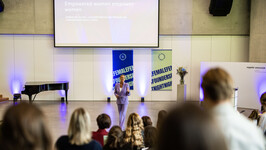
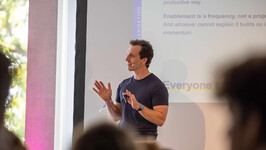
The misuse of religion—especially Christianity—has reached an intolerable level. Heinrich Bedford-Strohm begins his lecture on “Right-wing populism and religion: on the role of Christianity in public life” with this assessment. Anyone who uses faith to devalue others turns it on its head. For at the heart of the Bible lies exactly the opposite: love for one’s neighbor, and the protection of the weak and the stranger. His guiding principle is remarkably simple: “First and foremost, you’re a human being.” Only then does one become a follower of a party or an ideology. For Bedford-Strohm, this is the key to how a divided society can find its way back together: being clear on the issues while still not leaving anyone behind.
Bedford-Strohm served as regional bishop of the Evangelical Lutheran Church in Bavaria until 2023 and as chair of the Council of the Evangelical Church in Germany (EKD) from 2014 to 2021. Since 2022, he has chaired the Central Committee of the World Council of Churches. This body brings together some 350 churches from around the world, including the Russian Orthodox Church.
“Hate is not an opinion”: how right-wing populism exploits fear
According to Bedford-Strom’s analysis, right-wing populist movements rely primarily on three tactics. The first is fear. He counters this with one of the most common phrases in the Bible: “Do not be afraid!” For him, this phrase also represents trust in the future. The second tactic is national self-assertion, which is troubled by the dark chapters of its own history. With “Make America Great Again,” even self-critical distance is viewed as a threat. This is the exact opposite of Christianity, in which self-criticism is central. The third tool is aggressive communication, for which social media is tailor-made. Its business model thrives on click counts, and these are highest for extreme content. Anyone who frames this as a matter of free speech receives a clear rebuke: “Belittling other people and xenophobia are not opinions.”
But doesn’t every group just pick and choose whatever suits them from the Bible? Bedford-Strohm doesn’t let this objection from the audience stand. Anyone who reads the Bible as a whole will repeatedly encounter the same core message. “You don’t have to have studied theology to understand and interpret the Bible, but it does help,” he says, prompting laughter from the audience. The core message, he explains, is the double commandment to love God and one’s neighbor, and to protect strangers. Bedford-Strohm calls on people to put themselves in the shoes of refugees coming to Germany.

Christianity must never be used to justify wars and conflicts
Bedford-Strohm illustrates what this abuse looks like in practice by citing two countries. Putin justifies his war of aggression against Ukraine with the rhetoric that the Christian West must be defended against the “decadent West.” In 2024, a committee chaired by Russian Orthodox Patriarch Kirill I even spoke of a “holy war.” The World Council of Churches has confronted the Russian Orthodox Church on this issue but has deliberately not expelled it in order to keep the last channels of communication open. Nevertheless, the basis for these discussions is clear: The war is condemned and must never be justified on the grounds of Christianity.
In the U.S., Project 2025—a strategy paper for Trump’s second term—invokes, of all people, Dietrich Bonhoeffer. The Protestant theologian resisted the Nazi regime and was executed in 1945. Bonhoeffer warned against “cheap grace,” explains Bedford-Strohm—that is, against confusing grace with the acceptance of injustice. Project 2025 interprets this to mean exactly the opposite. As he describes how, in right-wing Christian circles, the storming of the Capitol was equated with resistance against the Nazis, a murmur runs through the audience.

The Golden Rule from the Sermon on the Mount is more important than ever
For Bedford-Strohm, the U.S. midterm elections demonstrate that it is possible to invoke the Bible in a very different way. In Texas, Democrat James Talarico won; in Kansas, Methodist pastor Adam Hamilton won, becoming the state’s first Democratic senator in nearly a century. Both explicitly identify as Christians. Bedford-Strohm reads from Hamilton’s victory speech, which he translated himself. In it, Hamilton quotes the Golden Rule from the Sermon on the Mount: “Do unto others as you would have them do unto you!” They invoke the Bible, says Bedford-Strohm, but not a misused Bible.
One sentence in particular sticks with me from the evening: “ First and foremost, you’re a human being.” This applies just as much to refugees coming to Germany as it does to political opponents with whom one engages in heated debate. Anyone who invokes Christianity must be held to this standard.
More articles
 10/27/2026LifeFemale Founders Night
Underestimated, Overlooked, Undeterred: What Drives Female Founders
At Female Founders Night at Zeppelin University, female founders and entrepreneurs share their stories of how they’ve made their mark in a global economy where women are still the exception.- 10/08/2026LifeVillage Hub
Starting a business is a matter of practice
This year's Village Hub focuses on the question: If AI makes companies smaller, flatter, and faster—what skills do founders actually still need? - 09/28/2026LifePhoto Gallery
ZU Summer Festival, themed “Beyond borders.” featuring a diverse program and many guests
Zeppelin University opened its doors and invited anyone interested to meet, exchange ideas, and celebrate together.  08/17/2026LifeInvestor Summit Bodensee
Why Good Ideas Need the Right Connections
For founders seeking funding, the Investor Summit Bodensee is about much more than just a pitch on stage. After all, the most valuable connections are made afterward.