
"Don't talk about us—talk to us"
At the NATO Talk 2026 held at the Hotel Adlon Kempinski in Berlin, high-ranking experts from the military, the diplomatic corps, politics, and academia discussed the topic “Between Nostalgia for the West and Vision—The Future of European Defence.” Unlike in most security policy debates, the younger generation also had a say.
“Don’t talk about us—talk with us.” Retired Brigadier General Kay Brinkmann, the German deputy director of the George C. Marshall European Center for Security Studies, heard this from his daughter. Brinkmann quoted her at the conclusion of NATO Talk 2026. For us at the Club of International Politics e.V., it sums up well what the day was all about.
As part of this year’s NATO Talk, our association traveled to Berlin with a group of students. A partnership organized by Nicolas Hoos also enabled several students from Sciences Po in Paris to take part in the excursion and deepen the German-French exchange. In addition to the NATO Talk, we used our time in Berlin to visit, among other places, the Embassy of the Republic of Poland and the Federal Ministry for Economic Cooperation and Development (BMZ).
Four panels cover a wide range of topics
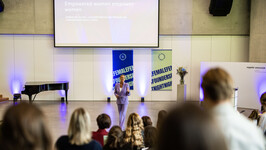
For the main purpose of our excursion—the NATO Talk 2026, organized by the German Atlantic Society e.V. (DAG) in cooperation with the George C. Marshall European Center for Security Studies—around 400 guests gathered at the historic Hotel Adlon Kempinski in Berlin, including many young students. In addition, more than 2,500 people followed the conference via livestream. The conference’s theme was “Between Nostalgia for the West and Vision—The Future of European Defence.”
Those who long for the “good old days” have not yet developed a strategy, said DAG President Christian Schmidt in his opening remarks. In his subsequent keynote address, State Secretary Dr. Géza Andreas von Geyr of the Federal Foreign Office called for a Europe that must become “faster” and “more assertive.” Four panels that followed covered a wide range of topics. Topics included the future of transatlantic relations, the Eastern Flank Deterrence Initiative as a new deterrence concept on NATO’s eastern flank, whether and how Germany should assume a leadership role in Europe, and finally the “Generation of a New Era”—in other words, our generation.
New and Exciting Perspectives on the Turn of the Century and Conscription
Moderated by Fabian Frenger, vice president of Junge DAG and head of the Berlin regional group, the discussion featured Quentin Gärtner, former secretary-general of the Federal Student Conference; Vivian Tauschwitz, a CDU member of the Bundestag; and Friedrich Opitz of the German Council on Foreign Relations.
Right at the start, Gärtner posed a rather uncomfortable question to the audience regarding the perennial issue of mandatory military service: “Would you like to be forced to do something?” The audience responded with a surprising but approving laugh. For Quentin Gärtner, this is not about refusal, but about participation. Anyone drafting a law that affects millions of young people must speak with them. His counterproposal: a mandatory service year for everyone. Everyone would complete it, either in the Bundeswehr or at a social service organization. It’s an exciting concept that has also met with approval among the members of our association. This approach distributes responsibility fairly and views security as a responsibility of society as a whole. Vivian Tauschwitz, who herself served in the Bundeswehr, also spoke out in favor of a “year of service to society” and believes it’s wrong to exempt women.
Gärtner’s line, “We are not the ‘wimp’ generation,” really sticks with you. It’s an almost “offhand” statement that actually reveals a lot of depth. It offers insight into a generational conflict we’re currently experiencing: Older people are quick to label young people as complacent, while young people themselves often feel they’re not being heard. Friedrich Opitz expanded the discussion by adding another perspective drawn from conversations with young people in Saxony. There, he noted, the term “turning point” is practically an insult to some, since a “turning point” has been the norm there for 35 years. His research underscores the ongoing structural differences between East and West, which are also reflected in the younger generation. His advice to politicians: get out of Berlin and into the bars and adult education centers.
Let's talk to each other, not about each other!
The NATO Talk 2026 showed what happens when generations engage with one another openly. Perhaps the concept of generational conflict is often more of a construct than it seems, and can be overcome. The young can learn from the old and vice versa, because no one is ever done learning. Challenges of this magnitude are best tackled together. Or, to quote Brinkmann’s daughter: Talk with each other, not about each other!
More articles
 02/13/2025LifeGlobal Talk
Former ambassador Martin Erdmann on Europe's security in transition
In the Global Talk, Martin Erdmann shed light on the challenges facing NATO, transatlantic relations and Turkey's geopolitical role. 11/23/2026LifeLecture by Heinrich Bedford-Strohm
“First and foremost, you’re a human being.”
In a lecture, theologian Heinrich Bedford-Strohm explains why right-wing populism and the Christian faith are incompatible.- 10/27/2026LifeFemale Founders Night
Underestimated, Overlooked, Undeterred: What Drives Female Founders
At Female Founders Night at Zeppelin University, female founders and entrepreneurs share their stories of how they’ve made their mark in a global economy where women are still the exception. - 10/08/2026LifeVillage Hub
Starting a business is a matter of practice
This year's Village Hub focuses on the question: If AI makes companies smaller, flatter, and faster—what skills do founders actually still need?