When artificial intelligence follows the cargo bike
What began with cargo bikes has become a multi-layered reflection of mobility research at Zeppelin University. And AI is also involved.
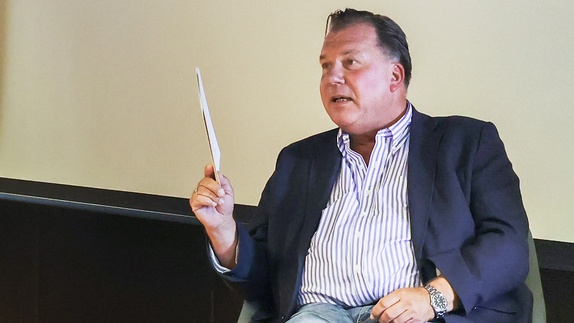
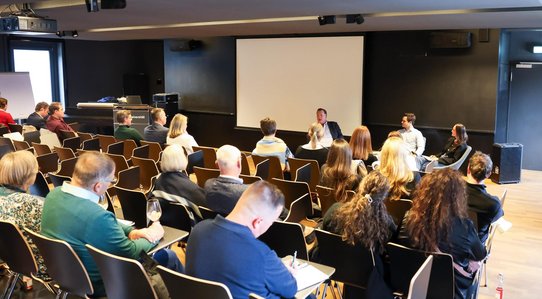
The "Center for Mobility Studies" (CfM) has ten successful years of research behind it. And Prof. Wolfgang H. Schulz and his team are also pursuing ambitious plans for the near and distant future. General independence is the goal. "Without anyone interfering," emphasized the institute director during a panel discussion at the ZU summer party.
However, it is also always about acting in a socially responsible and sustainable manner, said the lecturer at Zeppelin University. The expertise of the scientist, who comes from the Cologne area, is highly regarded not only at Lake Constance, but also in federal political bodies. Together with his colleagues, he developed the theory of the institutional role model.
It all started with a cargo bike
The CfM used the example of a cargo bike to illustrate what the mobility transition looks like today and how and where it can be put to good use. In Herne, North Rhine-Westphalia, the institute worked with a pharmacist who was able to make savings over a certain period of time. The fact that his employees were using bicycles instead of cars meant that they would have received fewer parking tickets.
Up to ten prototypes of cargo bikes have been put on the road and the company is also interested in successfully implementing similar projects in the future. The fact that artificial intelligence - AI for short - is now also being used for this is part of the course of time. And yet Prof. Schulz "outed" himself as a fan of So-yeon Schröder-Kim - the wife of former German Chancellor Gerhard Schröder.
The future takes place in the present
The wife of former German Chancellor Gerhard Schröder would have said that her husband lives in the present. An approach that the CfM would also take into account in its research. Finally, Henrik Kleis used his research to explain that groundbreaking inventions such as the Concorde or Google Glass no longer exist, and that the Windows Phone did not achieve the sales figures predicted and hoped for by the company.
The research work of the Center for Mobility Studies (CfM) has parallels with evolutionary history. For while the Neanderthal man lingered on the spot, Homo Sapiens - i.e. man - overcame space to deal with the distribution of resources.
In short, the CfM will continue to conduct analyses in order to optimize new mobility concepts - under regulatory, ecological, economic, cultural or planning conditions as well as the use of AI.
More articles
 12/16/2025ScienceMobility cooperatives
Better to share than (not) own
Innovation researcher Matthias Weiss talks in an interview about the potential, opportunities and challenges of mobility cooperatives. 12/01/2025ScienceApplied science
AI and VR help job center advisors practice difficult conversations
ZU students have used VR and AI to simulate job center consultations. The Friedrichshafen case managers are enthusiastic about the potential. 09/21/2026ScienceThree Questions for Simon Koschut
Security. Europe. Responsibility.
How Europe's security order is changing, what role transatlantic relations play in this process, and what responsibilities academia and universities bear in a new security landscape. 07/16/2026ScienceThree Questions for Anja Achtziger
More Than Just Studying. Motivating. Making Decisions. Taking Responsibility.
Why Zeppelin University emphasizes judgment, responsibility, and interdisciplinary thinking, and why these skills are more important than ever before.