Better to share than (not) own
Mobility cooperatives are a promising approach for efficient mobility in the future. But how widespread are they in Germany? What values do they convey and what else makes them attractive? ZU professor and innovation researcher Matthias Weiss on the potential, opportunities and challenges of mobility cooperatives.
What is a mobility cooperative? What is its core idea and what are its goals?
Professor Dr. Matthias Weiss: Mobility cooperatives are collectively organized associations of people and/or organizations that share vehicles and mobility services. Their core idea is based on cooperative principles such as self-help, self-administration and co-determination. The aim is to provide mobility as a jointly organized service that is geared towards the needs of the members. The focus is on ecological and social aspects, such as the reduction of CO₂ emissions, the more efficient use of resources and the promotion of social participation. Cooperatives offer a democratic alternative to commercial providers and enable members to identify strongly with the organization through co-determination rights.
Mobility cooperatives particularly suitable for the socio-ecological transformation of mobility
How widespread are mobility cooperatives in Germany and are there differences between rural and urban areas?
Weiss: There are numerous mobility cooperatives of very different sizes in Germany - from small initiatives with 40 members to large organizations with over 74,000 members. Our research shows that mobility cooperatives are active in both urban and rural areas, but have different challenges and potential. In urban areas, the focus is often on integration into existing multimodal transport services and on reducing CO 2 emissions, while in rural areas the focus is more on ensuring basic mobility and social participation. The organizational form of the cooperative allows flexible adaptation to local conditions and needs, which makes it particularly suitable for the socio-ecological transformation of mobility and therefore also explains the growing number of these cooperatives.
What are the decisive factors for the willingness to join a mobility cooperative?
Weiss: The willingness to join depends heavily on psychological and social factors. The studies that we have carried out as part of the "GenoMobil" research network show that personal norms, social identification and collective expectations of effectiveness are decisive. People are more likely to join if they identify with the aims of the cooperative and believe they can make a positive social and/or environmental impact through their involvement. Perceived practicability and concrete benefits also play an important role. Communication strategies that emphasize ecological and social benefits, as well as participatory processes for co-design, additionally promote the willingness to join.
Mobility cooperatives between democracy, participation and solidarity
What values characterize mobility cooperatives?
Weiss: Like cooperatives in general, mobility cooperatives are characterized by values such as democracy, participation and solidarity. Values are reflected in the cooperative form of organization, which is based on joint decision-making and co-design. The members are not only users, but also co-creators and owners of the services. Ecological responsibility and self-help also play a key role in mobility cooperatives. Social responsibility is reflected, for example, in transport services for the elderly or in the provision of low-cost mobility options. Ecological values are emphasized through the promotion of low-emission vehicles and shared use. These values form the basis for a sustainable mobility culture and strengthen members' identification with the cooperative.
What areas of tension arise between the theoretical values and the actual practice and how can this be counteracted?
Weiss: Areas of tension arise above all between the claim to co-determination and the practical implementation of the mobility offer. As the size of the cooperative increases, the range of services tends to become cheaper and better organized, but there is a tendency for participation to decrease and there is a risk of free riders who use the services without getting involved. The balance between democracy and efficiency is also challenging. To counteract this, it can be deduced from our findings that continuous social activation, transparent communication and the promotion of a strong sense of community are of great importance. Professionalization and a clear allocation of roles also help to keep the organization capable of acting without losing its cooperative values. Feedback mechanisms and visible successes strengthen the motivation for active participation.
What needs to be considered to ensure that a mobility cooperative is both profitable and socio-ecological?
Weiss: A mobility cooperative must develop a business model that combines economic viability with social and ecological goals. Accordingly, all three central pillars of sustainability must be adequately addressed. In order to systematize the relevant factors and their interactions, we have applied the Triple Layered Business Model Canvas (TLBMC) in our work, which integrates economic, ecological and social dimensions. The consequences of decisions and actions on the various aspects of sustainability can be derived from this. This is particularly helpful when decisions that aim to improve the ecological side of the business model also have a negative impact on the social or economic side of the business model. Only a holistic approach can prevent such interdependencies from being overlooked.
Universities as the perfect playground for new mobility cooperatives
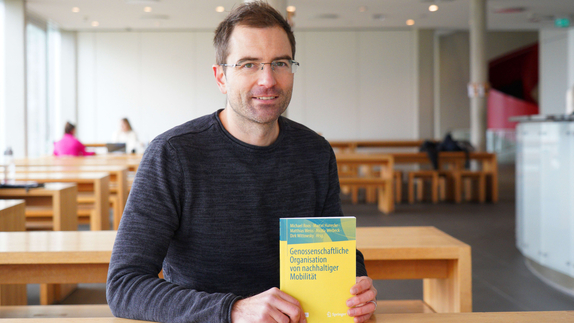
In the book you co-edited, "Cooperative Organization of Sustainable Mobility", studies and real-life experiments on mobility behaviour at the Ruhr University Bochum play a major role. Can a university be a perfect playground for mobility cooperatives?
Weiss: Yes, they can indeed. In most cases, universities offer ideal conditions for mobility cooperatives. Students tend to be very open to new forms of mobility, have digital skills and are often already multimodal anyway. The studies and real-life experiments at Ruhr-Universität Bochum show that social activation, workshops and participatory processes can be used to successfully introduce specific mobility services such as car sharing or electric cargo bikes. The high density of potential users, existing networks and the opportunity for research and evaluation make universities valuable fields of experimentation for sustainable mobility concepts.
The transport sector is the problem child when it comes to achieving climate targets. For years now, the sector's greenhouse gas reduction targets have been exceeded. What have politicians failed to do and what can they do to bring about a lasting change in mobility behavior?
Weiss: Politicians have failed to implement consistent measures to reduce motorized private transport or to reduce the emissions caused by private transport. Push instruments such as CO₂ taxes, parking fees or congestion charges are not used enough. At the same time - and this is perhaps even more important - there is a lack of attractive alternatives such as well-developed public transport or safe cycle paths. The results of our research network show the need for a transformation of mobility culture that goes beyond technical solutions. Political measures must address social norms and everyday routines, for example through targeted communication, participatory planning and the promotion of shared forms of mobility. Mobility cooperatives can make a relevant contribution to this.
Finally, a personal question: How do you get around and do you belong to a mobility cooperative?
Weiss: If possible, I use public transport and the train. This also applies in most cases. However, I live in the countryside and as there is no mobility cooperative here, I still have to use my own car. But at least I can charge it with electricity from our photovoltaic system and benefit from the advantages of electromobility. Unfortunately, the infrastructure is not yet developed well enough in this respect either, especially when we talk about the situation in apartment buildings. But that's another topic for another interview.
More articles
 11/25/2025ScienceDigital technologies in communication
Trust is about understanding
PD Dr. Martin R. Herbers explains how the digital transformation is challenging our democracy and how communication science can meet this challenge. 03/12/2026ScienceGuest article by PD Dr. Martin R. Herbers
Kick-off without a blueprint: What the state election in Baden-Württemberg reveals about the super election year 2026
After the state elections in Baden-Württemberg, the search for the "great lesson" begins. Is it just a revealing prelude or even a blueprint? 01/28/2025ScienceDemocracy and the Office of the President
Pen strokes and felt-tip pens for the people
What we are currently seeing in the USA shows how populism imagines political leadership and problem solving. 11/19/2024ScienceRussian propaganda
How does disinformation endanger our democracy?
ZU alumnus Leon Erlenhorst explains how Russian propaganda works in "Putin's Attack on Germany - Disinformation, Propaganda and Cyberattacks".