Security. Europe. Responsibility.
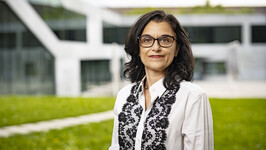
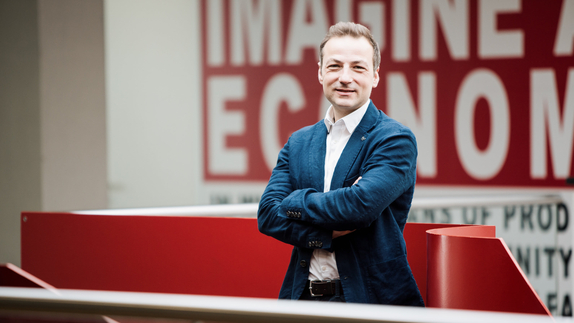
How Europe’s security order is changing, what role transatlantic relations play in this process, and what responsibilities academia and universities bear in a new security landscape: An interview with Professor Dr. Simon Koschut, Vice President for Research and Holder of the ZEPPELIN Chair of International Security Policy.
Professor Koschut, for several years now there has been talk in Germany of a Turning Point in security policy. What has actually changed fundamentally—and in what ways might this term fall short from an academic perspective?
Professor Dr. Simon Koschut: First and foremost, this Turning Point describes a very real change: security and defense have once again moved much more firmly to the center of political attention in Germany and Europe. Russia’s war of aggression against Ukraine has shaken the certainties upon which the European security order was built for decades. As a result, issues of military deterrence, defense capability, and strategic dependencies have gained considerable significance.
However, the term also has an analytical limitation: it suggests a clear historical break. Many developments that shape our current security order—the erosion of the multilateral order, China’s rise, the United States’ strategic reorientation, and the exploitation of economic dependencies for security policy purposes—began long before 2022. Russia’s war of aggression against Ukraine has intensified, accelerated, and brought these developments to light, but it did not cause them alone.
From a scholarly perspective, it is therefore insufficient to understand this “turning point” solely as a return to classical military security policy. Inter-state rivalries are intensifying, technological developments are altering power dynamics, and economic interdependencies are becoming relevant to security policy. Today, security emerges from the interplay of political, military, economic, technological, and societal factors. The challenge lies in avoiding an isolated view of these developments and in rethinking what security means under changing international conditions.
Europe’s security order is under pressure—from Russia’s war, global power shifts, and a changing transatlantic relationship. Which developments will particularly shape Europe’s security in the coming years—and where are the biggest blind spots?
Koschut: A key challenge will be to understand security more as an interconnected phenomenon. Military capabilities remain central, but security is by no means determined exclusively in this arena anymore. Cyberattacks, critical infrastructure, technological dependencies, energy supply, and access to strategic resources also influence the ability of states and societies to act.
Europe’s security remains firmly anchored in the transatlantic partnership. At the same time, U.S. priorities and expectations regarding Europe’s contribution are shifting. The crucial question is therefore not: more Europe or more NATO? Rather, what matters is how greater European political, military, and technological capacity can help make the alliance more balanced and sustainable in the long term.
Another potential blind spot lies in the societal dimension of security. Security frameworks are based not only on institutions and material capabilities, but also on trust, shared expectations, and a willingness to cooperate. Political cohesion and societal resilience are therefore just as important as military capabilities. Especially in times of hybrid warfare involving disinformation and intelligence operations, perceptions and emotions also play a greater role: they can stabilize political communities, but they can equally intensify polarization and conflicts.
The Defense Summit at Zeppelin University brings together academia, politics, business, the Bundeswehr, and civil society. What responsibilities do academia and universities have in the new security landscape—in research, teaching, and public debate?
Koschut: Academia cannot replace political decisions, but it can improve the foundations upon which they are based: It can provide evidence, make uncertainties transparent, identify conflicting goals, and scrutinize supposed certainties. This is particularly important when it comes to security and defense, because decisions are often made under intense time pressure, amid great uncertainty, and amid competing interests.
Universities do more than just moderate debates. Through research, they generate knowledge about conflicts, resilience, technological developments, and social cohesion. Through teaching, they impart subject-specific expertise, judgment, and a responsible approach to uncertainty. And through knowledge transfer, they bridge the gap between different disciplines, institutions, and societal perspectives.
Security-related research, in particular, places universities under a special responsibility. They must balance academic openness and freedom with research security, ethical reflection, and a responsible approach to dual-use knowledge. These tensions cannot be resolved by simple rules but require ongoing scientific, ethical, and institutional engagement.
The Defense Summit can serve as a forum for precisely this kind of engagement: not to stage a consensus or reduce the university to the role of a platform for special interests, but to bring together different logics and perspectives, make uncertainties visible, and subject assumptions to scientific scrutiny.
More articles
 07/16/2026ScienceThree Questions for Anja Achtziger
More Than Just Studying. Motivating. Making Decisions. Taking Responsibility.
Why Zeppelin University emphasizes judgment, responsibility, and interdisciplinary thinking, and why these skills are more important than ever before. 06/25/2026ScienceInternational Spring School
Conflict as a Resource for Cultural Policy
Young cultural policy makers from around the world gathered at ZU. They discussed spaces for negotiation within cultural institutions through pluriversal participation and conflict resolution. 03/12/2026ScienceGuest article by PD Dr. Martin R. Herbers
Kick-off without a blueprint: What the state election in Baden-Württemberg reveals about the super election year 2026
After the state elections in Baden-Württemberg, the search for the "great lesson" begins. Is it just a revealing prelude or even a blueprint?- 12/16/2025ScienceMobility cooperatives
Better to share than (not) own
Innovation researcher Matthias Weiss talks in an interview about the potential, opportunities and challenges of mobility cooperatives.