Conflict as a Resource for Cultural Policy
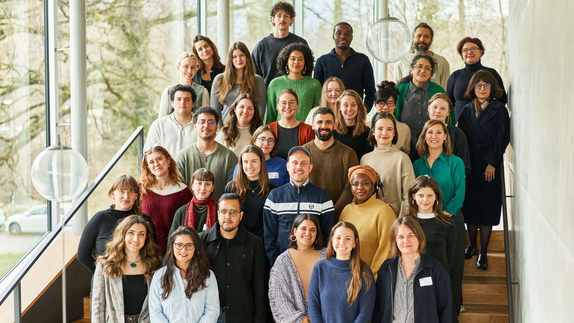
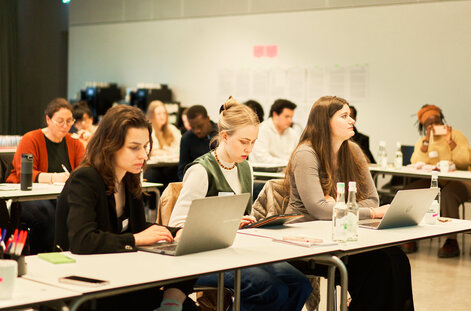
Young cultural policy actors from around the world gathered at Zeppelin University for the Spring School “Towards Future Cultural Institutions and Policy: Navigating Pluriversal Participation, Power Dynamics, and Conflicts.” Through lectures, panel discussions, and case studies, participants explored spaces for negotiation within cultural institutions through pluriversal participation and conflict resolution. This gave rise to a kaleidoscope of theoretical and practical methods, embedded in the participants’ respective contexts.
A total of 35 people from Germany, Serbia, Finland, Morocco, China, Uruguay, Mexico, India, Spain, Poland, the U.S., Turkey, the Democratic Republic of the Congo, and Iran exchanged ideas during the Spring School, including students from Zeppelin University enrolled in the bachelor’s and master’s programs in cultural and political studies.
This year’s Spring School further developed the concept of diversity into the concept of pluriversality. The focus was on translating theoretical models into practice and understanding conflictuality as a central component of cultural-political processes. The goal was not to jointly develop prevention strategies; rather, it was to recognize conflicts as an inherent part of pluralistic societies.
Consensus Despite Differences
Professor Dr. Friederike Landau-Donnelly of Humboldt University in Berlin opened the academic program with an introduction to the topic of agonism. In this context, parties to a conflict are not viewed as enemies, but as legitimate opponents who, despite fundamental differences, can form a “conflictual consensus.”
For her analysis, she introduced the Conflictual Consensus Matrix, which illustrates how resource conflicts—such as those over time, space, personnel, money, or access—are often intertwined with conflicts of values. For the participants, the matrix thus provided an analytical framework for distinguishing negotiable resource issues from deeper-seated normative disagreements and for addressing negotiation processes in a nuanced manner.
Cracks in the System
Leyla Ercan, the culture and diversity manager, highlighted the practical relevance of the topic. According to Ercan, invisible structures that have developed over time continue to have an impact in cultural institutions. These manifest themselves in ethnocentric and Eurocentric norms, classist barriers, heteronormative forms of discrimination, and colonial systems of representation in which the “Other” appears as a racialized and often sexualized object. In a post-migrant society, integration does not affect only people with a migration background; therefore, diversity processes should not stop at symbolic representation.
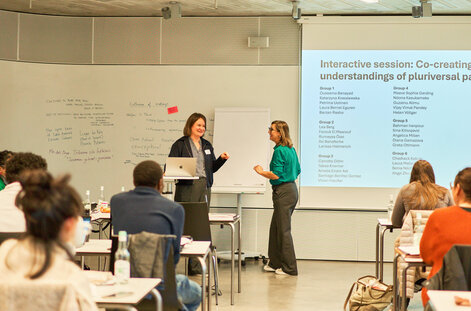
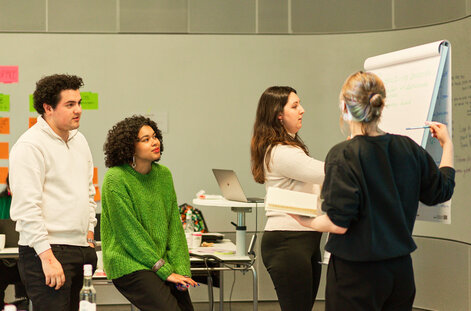
ZU Assistant Professor Meike Lettau and ZU Researcher Dr. Özlem Canyürek from the Assistant Professorship for Cultural & Media Policy Studies presented the concept of pluriversality. This term describes openness to diverse ways of life and everyday practices and understands conflict as constitutive. At the heart of pluriversality are relational practices and the handling of institutional entrenchments. Where structures make a fresh start difficult, change can manifest as a process of gradual shift through incremental cracks and breaks. Following this, participants worked in groups to apply conflict analysis methods and toolkits and conduct case study analyses.
From Morocco to Lubumbashi: Artistic Strategies for Making Things Visible
In general, the participants’ practical and academic backgrounds were explicitly incorporated into the learning environment. Oussama Benyahad, a doctoral candidate at Humboldt University in Berlin, presented his research topic, “Destabilizing Sight—Filming (Vulner)ability in Morocco.” He explores how Moroccan filmmakers grapple with questions of violence, agency, and the right to have a say.
Benyahad’s analysis is grounded in a Foucauldian perspective on power as a web of everyday, invisible structures and practices that stabilize hegemonies and marginalize other voices. He applies this perspective to Moroccan activist documentary film. Groups such as “Guerilla Cinema” bring structural—and particularly gender-based—violence to light, thereby becoming agents of social change. As a visual medium of communication, film is capable of connecting human bodies through a shared affective architecture.
Rumeysa Özel, a doctoral candidate at Istanbul Technical University, then presented her work as a contemporary art educator. Özel describes the art scene in Turkey as primarily shaped by secular actors who have little connection to a religiously conservative public. For this reason, she has been organizing guided tours of key contemporary art venues in Istanbul since 2011 to facilitate encounters with conservative segments of the population. However, during the 2011 Istanbul Biennial, the “Corridor of Queer Identities” became the site of profound confrontations and fierce backlash, forcing the project to be terminated. This example made it clear that cultural institutions can make social conflicts tangible and, in specific instances, open up spaces for encounter; however, their potential for change apparently reaches its limits where deep-seated value conflicts and structural power asymmetries persist.
“Towards Non-Extractivist Curating: Kirata as an Alternative Way of Thinking, Producing, and Sharing” was the title of the presentation by Chadrack Kakule, a curator of contemporary art and a master’s student specializing in the art of Africa, the Americas, and Oceania at the University of East Anglia in the United Kingdom. He presented his approach to non-extractivist curating using the example of “Kirata,” an alternative way of thinking, producing, and sharing. “Kirata” refers to a critical, subversive engagement with curating as a colonial practice and as a position of institutional power. Rather than adapting the local to Western standards, local positions and frameworks are introduced into international art discourses.
At the heart of Kakule’s practice is the “Centre d’art Waza,” founded in Lubumbashi in 2010, which brings together curators, researchers, and cultural practitioners with the goal of establishing the city as an important hub for contemporary art. “Waza,” meaning “to imagine,” describes a practice of cultural and institutional imagination that experiments with alternative forms of sharing, raising awareness, and creating curatorial platforms. The “Centre d’art Waza” operates independently of government funding and creates space for experimental practice, which is also carried out internationally.
Networks of solidarity that transcend state and continental borders
At the conclusion of the Spring School, the insights gained were applied to the processes of cultural and political education. The focus was on understanding pluriversal practice as relational practice: relationship-building and situated solidarity took center stage, as did the dismantling of institutional barriers to access, participation, and recognition. Specifically, this entailed a commitment to redistribute institutional resources in a way that promotes pluralistic participation. As young cultural-political actors, the participants also examined their own positioning within the field and emphasized the possibility of challenging existing power structures through this situated agency. Despite unresolved questions, there was a gain in courage and analytical clarity in dealing with conflicts.
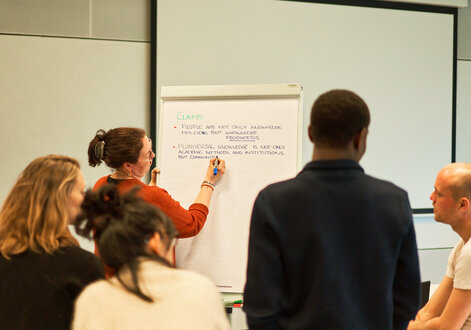
Last but not least, the Spring School aimed to strengthen exchanges among participants and establish networks of solidarity that transcend national and continental borders. A dinner prepared together once again brought this relational dimension to life and served as the perfect conclusion to an intense week.
Background
The Spring School was made possible by funding from the Federal Agency for Civic Education/bpb. The program was developed in collaboration with Assistant Professor Dr. Meike Lettau and Dr. Özlem Canyürek from the Department of Cultural & Media Policy Studies at Zeppelin University, as well as Leyla Ercan, Cultural and Diversity Manager and organizer of the Fluid Identity 2.0 Festival. Charlotte Raeithel, Kamila Brugger, and Lars Linnenbürger supported the organization as student aides and a project assistant.
More articles
 10/14/2026ScienceThe future of multilateralism
“International organizations rarely die—they are hollowed out.”
How the international order is changing amid growing autocratic influence, and whether multilateralism still has a future: An interview with Professor Dr. Maria J. Debre. 09/21/2026ScienceThree Questions for Simon Koschut
Security. Europe. Responsibility.
How Europe's security order is changing, what role transatlantic relations play in this process, and what responsibilities academia and universities bear in a new security landscape. 07/16/2026ScienceThree Questions for Anja Achtziger
More Than Just Studying. Motivating. Making Decisions. Taking Responsibility.
Why Zeppelin University emphasizes judgment, responsibility, and interdisciplinary thinking, and why these skills are more important than ever before. 03/12/2026ScienceGuest article by PD Dr. Martin R. Herbers
Kick-off without a blueprint: What the state election in Baden-Württemberg reveals about the super election year 2026
After the state elections in Baden-Württemberg, the search for the "great lesson" begins. Is it just a revealing prelude or even a blueprint?