

Zeppelin University Library
As a scientific information center, we support students, scientists, employees, and external guests with all questions regarding the supply of literature.
Library service hours
Monday — Friday: | 09:00 a.m. — 04:00 p.m. |
Service & opening hours | 24-h access
External guests of ZU have access to the library during our service hours.
The library at a glance
Services, information and research tools in one overview.
About us
The academic library of Zeppelin University is a service provider for students and teachers. It sees itself as a scientific information center and is geared to the current requirements of research and teaching.
As an information and competence center, the library is a contact point for internal and external interested parties. The use of the library is open to all guests.
With currently around 275,000 media units (including 210,000 e-books), free access for all members of Zeppelin University to various online full-text databases and journal packages, as well as 100 individual subscriptions to specialist journals, the library offers an extensive and diverse media stock for study and research.
Contact
Zeppelin Universität
Library
Fallenbrunnen 3
88045 Friedrichshafen
Tel +49 7541 6009 1180


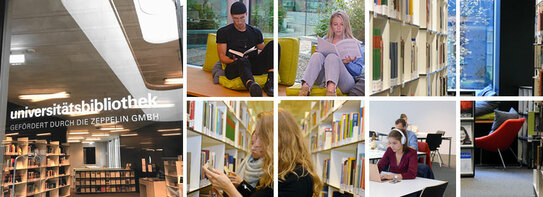
Old building and new building: The library is located on the first floor of the ZF Campus in Fallenbrunnen. The library premises combine parts of the old and new buildings.
The side rooms, as well as the long corridor at the back of the library, belong to the old building (barracks) and are directly connected to the inner core (new building) of the library. In some places you can see the former outer wall of the building and look through windows into a corridor of the old building behind it.
(Photos: ZU/Lena Reiner)
In addition to the library, there are so-called intermediate rooms between the lecture halls that can be used as group workstations. Although these areas are close by, they are not directly part of the library. The former library rooms at the SMH site have since been repurposed and are now home to the “PioneerPort” start-up center.


Art installation in the library
In the library, in the shelf area A-L, the art installation "Intertext" by the artist Christof Salzmann is exhibited. An informational text about the artwork can be found on the outside of the beginning shelf of the signature group "AA-AK".
Seven light boxes are placed on different shelves, directly between the books of the library and present the weight of knowledge. Photographs each show a group of books from the library's collection, lined up on a scale, revealing the weight of those books. The titles of the books, read from the light boxes, also combine to create poetic texts.
(Photo series: FUZZY-SPACE/Installation by Christof Salzmann)
The provision of information and knowledge is an important component for the sustainable development of society. The library of ZU also collects literature on topics of sustainability, based on teaching and research.
The library's collection includes media on central and advanced topics such as:
New acquisitions. Selection from the last 3 months.
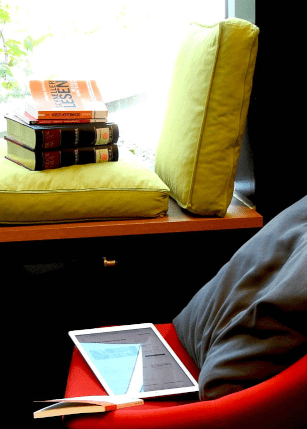
(Foto: ZU/Rolf Hannemann)
ZU sustainability report in the library collection:
Sustainability Report | On the way to a sustainable university 2021-
Parts 1 and 2 in the library collection: AL 52763 S478 A9-1 and -2
Part 3 can be found at story.zu.de
View and e-access in OPAC.
Thinking sustainability together
Bibliotheken können auf ökologischer wie gesellschaftlicher Ebene zur nachhaltigen Entwicklung beitragen und leisten damit einen wichtigen Beitrag für die Zielerfüllung der Agenda 2030. Alle 17 Nachhaltigkeitsziele stehen in Verbindung mit der Arbeit von Bibliotheken.
The German Library Association. Sustainable Libraries: https://www.bibliotheksverband.de/nachhaltigkeit
Sustainability also means: working together to create a sustainable world. The 17 Sustainable Development Goals of the United Nations' 2030 Agenda provide good guidance in this regard. The Sustainable Development Goals (SDGs) show a variety of ways in which sustainable development can succeed worldwide - socially, ecologically and economically.
Libraries accompany this path as places of knowledge, education and exchange. They support the SDGs by making information accessible, creating learning spaces and bringing people together in dialog.
It is also about becoming aware of how today's actions influence future developments - and how we can shape a society together that is fair, open and sustainable.
What is the 2030 Agenda? The 2030 Agenda is the UN's global framework for sustainable development. It comprises 17 goals that provide guidance worldwide - from education and climate protection to social justice.
What is the 2030 Agenda?
The IFLA Library Map of the World offers an exciting insight into the global commitment of libraries. In addition to basic library data, it also contains numerous examples of how libraries around the world are contributing to the implementation of the SDGs.
IFLA Library Map of the World
International Federation of Library Associations and Institutions (IFLA)


Media classification / systematics:
The media are arranged subject-systematically, so that content-related books are predominantly placed next to each other. The thematic focus of a medium is taken into account. The library of ZU uses the Regensburg Union Classification (RVK) as a classification system.
RVK:
RVK stands for "Regensburger Verbundklassifikation" / "Regensburg Union Classification". It is a classification system for the subject indexing of holdings in academic libraries. Numerous libraries use the RVK or create classifications based on the RVK. It ensures that media with related content are grouped together on the shelf.
The RVK Online offers an overview and a direct view of the classifications.
Lineup of media - implementation:
Signature:
Signatures are formed based on the RVK. The signatures identify the content and location of a medium in the library. They are listed in the catalog and indicated on the spine labels of the books. The media are sorted by signatures and placed on the library shelves in a freely accessible way. The sorting is alphanumeric.
A signature is composed as follows:
Example of a signature: AP 15400 M947 G8(14)
[1] AP 15400 [2] M947 [3] G8 [4] (14) [5]-DVD
- Notation / position within the shelf classification
- Encrypted last name of the first author (or similar)
- Encrypted title of the original (Optional)
- Year, edition, copy and or volume count (Optional)
- Additions such as "-DVD" (Optional)
The endings from point 4 of the example signature have the following meaning:
- Year: ".9XX" / ".XXXX" Year specification. The year specification indicates a relevant year (annual report), but
can also be used as an alternative to the circulation or volume
count. For "19XX", the "1" is omitted. From 2000 on, the year is written out in full
- Edition: "(X)" edition count for different editions of a title (e.g. 14th edition = (14));
- Copy: "+X" copy count for multiple media of a title in the identical edition (e.g. second copy = +2).
- Volume: "-X" volume count for several volumes that belong together (e.g. volume 1 = -1, volume 2 = -2).
German and English editions can be placed under different signatures, but are usually placed directly next to each other. Often the signatures differ in point 3, since here either the spellings deviate or this is faked.
Note: Please note special locations of media. Media are not always located under their signature on the regular shelf.
Locations:
A-L:
Left side of library: ethnic studies, college and university studies, classical archaeology, art history, media and communication studies, musicology, reference works, education, philosophy, linguistics and literature, theology and religious studies, science studies and organization.
M-N:
[Back aisle of the library]: history, political science, sociology
P-Q:
[Right side of the library]: general business administration, law, economic theory, economics
QV-Z:
[Right side of library]: Biology, Chemistry, Geography, Computer Science, Mathematics, Medicine, Natural Sciences, Pharmacy, Physics, Physical Education, Engineering.
Theses BA | MA ("Abschlussarbeiten"): The theses are located on the right side of the library, in the small cabinets in front of the right reading room. Older volumes can be requested from the library team, as they are stored in the magazine.
AV-media (DVD, CDs, MCs, VHS): AV media are located on the right side of the library, in the adjacent passage room of the signature area "R-Z". MCs and VHS can be requested from the library staff, as they are located in the magazine.
Dissertations (ZU) und Habilitation theses (ZU): The media are located in the entrance area of the library, on the shelves directly after the entrance door on the left against the wall in the right shelf area. If available, additional copies are in the regular library collection. Dissertations and postdoctoral theses from other institutions can be found in the regular holdings.
Lecturer Shelf: The media are located in the entrance area of the library, on the shelves directly after the entrance door on the left wall in the left shelf area. If available, additional copies are located in the regular library collection.
Handapparate (Media on permanent loan to Staff Members):
Handapparate (reference books) are not part of the library collection, but are listed in the library catalog. The media of the handbooks "belong" to the chairs / departments and are placed in the offices or secretariats.
Humboldt Project: The media of the projects are not located separately. Project books known to the library can be researched using the keyword search with "Studentische Forschung" (which translates as "Student Research"; You can only search for the German keyword).
"Masterapparat" [Master collections]: The master reference holds are located on the right side of the library, in the master study room and, if applicable, in the room for master thesis research. Go through the passage room of the signature area "R-Z" and then through the research workroom into the master workroom. If necessary, the media are located in the upper work compartments on the table.
New acquisitions shelf: The new acquisitions shelf is located on the right side of the library, between the service desk and the right reading room.
Fromm Collection (KSG): The media are located directly opposite the new acquisitions shelf.
Semester Reserved Collection: The semester reserved collections are located on the left side of the library in the room "Semester reserved collections | Printer room". In the entrance area of the library, go around the slight bend to the left and then straight ahead.
Journals (boxes, magazine): Current journals are located in the entrance area of the library directly to the left of the middle reading room. In the journal boxes you will find the journal issues of the current year. Older volumes can be requested from the library team, as they are stored in the magazine.
Newspapers: Current issues, as well as issues from a few weeks back, can be found in the newspaper rack across from the service counter. Issues from previous months can be found in the research workroom. The research workroom is located on the right side of the library. Go through the passageway room of the "R-Z" signature area to then enter the research workroom. The newspapers are located in the middle shelf just after the door on the right.
Special locations are displayed in the online catalog, at the location display, or in the full view of a match.
The most frequently asked questions and answers:
Can different editions of a book be in different systematic places?
In rare cases, this is possible. For example, if a book with many copies is part of the collection and covers more than one subject area, a double assignment may be made in exceptional cases.
Does the edition of a medium make a difference?
A new edition can be an identical reprint, but it can also be an edition with changes. What meaning an edition designation has in a particular case must be examined individually. Generally, a newer edition (higher number) is considered to be presumably better, since it may have been revised. Exact information about the edition at hand can usually be found on the back of the main title page or also near an imprint.
Are signatures unique?
The respective copy signatures are uniquely assigned to identify exactly one particular copy from the holdings in each case. Duplicate copy signatures should not occur and will be corrected as soon as they become known.
Are signatures permanent?
As a rule, signatures are permanently assigned and do not change. Exceptions, however, are adjustments to the systematic or individual corrections. The term "permanent" is therefore inapplicable, even though this will usually be the case.
Are there different editions on a catalog title record?
[Simplified] If an edition is a reprint, it is associated with the earliest matching record, since there is no significant difference. The library will make this known via the shelfmark if it seems necessary. A "really" new edition gets its own record and therefore its own hit in the online catalog.