

New study published: IRM redefined for digital collaborations
In his latest paper, Henrik Kleis from the Chair of Mobility, Trade and Logistics at Zeppelin University presents a further development of the Institutional Role Model (IRM) as an innovative economic system architecture. In view of the growing challenges posed by digitalization and geo-economic changes, he examines how the IRM can be optimized to promote effective cooperation in complex digital projects.
Key innovations:
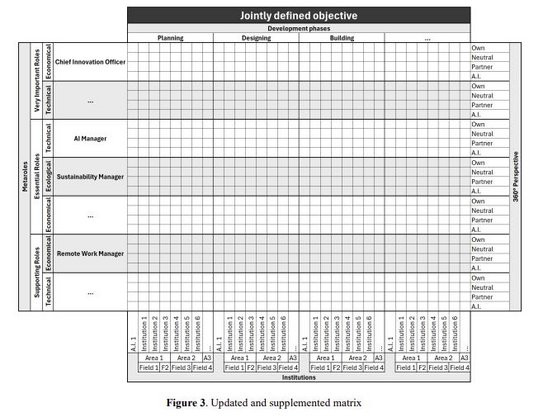
- Introduction of new key roles: The model now integrates roles such as Chief Innovation Officer, Sustainability Manager, AI Manager and Remote Work Manager to meet the current demands of digital and sustainability projects.
- Prioritization of roles: Roles are categorized into "Very Important Roles," "Essential Roles," and "Supporting Roles." This allows resources to be allocated more efficiently and the focus to be placed on critical tasks.
- Integration of artificial intelligence: AI is anchored in the model both as a supporting perspective and as an independent institution in order to improve efficiency and decision-making in digital projects.
- Adjustment of the dimensions: The temporal and operational dimensions of IRM are updated to reflect agile methods and software development cycles. In addition, there is a visual differentiation within the dimension of institutions.
Thanks to these adjustments, the updated IRM offers a flexible and up-to-date tool for managing complex projects. It facilitates the harmonization of technical, economic and ecological aspects, reduces complexity and strengthens transparency and trust between the cooperation partners.
Conclusion: The paper shows how IRM can continue to play a central role in shaping successful collaborations in the future. The updated model is optimally adapted to the requirements of digital transformation and makes it possible to fully exploit the added value of cooperation as an effective management tool.
Read the full paper free of charge here