Till Leander Schröder: Effectively staged
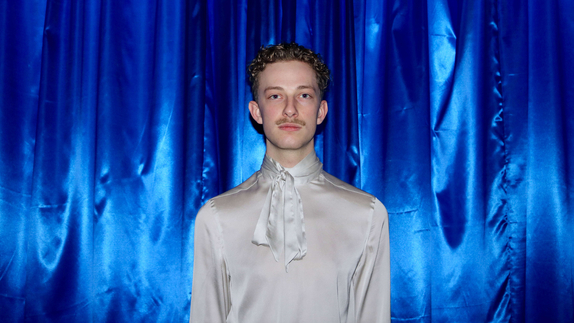
Till Leander Schröder's strong presence cannot be denied. This is not only due to his height, but also to his extroverted appearance and extravagant style of dress. However, he also knows how to convince with content, otherwise he would not have been elected student representative and youth mayor. He proved just how versatile he is at ZU: It was here that he discovered that art can also be used to effectively stage and convey messages.
Till Leander Schröder grew up sheltered in a village called Benthe, not far from Hanover and incorporated into Ronnenberg, so that he enjoyed the benefits of both rural and urban life to the full. "My parents supported me and encouraged me to do what I really wanted to do," Schröder mentions. He has often been able to observe how people are treated and how they respond to the needs of others: For example, when he worked in his mother's speech and learning therapy practice or when his father, who works in venture capital, told him about his encounters with young entrepreneurs. "I learned how important it is to show tact and build trusting relationships," explains Schröder.
Behaviors that are also required in politics and possibly one reason why Till Leander Schröder ventured into school politics at an early age. After all, he was elected class representative in the sixth grade. "I've always felt the need to change things for the better," notes Schröder. He then achieved far greater effectiveness and success as student representative and head of the student council. Together with other members of the student council, as well as teachers, he was accepted into the nationwide "School without Racism - School with Courage" network. In cooperation with Caritas Hannover, he was also co-organizer of a fundraising campaign for refugees from Ukraine.
From student representative to youth mayor
Through his commitment, Till Leander Schröder not only maintained close contact with the school management and the state education authority, but also with local politics. He began switching back and forth between the school and local political levels when the SPD member of parliament (and current SPD Secretary General) Matthias Miersch supported his constituency in setting up a youth parliament in Ronnenberg. "It was immediately clear to me that I wanted to get involved in local politics by running for the youth parliament," reports Schröder.
He sat there as a member for two terms and also held the office of deputy youth mayor and then youth mayor. This meant familiarizing himself with a potpourri of topics in order to have a say and help shape them: Education, youth, sport, senior citizens, social affairs, equality and integration. "At first, it was a bit overwhelming to deal with local political issues and various political interests at the age of just 14," says Schröder. "But over time, I gained more and more self-assurance and self-confidence. I was able to learn a lot, but this was also due to the fact that the concerns of the young people were well received by the local councillors."
Networking meetings and a school internship in the office of Kerstin Liebelt, then an SPD member of the state parliament, led him to the Lower Saxony state parliament. After the internship, he received a request to apply for an open position as a media and public relations officer in the office of SPD member of state parliament Doris Schröder-Köpf. "The fact that I eventually got the job probably had to do with my knowledge of political processes," Schröder mentions. Because the amount of work and time required was higher in some phases, he sometimes had to deal with press or citizen inquiries in the middle of school lessons. "And yet it was a valuable time in which I was able to experience how citizen-oriented politics can succeed," explains Schröder.
Although he could have continued his work as an advisor in the MP's office, although he was offered a place on the list for the local council elections and although he was well connected and well-known in Ronnenberg, it was clear to him that he wanted to study, move away and experience something new. With a broad range of interests and an A-level average of 1.0, he was faced with a difficult choice of course that Google had to narrow down. So he asked the search engine where the best place to study International Relations was. The search result: the PAIR Bachelor at Zeppelin University. "After scouring the website, I knew that ZU was the right place for me to develop academically and personally," reports Schröder. "When I told my parents about it, they told me that an acquaintance had once studied there. In several conversations with her, the SPE Bachelor gradually emerged as the better choice for me."
But it didn't stop there. After two semesters, he switched from the SPE to the CCM Bachelor's degree. Which is surprising, because when you look back at the subjects he studied in his A-levels, you look in vain for artistic-cultural docking points: Spanish, German, politics, mathematics, education. "I was fascinated by the artsprogram and its exhibitions right from the start," explains Schröder. A Zeppelin project in which he compared various productions of Antigone, a cultural studies course with Professor Dr. Jan Söffner and a lecture by Charlotte Hüser on the topic "Untimes for art? The significance of the zeitgeist for the view of art" did the rest: "This made me realize that there are many overlaps between politics and art. Both disciplines deal with topics that move society and people, and they always try to mediate between various (ideal) ideas - they only differ fundamentally in their approach."
Awakening emotions and stimulating discourse with art
Till Leander Schröder worked as a curator for the first time in the "Curatorial Practice Project" course taught by Professor Dr. Karen van den Berg and Rahel Spöhrer. As part of a student curatorial practice team, the aim was to enrich the two-day symposium "Angst, Ressentiment, Spaltung" with further artistic positions - including an installation that uses artificial intelligence to transform hate speech into positive poetry. Under the title "Female Gaze", he curated his own exhibition together with Charlotte Raeithel and in cooperation with a French photo collective, in which a specially produced video work was also shown. This was followed by the artistic direction of the student cultural association "Der Raum" at Buchhornplatz 6 in Friedrichshafen - a safe space and at the same time a free space for artistic development.
"I realized that with my curatorial work I can stage art in such a way that it arouses people's emotions and interest in topics and stimulates discourse," explains Schröder, who passes on his knowledge of curating as a tutor on the "Curatorial Practice Project" course and deepens his knowledge as an assistant at the Chair of Art Theory & Staging Practice. He also broadened his own horizons during an internship at the Vitra Design Museum - in the middle of Art Basel and in preparation for the exhibition "Nike: Form Follows Motion", which sheds light on the design history of the world's largest sports brand. The internship resulted in a relationship from which he will benefit for a long time to come. Sabrina Handler, the deputy director and COO of the museum, has become his practical coach: "The CCM course prepares me for a future as a curator by combining perspectives from culture, communication and management and expanding them to include socially relevant issues from other disciplines." He hopes to gain new perspectives from his upcoming semester abroad at the University of Bergen.
More articles
 10/17/2024PeoplePioneer of the month
Sivany Kanagalingam: Committed advocate for democracy
Sivany Kanagalingam honed her critical thinking during her PAIR studies, which also led her to become involved in democracy in a variety of ways. 08/26/2026PeoplePioneer of the month
Hannah Hartenstein: In Tune with a Culture of Empowerment
For years, Hannah Hartenstein worked behind the counter at the student café “Beton & Bohne”. At the same time, a unique interest began to take shape: an interest in the economic side of the healthcare system. 07/15/2026PeoplePioneer of the month
Leon Löchle: Life in a Highly Frequented Area
For Leon Löchle, getting involved is as much a part of life as the air he breathes. It means a great deal to him to stand up for others or to help them have a good time. 04/22/2026PeoplePioneer of the month
Laura Knobloch: Extremely focused
What began as an interest in politically and religiously motivated extremism has developed into the central focus of Laura Knobloch's academic work.