Two ZU students at the United Nations: "All issues are youth issues - we need to be heard"
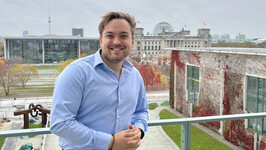
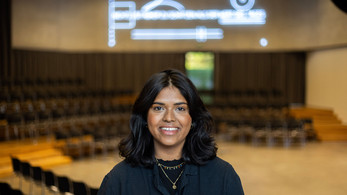
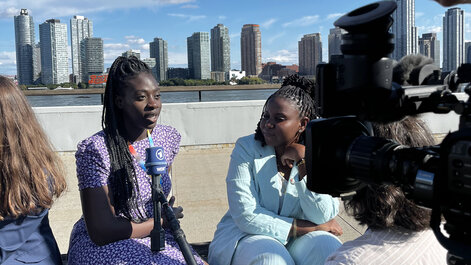
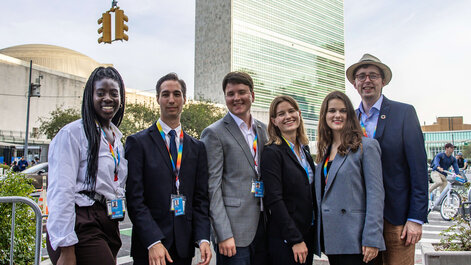
Ferhat Cicek and Rhoda Zündorf were at the United Nations as German Youth Observers. In this interview, they talk about what they took away from their time there.
In an interview with Ferhat Cicek and Rhoda Zündorf, the German Youth Observers at the United Nations, we find out how they believe young people can be more actively involved in global decision-making processes. They talk about their experiences at the "Summit of the Future" in New York. They argue for greater participation of the younger generation in shaping the global future.
What gave you the honor of flying to the "Summit of the Future" in New York as representatives of the Federal Republic of Germany?
Ferhat : The German United Nations Association are our sponsors. At the beginning of the year, the DGNV was looking for motivated young people with an interest in the UN who would be interested in flying to New York as German Youth Observers. The DGNV represents and advises the German Federal Government and the Bundestag on UN-related issues, so it was very important for applicants to want to stand up for the values of the UN.
We then both came across it separately and initially applied in writing. In the second selection round, we had to go through interviews and were both very grateful that we were selected. In total, six were selected from over 100 applications and we were among them.
Rhoda: I've always been interested in international relations and how things work there. Before that, I was very involved in discrimination issues, so I thought that now I wanted to get involved in other topics. That's why I applied.
Are there currently certain topics or issues that you think are particularly important for young people in Germany?
Ferhat: Young people in Germany are particularly concerned about the big issue of digitalization, which is also a chapter in the Pact for the Future. A lot of things are connected to this, and I think it's an issue that affects many young people. But of course, many young people in Germany also look at the wider world, which is currently characterized by conflicts, which is why another important issue is peace and international security. Especially because there are many people living in Germany, including the two of us, who have a migration background and some of whom have experienced flight.
Rhoda: I think many young people have the feeling: can the UN do anything at all and how effective is the UN? We have so many conflicts and what does the UN actually do? That's why I thought it was so important for young people to take part in the process and see how the UN works from the inside and then be able to tell other young people about it afterwards.
Which decision in this Pact of the Future were you personally most pleased about?
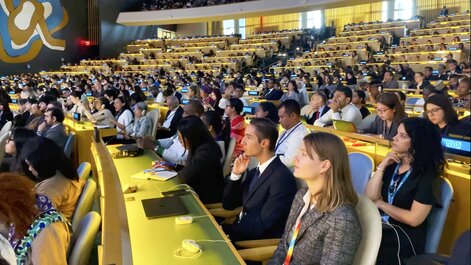
Rhoda: For me it is that there is a whole chapter just on youth empowerment and youth participation and that it is about empowering young people all over the world. In general, however, it is a pity that there is always talk of action, but no active steps have been mentioned. I see this as a general problem of the UN, you always have these big goals, but the real question is how we fulfill them and that's what I missed. The language remains vague, so I would have liked to see clear words and a more step-by-step plan for implementing the UN's goals.
The Summit of the Future is very much focused on long-term perspectives. How do you think young people should be involved in this future planning?
Ferhat: I remember a quote from a speech in the General Assembly "the parliaments are our allies". The UN itself has no power base, but relies heavily on the member states to implement the Pact of the Future, whose task it is now to translate the Pact into national legislation. Young people naturally play a very important role here when it comes to mobilizing their needs, approaching politicians and also demanding this. In the future, we will be the decision-makers who are ultimately responsible for continuing to implement this pact. There has also been a lot of talk about generations that are not even here yet, and it is precisely these generations that we must take into account and ask ourselves: how can we live now in order to leave behind a world that is still worth living in for future generations?
How do you pass on your findings here at Zeppelin University? Is there anything in particular you want to tell your fellow students?
Rhoda: Finding out what you stand for and standing up for it is the most important thing. The university gives us so many opportunities to get involved, and through involvement and participation we are seen, we are heard and we are taken seriously. I haven't been here at the university for long, but I see so many young people with so much energy and I believe that you have to find out where this energy belongs.
Ferhat: My advice is to educate yourself, become experts in your subjects, because that's how you can prove that you've got something. You know your subject and are then taken seriously.
What challenges do you see in integrating youth issues into global decision-making processes, such as at the United Nations? Are there any hurdles that need to be specifically addressed?
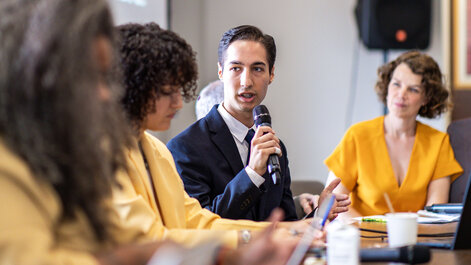
Ferhat: One thing we have had to make clear time and again is that all issues are youth issues. There is nothing that doesn't affect young people. That's why the first hurdle is to show that we need to be heard everywhere, no matter what the issue is. We are there, we listen, we give our opinion, but we are not involved.
Rhoda: In general, only a few countries have sent youth delegates, especially the countries on the African continent. That's a shame, because that's not the way to involve young people. It is really important to gain insights and, above all, that we are not denied such insights.
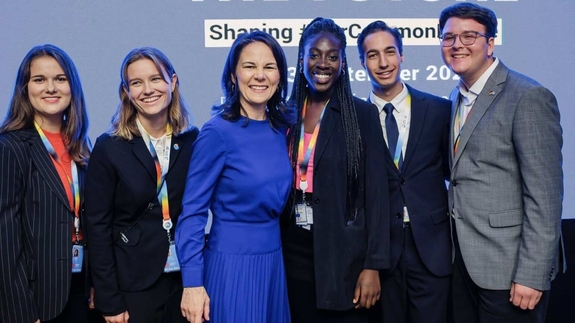
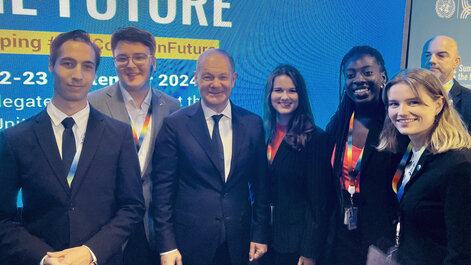
We were able to meet many leading political figures, such as Annalena Baerbock, and photos are often taken with young people at such events. But we don't just want to be seen in photos, we also want to be listened to.
How do you envision the future of international cooperation? What role do you think young people will play?
Ferhat: If we look at the future of international cooperation, a lot will change. It can't go on as it is now, because this North-South divide is still reflected in the UN. The current world order no longer looks like this. The BRIC countries, the global South, i.e. China, Russia, etc., are gaining more and more power and influence. If the UN or other international organizations do not adapt, they will ultimately collapse and become incapable of acting.
And in order to resolve global conflicts effectively, everyone must work together, all states and all governments. Russia, for example, is currently blocking everything in the UN. We also heard that from Ambassador Zahneisen. Russia has not even accepted the Pact for the Future. Here we simply see that something definitely has to change. Multilateralism must be taken seriously again by states, and that can only be achieved if the UN reforms itself.
More articles
 07/15/2026PeoplePioneer of the month
Leon Löchle: Life in a Highly Frequented Area
For Leon Löchle, getting involved is as much a part of life as the air he breathes. It means a great deal to him to stand up for others or to help them have a good time. 06/18/2026PeoplePioneer of the month
Julia Sonntag: Always One Step Ahead of Stagnation
Julia Sonntag is what people generally call a loyal soul. She feels a deep connection not only to the Lake Constance region, but also to the initiatives and jobs she’s involved in.- 12/12/2024PeoplePioneer of the month
Till Leander Schröder: Effectively staged
Till Leander Schröder was active as a youth politician. It was only at ZU that he discovered that messages can also be conveyed effectively as a curator. - 10/17/2024PeoplePioneer of the month
Sivany Kanagalingam: Committed advocate for democracy
Sivany Kanagalingam honed her critical thinking during her PAIR studies, which also led her to become involved in democracy in a variety of ways.