ZF and ZU jointly research fundamental issues of the future
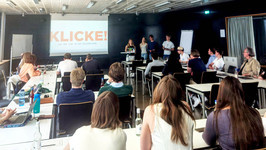
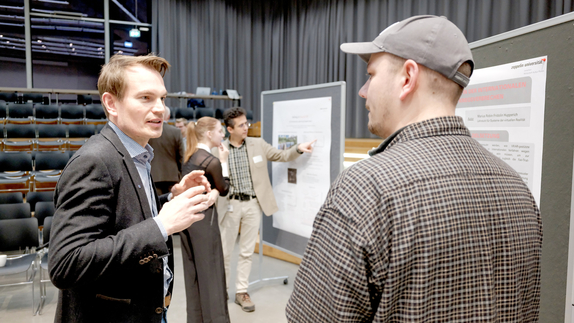
For the second time, professors from ZU and department heads from ZF met at a symposium to present the results of their joint research projects.
"How are societies and organizations changing through the use of artificial intelligence?" is how Prof. Dr. Mateusz Dolata explains the mission of his chair, the ZF Endowed Chair of Artificial Intelligence, on a Friday morning in the Graf-von-Soden-Forum at Zeppelin University. His focus is on socio-technical issues - in other words, the interplay between humans and machines. "My goal is to enable humans and artificial intelligence to work better together."
At the symposium, which has now taken place for the second time and was attended by employees from ZF and ZU, Prof. Dolata explained how these questions can be explored in a corporate context. A research project aims to find out how meetings can be made more productive if an artificial intelligence - known as an AI agent - participates as an additional team member to observe and moderate the meeting when appropriate.
The AI agent could ensure that all participants have the same speaking time, that no questions are forgotten or that destructive emotions have a negative impact on the discussion. How well this would work would have to be researched. And whether people would accept such an AI colleague.
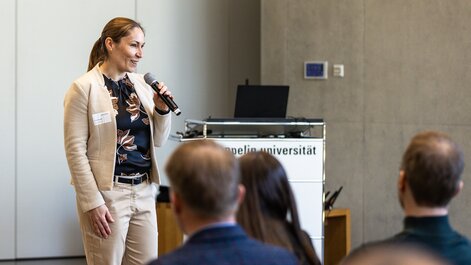
Everyone is here to get answers to questions like these, explains Dr. Karoline Bader-Pfeffer, who is responsible for digitalization at ZF. "The right dovetailing of business, science and society is crucial," explained Bader-Pfeffer, emphasizing the importance of the collaboration between ZF Friedrichshafen AG and Zeppelin University. "I think this is an absolutely successful project," said acting President Prof. Dr. Anja Achtziger. "A project that conducts urgently needed basic research and will certainly develop new, shared visions."
Train dangerous situations in harmless virtual worlds
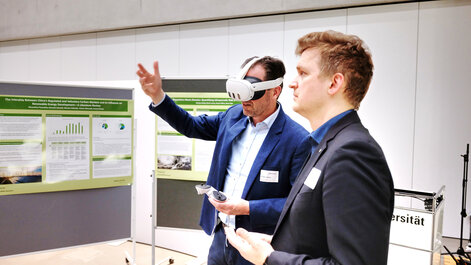
Prof. Dr. Raphael Zender, ZF Endowed Chair of Virtual Reality Systems, presented the first application scenario of the VR technology he is researching: the virtual ZF factory hall, which his team developed in collaboration with a team from ZF. New ZF employees and visitors can visit this factory hall with VR glasses and undergo all the necessary safety training before entering a real ZF factory hall.
This virtual training should also help to reduce the number of accidents at work. The advantage is that even challenging safety scenarios can be simulated in the virtual hall without putting the trainees in danger. The factory hall is now to be further developed.
Prof. Dr. Florian Muhle, holder of the ZF Endowed Chair of Communication Science with a focus on digital communication, has spent the past few months investigating how ZF employees experienced the introduction of Microsoft AI "Co-Pilot". The results of the study should help to provide better communication support for the introduction of software in the future. A research project based on this will determine the extent to which artificial intelligence can support the company's public relations work.
ESC reporting is of great importance for companies
ESG reporting is a topic that is somewhat more difficult for the general public to grasp, but is one of the biggest challenges facing international corporations today. ESG is an abbreviation of the three terms environment, sustainability and governance. In almost all countries and markets, laws require companies to publish reports outlining their ESG-specific processes.
Since the introduction of these reports, rating agencies have specialized in evaluating them. These ratings in turn influence the financing conditions of companies. The better the ratings, the more favorable conditions are possible.
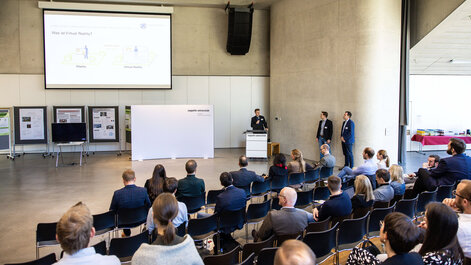
The researchers at the ZF Center for Sustainability Research, led by Prof. Dr. Florentina Paraschiv, analyze the rating agencies' evaluation processes and can then make recommendations on how internationally active companies such as ZF should design their reports in order to best meet the requirements of the various rating agencies. This basic research helps ZF to improve its position in the international financial market.


New ideas in exchange between ZF and Zeppelin University
At the end of the symposium, the ZU and ZF employees came together to discuss further project ideas. It all started with an idea. The success story of ZF Friedrichshafen AG began 110 years ago with an idea. The success story of Zeppelin University began 22 years ago with an idea.
More articles
 06/17/2025ScienceStudent research
The big performance - how the Student Research Day went
At the student research presentation day, many projects looked at how modernity is shaped by representations. 09/21/2026ScienceThree Questions for Simon Koschut
Security. Europe. Responsibility.
How Europe's security order is changing, what role transatlantic relations play in this process, and what responsibilities academia and universities bear in a new security landscape. 07/16/2026ScienceThree Questions for Anja Achtziger
More Than Just Studying. Motivating. Making Decisions. Taking Responsibility.
Why Zeppelin University emphasizes judgment, responsibility, and interdisciplinary thinking, and why these skills are more important than ever before.- 06/25/2026ScienceInternational Spring School
Conflict as a Resource for Cultural Policy
Young cultural policy makers from around the world gathered at ZU. They discussed spaces for negotiation within cultural institutions through pluriversal participation and conflict resolution.