Kick-off without a blueprint: What the state election in Baden-Württemberg reveals about the super election year 2026
When the first major election result of the year is known, the search for the "big lesson" begins almost automatically. This is no different after the state elections in Baden-Württemberg. For ZU private lecturer Dr. Martin R. Herbers, the state election is a revealing start to the super election year 2026, but nothing more.
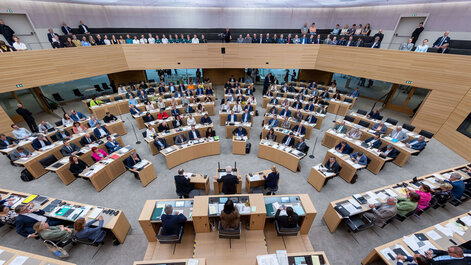
The Greens were once again the strongest party with 30.2%, followed almost equally by the CDU with 29.7%. They were followed by the AfD with 18.8% and the SPD with 5.5%; the FDP and the Left Party missed out on a place in the state parliament with 4.4% each. Voter turnout was 69.6%, significantly higher than in 2021. 157 MPs sit in the new state parliament; the Greens and CDU each have 56 seats.
This is a result that attracted attention nationwide. It is close, symbolically charged and politically easy to connect with. This is precisely why it is worthwhile not immediately looking for a blueprint for the next elections, but first asking two simpler questions: What was actually talked about in this election campaign? And how far does this result even extend beyond Baden-Württemberg?
Economy as a guiding theme - but in a narrow sense
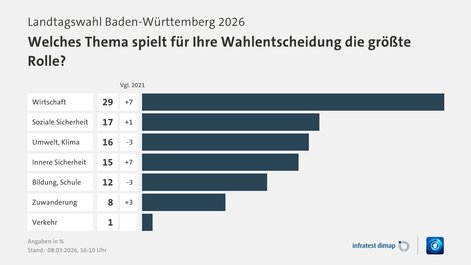
There is good evidence that the economy was the main topic of the election campaign. In a YouGov survey conducted shortly before the election, 39% of eligible voters named the economy as one of the three most important issues; for 22%, it was even the most important issue of all. This was followed by immigration and asylum as well as housing and rent. The ZDF political barometer also visibly framed the final spurt of the election campaign with economic concerns as well as problems in education and energy policy.
This comes as little surprise in Baden-Württemberg. The state has a strong industrial base, particularly in the automotive industry, mechanical engineering and medium-sized manufacturing companies. In the election campaign, "the economy" was therefore primarily negotiated as a question of location, employment, competitiveness and industrial future. However, this is precisely where there is a gap: what was meant was mostly the classic industrial economy, but much less often everyday business-related topics such as working hours, work-life balance, further training, securing skilled workers from the perspective of employees or changing expectations of good work.
This is not analytically trivial. After all, economic change is not only decided in companies, associations and ministries, but also in how people experience work, security and the future in their everyday lives. An election campaign that talks about the economy almost exclusively in terms of industrial policy therefore falls short. This broader view is likely to become more important in the future, especially in a state like Baden-Württemberg, which must manage economic transformation not only technologically but also socially.
An electorate with clear differences
A look at voting behavior also shows that political offers by no means met with a homogeneous electorate. According to the State Agency for Civic Education, the Greens remained the strongest force among 16 to 24-year-olds; the Left and smaller parties were voted for more frequently than average in this age group at 14% each. The Greens were also ahead among first-time voters; the CDU, AfD and Linke received 16%, 15% and 14% respectively, while the SPD and FDP each received 6%. There were also differences by gender: the Greens, SPD and Linke did better among women, while the CDU, FDP and especially the AfD did better among men.
These differences should not be treated as a side note. They indicate that economic uncertainty, expectations for the future and political interpretations are processed differently in society. A narrow concept of the economy does not appeal to all groups in the same way. For this reason alone, it would be short-sighted to read the election result simply as confirmation of a single dominant election campaign narrative.
Why Baden-Württemberg is not a blueprint
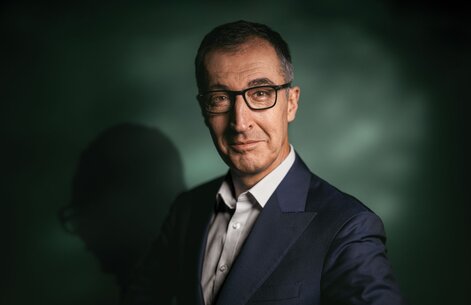
The second major pattern of interpretation began immediately after the election: the strong result of the Greens as a possible model for further elections. This interpretation is understandable. Cem Özdemir was a very strong figure in the election campaign. Even before the election, the ZDF Politbarometer showed a clear lead for Özdemir in the question of the desired prime minister. YouGov also found an interesting constellation: the CDU was more convincing as a party, but Özdemir was more convincing as a candidate.
Nevertheless, it would be premature to derive a general formula from this. Baden-Württemberg is not an average state politically. The Greens have been institutionally anchored there in a special way since 2011. Added to this is the long impact of the Kretschmann years, the experience with green-black governments and a political culture in which the ability of the Greens to govern has long been normalized. In addition, the new electoral law with two votes applied for the first time in 2026; at the same time, 16 and 17-year-olds were allowed to vote in a state parliament election for the first time. According to the State Agency for Civic Education, around 650,000 people, or 8.4 percent of eligible voters, were able to cast their vote for the first time.
The result is also not easily transferable geographically. In smaller municipalities, the CDU performed significantly better than nationwide with 35%, while the Greens were clearly ahead in larger cities and densely populated areas with 38%. Such patterns do not occur by chance. They are linked to regional economic structures, political milieus, candidate profiles and very specific local perceptions of problems. Baden-Württemberg is therefore an analytically interesting case - but not a template for Rhineland-Palatinate, Saxony-Anhalt, Mecklenburg-Western Pomerania or even federal politics.
Democracy is more than pattern recognition
Especially at the start of a "super election year", it is tempting to immediately read every result as an omen for the next one. But in doing so, it is easy to lose sight of what democracy is actually about. Elections are not just tests for future elections. They are moments in which social problems become visible, political proposals meet with a response - or not - and regional conflicts are dealt with publicly.
In this sense, the election in Baden-Württemberg shows two things. Firstly, the economy can be a dominant election campaign topic without adequately covering all relevant issues of work and everyday social life. Secondly, a strong result for one party is not yet a reliable template for other political arenas. Anyone who hastily deduces recipes from individual election results is underestimating the inherent logic of democratic processes.
Perhaps this is precisely the most important lesson of this election season: democracy should not only be thought of in terms of the next result. The decisive factor is not just who is narrowly ahead, but also which issues become visible, which groups feel addressed and how openly political competition remains organized. Baden-Württemberg was therefore a revealing start to the 2026 election year - but not a blueprint.
PD Dr. Martin R. Herbers is a netPOL employee at Zeppelin University. As a private lecturer in communication science, he researches the interplay between democracy, technology and public communication.
More articles
 11/25/2025ScienceDigital technologies in communication
Trust is about understanding
PD Dr. Martin R. Herbers explains how the digital transformation is challenging our democracy and how communication science can meet this challenge. 12/16/2025ScienceMobility cooperatives
Better to share than (not) own
Innovation researcher Matthias Weiss talks in an interview about the potential, opportunities and challenges of mobility cooperatives.- 04/29/2025ScienceTransport policy
What happens to the special infrastructure assets?
The next government has put together a 500 billion package. What will be left of this for the transport infrastructure? asks Alexander Eisenkopf.  01/28/2025ScienceDemocracy and the Office of the President
Pen strokes and felt-tip pens for the people
What we are currently seeing in the USA shows how populism imagines political leadership and problem solving.