The big performance - how the Student Research Day went
At the student research presentation day, many projects looked at how modernity is shaped by representations.
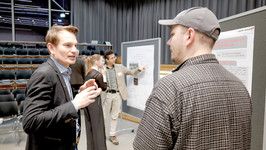
Once again this spring semester, students could read the anticipation of the Student Research Day, where students present their research projects to a small audience, from their faces. The range of topics was broad: everything from contraception to populism was represented. There was a common thread running through many of the presentations: performance.
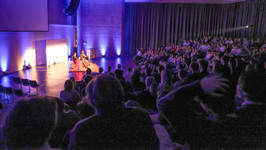
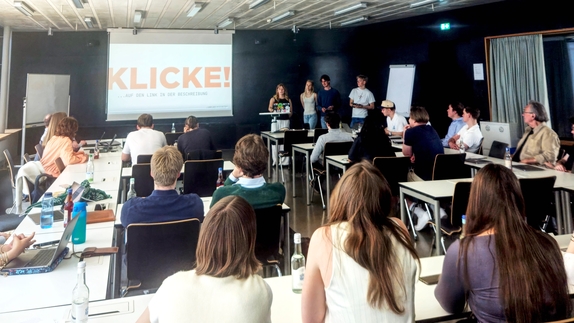
After a welcome in the lounge, the Student Research Day began with a presentation on how young people are influenced by influencers when it comes to contraception. The room was packed to the last row with students and some professors, all of whom followed the research group as they presented their critical analyses: on the role of so-called "medfluencers" on platforms such as Instagram or TikTok - and on the question of how much this content actually influences the contraceptive behavior of young adults.
"People feel uncomfortable talking about it - there is too little education," says Romy Butz. The results showed how strongly digital algorithms and social media can shape health behavior: Ella Mayr said, "Influencers show that a woman doesn't have to take the pill and live with it, but that there is just alternative A, B or C!".
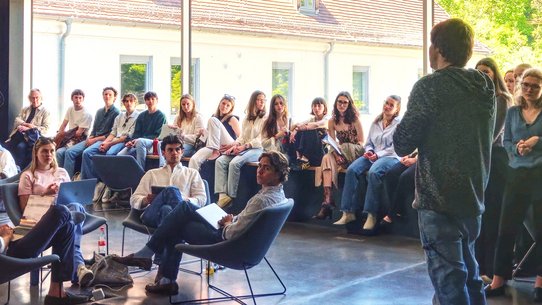
Another group deals with the question of whether populists can be considered new "heroes or heroines" today - using Donald J. Trump as an example - based on Theodor W. Adorno's 1963 thesis that the social conditions for fascism continue to exist.
Today, however, it is not fascists but populists like Trump or the AfD who are popular. "Whether it's Donald Trump or the AfD in Germany - right-wing populism is more popular than ever," says Sara Hakob. These productions follow patterns - they make use of emotional narratives, draw on symbolism and evoke a sense of togetherness. And none of this is a coincidence, but a performance - populists will do anything to increase their reach and popularity. The group explains to the audience how political power is defended today not only through argumentation, but also through staging.
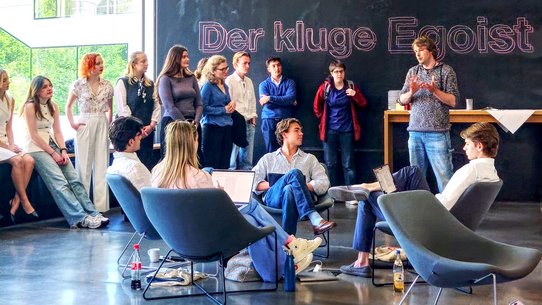
We encounter performance everywhere - whether in the digital world or in reality
Between cycle apps and election campaign shows, one thing became very clear at this year's Student Research Day: we encounter performance everywhere. It has an impact in the digital space when influencers influence our health behavior - sometimes with heart, sometimes with a hashtag. It can be seen in big politics when populists stage themselves to tell heroic stories that are often more fiction than fact.
So whether you're scrolling or voting - if you portray something and polarize it, you gain attention. And those who gain attention can influence and thus instrumentalize their voters or followers.
The question of representation is also present in the titles of other lectures: "Performance of femininity", "The performance of the city of Friedrichshafen in relation to gender-equitable urban development" or "Performance of economic cooperation between China and African countries from an economic, geopolitical and ecological perspective using the example of Angola" - all of these lectures have the word "performance" in their thesis.
So at the end of the day, what remains is not only the memory of the twenty-four lectures with seventy-three students and coffee breaks that invited further discussion, but also, in my opinion, the realization that performance is not a question of the stage, but of perspective.
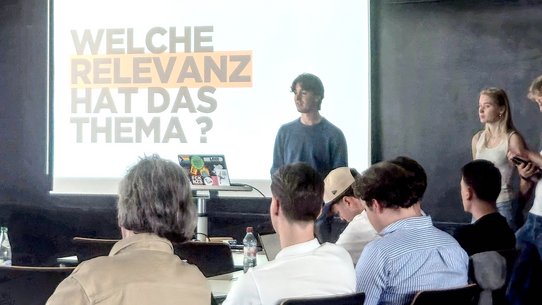
The Student Research Day also showed once again that students can do both: observe and question. At least that's what was heard in the discussion rounds. The theses and statements of the groups did not just stand there in the room. With curiosity, depth and the courage to sometimes read between the lines, the audience got to grips with the speakers.
More articles
 12/08/2025ScienceApplied science
ZF and ZU jointly research fundamental issues of the future
For the second time, employees from ZU and ZF met at a symposium to present the results of their joint research projects.- 04/17/2025ScienceStudent initiative
"This permanent puberty, that's the core, we have to preserve it!"
The "Stunde Null" event was designed to motivate the student body at ZU. Lisa Montigel and Arved Friese on the power of community and the potential of empty spaces.  09/21/2026ScienceThree Questions for Simon Koschut
Security. Europe. Responsibility.
How Europe's security order is changing, what role transatlantic relations play in this process, and what responsibilities academia and universities bear in a new security landscape. 07/16/2026ScienceThree Questions for Anja Achtziger
More Than Just Studying. Motivating. Making Decisions. Taking Responsibility.
Why Zeppelin University emphasizes judgment, responsibility, and interdisciplinary thinking, and why these skills are more important than ever before.