AIB Conference 2024 in Seoul with LEIZ researcher
Tobias Grünfelder, research fellow at the Leadership Excellence Institute Zeppelin (LEIZ), was invited to the Academy of International Business (AIB) annual conference 2024 in Seoul to host a panel discussion on “Ethics in Cross-Cultural Management” and to present his PhD project at the Sheth/AIB Doctoral Consortium. The AIB is home to international business scholars worldwide, connecting scholars across geographic, disciplinary, social, and cultural boundaries.
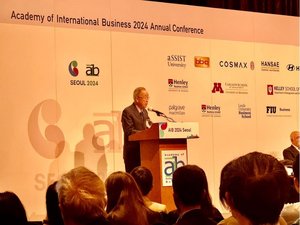
The conference was opened by former UN Secretary-General Ban Ki-moon, who pointed out that implementation and financing plans to achieve the Sustainable Development Goals must consider inequalities and human rights, especially for women and girls (SDG 5).
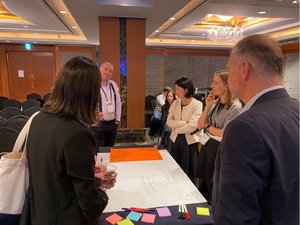
The panel discussion “Ethics in Cross-Cultural Management” was organised by Tobias Grünfelder (Zeppelin University) and Sabrina Göstl (Ivey Business School) and reflects a research focus of the LEIZ. Many ethical theories are based on moral universalism, the idea that some system of ethics is universally applicable to everyone. However, critics suggest that ethical rules are relative to culture.
Advocates of this cultural relativism conclude that people should not impose their ethical standards on others. Yet, cultural relativism is also rejected by many - even described as a “sleeping tiger” that can lead to arbitrariness and opportunism. While this debate has existed for years, it is called back on the agenda in the face of global conflicts, a changing global order, increasingly polarized societies, and new working models.
This raises the questions: how can multinational enterprises (MNEs) engage in cross-cultural management that moves beyond moral universalism and cultural relativism to initiate a moral learning process across cultures? The panel discussion addressed this question by reassessing current theoretical perspectives considering real-world challenges faced by MNEs, fostering an exchange of experts illuminating cross-cultural ethics from different theoretical angles, and encouraging ideation to move the debate forward.
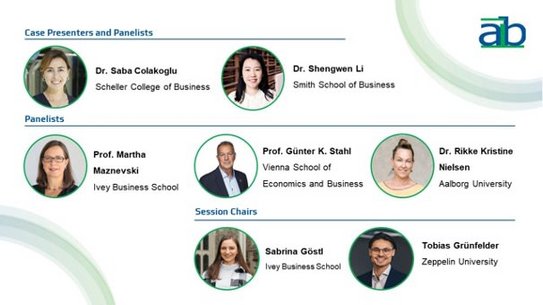
Thus, the panel discussion with an interactive World Café was an opportunity for the international business community to embark on a dynamic learning journey and make the current state of research visible. The following experts were part of the panel discussion: Dr. Saba Colakoglu (Scheller College of Business), Prof. Rikke Kristine Nielsen (Aalborg University), Dr. Shengwen Li (Ivey Business School), Prof. Martha Maznevski (Ivey Business School) and Prof. Günter K. Stahl (WU Vienna).
Overall, the panel discussion showed that moral universalism and cultural relativism undoubtedly have their strengths and drawbacks, that one or the other concept is not better, that it always depends on a context, that paradoxical thinking is helpful, that students need to be prepared for these situations and that leadership must initiate joint learning processes across cultures. Overall, a transnational approach (a mix of global integration and local responsiveness) seems promising for organizations working in an international context.