Transcultural Learning in the South Caucasus – The Magic of Cooperation
How can transcultural learning in the South Caucasus look and succeed?
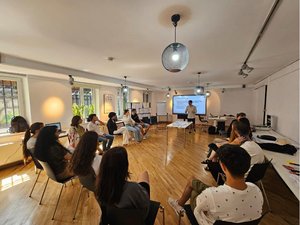
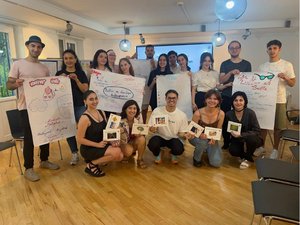
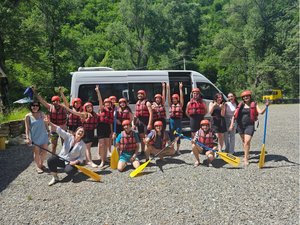
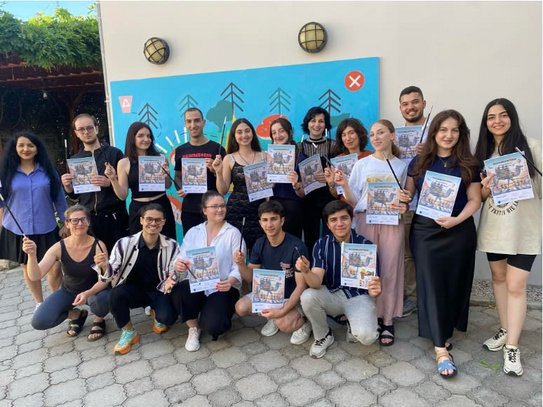
This question was the focus of a summer school in Georgia for students from Armenia, Azerbaijan, and Georgia, organized by Anika Freese (DAAD lecturer in Tbilisi, Georgia) and Tobias Grünfelder (research associate at the Leadership Excellence Institute Zeppelin University & magician). From June 15 to 23, 2024, five students from Armenia, Azerbaijan, and Georgia each made their way to an extraordinary encounter in Tbilisi: They came together to participate in a summer academy on the topic "Transcultural Learning in the South Caucasus – The Magic of Cooperation." This unique initiative aimed to build bridges and create shared experiences — beyond the conflicts that often shape this region.
Discovering and Creating Commonalities
The goal of the summer school was to create a space with a transcultural approach in which commonalities could be discovered and points of connection found. For this, a concept was developed in which participants not only theoretically learned something about transcultural learning but also almost immersively dived into transcultural learning by learning transculturally themselves and simultaneously investigating to what extent civil society actors in the South Caucasus are active transculturally.
The Potential of a Transcultural Approach
In the past, intercultural approaches have often focused on questions of dealing with differences, emphasizing cultural differences and thus the conflicts between various cultures. A transcultural approach starts from the observation that cultures do not exist side by side but with each other and that tolerance and the willingness to resolve conflicts are necessary but not sufficient to deal with the economic, political, and cultural challenges of the 21st century (Wieland 2020).
The Four Learning Phases of the Summer School
In four intensive phases, the participants — all with German language skills of at least B1 level — explored the role of civil society actors in Tbilisi. From team building to theoretical foundations to practical fieldwork and the creation of blog articles: The students dived deep into the methods of social science research while expanding their language and transcultural competencies. The summer school was designed and organized according to concepts and methods of transcultural education (Grünfelder et al. 2024).
Diverse Results in the Form of Blog Articles
The results of the blog articles were published on Medium and provide insights into the great collaboration between the students. The results are very diverse and show:
- Different skills are important for cooperation across cultural boundaries (e.g., openness, tolerance, creativity, etc.).
- Personal encounters and shared experiences as well as learning opportunities can help overcome conflicts.
- Joint learning processes require patience and willingness to engage with each other.
- In some situations, there is no right or wrong.
You can find the link to the blog articles with further information about the project here: https://medium.com/@anika.freese/daad-sommerakademie-2024-transkulturelles-lernen-im-s%C3%BCdkaukasus-5587444ed1df.
Overall, the summer school was a great success, and a transcultural approach with a focus on commonalities and shared experiences has the potential to change collaboration and understanding in the region.
References:
Grünfelder, T., & Baumann Montecinos, J., Smith, H. & Schwengber, J. (2024). Transcultural Education — A Framework for Supporting Students to Develop Commonalities in Cultural Complexity. In: Deardorff, D. K., & Tatebayashi, M. (Eds.). (2024). Current Perspectives on Intercultural and Global Competence. STAR SCHOLARS PRESS.
Wieland, J. (2020). Relational Economics. A Political Economy. Springer.