

LEIZ Publication in the Journal for Business, Economics, and Ethics
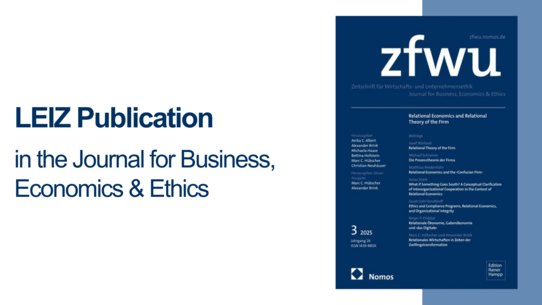
LEIZ is pleased to announce the publication of the third issue of the Journal for Business, Economics, and Ethics in 2025.
This special issue honours the work of our director, Prof. Josef Wieland, whose research has profoundly influenced the fields of relational economics and business ethics. In light of the digital and sustainable transformation his ideas are more relevant than ever. The issue assembles contributions from researchers who have been closely involved in the Relational Economics research program, which Prof. Wieland and LEIZ have advanced over the past several years through meetings in Friedrichshafen, Paris, and Copenhagen.
At the centre of the relational theory of the firm presented by Prof. Wieland in this issue are three key building blocks:
1. The firm as a relational nexus – companies are understood as networks of relationships with employees, partners, customers, and society.
2. Relational transactions in relational spaces – economic interactions are embedded in structured social and institutional contexts that shape trust, cooperation, and coordination.
3. The cooperation corridor as a governance framework – value creation is oriented by shared rules and boundaries that enable responsible cooperation in both business and society.
The editors, Prof. Dr. Dr. Alexander Brink and Prof. Dr. Marc Huebscher, contributed a joint article engaging with these concepts and outlining how relational economics can guide organisations in navigating the twin transformation, ensuring that digital innovation and sustainability are aligned rather than viewed as competing objectives. Contributions from LEIZ researchers Dr. Matthias Niedenführ and Jonas Stark, as well as from renowned experts Prof. Dr. Michael Schramm, Prof. Dr. Jacob Dahl Rendtorff, and Prof. Dr. Birger P. Priddat, further enrich this issue.
Prof. Josef Wieland’s article on value creation through cooperation not only recognises his lifelong scholarly achievements but also serves as a conceptual anchor for the entire issue. We hope this publication will foster further debate on how relational thinking can support the development of responsible, resilient, and future-ready economic systems.
The ZFWU issue is available here
Complementing this work, a dedicated book series, Relational Economics and Organization Governance, has been published with Springer. The book series is available through this link