

Chair of International Relations
Latest news
Publications
Book: How Regional Organizations Sustain Authoritarian Rule: The Dictators' Club
Authoritarian regional organizations - dictators' clubs - have grown remarkably in both number and importance. This book examines the role of these dictators' clubs in world politics. It analyzes how and why incumbent regimes join dictators' clubs, compares their activities over time and across different regions of the world, and analyzes their impact on domestic politics of survival. Using a methodical combination of statistical analysis and case studies, the book illustrates how dictators' clubs have helped to defend autocratic regimes against pro-democracy protesters, co-opt political elites, legitimize rigged elections, regulate the behavior of member states, and protect regimes from the consequences of international sanctions. While regionalism has long been associated with states' efforts to promote democracy and human rights, the book shows that dictators' clubs reinforce authoritarian rule worldwide.
The book can be found here.
Blogposts on the book appeared on Democracy without Borders, ENSURED and UCCG.
Hollow Multilateralism: How Autocracies Contest Norms and Procedures of International Organizations. International Affairs, (with Daniëlle Flonk).
Are Non-Democracies Taking Over? Autocratization and International Organization Membership, (with Thomas Sommerer).
Weathering the Storm? The Third Wave of Autocratization and International Organizations, University of California Institute on Global Conflict and Cooperation Working Paper, November 17, 2023, (with Thomas Sommerer).
You can find a complete list of publications here.
Interviews & Public Engagement
BodenSee Youth Conference 2025
The Bodensee Youth Conference 2025 posed the question of whether we are already experiencing the end of the liberal era? In addition to keynote speeches and panel discussions, this overarching topic was also addressed in workshops, which participants were able to attend on October 8, 2025. The workshop with Prof. Maria Debre dealt with the role of autocratic regimes and authoritarian practices in the international legal system. In an analysis of the basic principles of the liberal understanding of international law, it was worked out how authoritarian states deliberately question these principles, undermine them or replace them with alternative interpretations. Specific case studies on international criminal jurisdiction, global human rights protection, world trade law and climate jurisdiction were used to analyze the extent to which a systematic change is taking place or has taken place. The central questions were: Are we experiencing a fundamental change in international law towards an authoritarian legal order?Has international law ever been an effective instrument for limiting state power? Is it becoming increasingly politicized and undermined?And if so, who is the main threat?
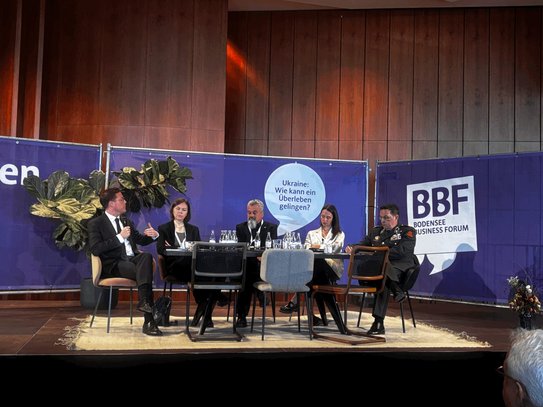
Bodensee Business Forum 2025
Detlev Simons (Chief of Staff of the NATO Joint Support and Enabling Command in Ulm), Manuel Hagel (State Chairman of the CDU Baden-Württemberg), Ljudmyla Melnyk (Head of the Ukraine Program at the Institut für Europäische Politik e.V.) and Maria Debre (Professor of International Relations at Zeppelin University) took part in the discussion on the current situation in Ukraine on 9 October 2025. The panelists warned that Ukrainians are not people with infinite resilience. They are not a nation with superpowers, but people who need and deserve support. The panel was moderated by Jan Jessen, a crisis and conflict journalist from Funke Medien Gruppe.
More information here.
Career Talk Young DGAP
#CareerTalks is an initiative of the AG Feminist Foreign Policy with the aim of promoting professional participation in political contexts.
Prof. Dr. Maria Debre was invited to the exchange on 11.03.2025 to talk about career paths in teaching and research.
The Zoom event was moderated by the heads of the AG Feminist Foreign Policy of the Young DGAP.
Panel "The Ukraine war and the security situation in Europe after the US election"
Experts and participants, including several members of the BSH University Group for Foreign and Security Policy, came together at the Academy for Political Education in Tutzing on December 13 and 14, 2024 under the title "360 Degrees - A Review of the Year in Security Policy". The conference offered an in-depth analysis of the key security policy developments of the year and ventured an outlook on future challenges.
The panel focused on the far-reaching effects of the war in Ukraine and the strategic consequences of the US election for the security situation in Europe. These complex topics were enriched by the online expertise of Dr. Margarete Klein (SWP), while Dr. Anja Opitz (Academy for Political Education) and Prof. Dr. Maria J. Debre (Zeppelin University Friedrichshafen) led and deepened the debate on site.
You can find more information here.
Interview on the election in Azerbaijan and international election observation
"It's a legitimization of the existing power. It's a matter of saying to your constituents, 'Look, these were free elections; look, they took place according to international standards'. It's a common mechanism in autocracies"
For an article on the election in Azerbaijan and its international election monitoring, Prof. Dr. Maria Debre gave an interview for the investigative platform "forbidden stories".
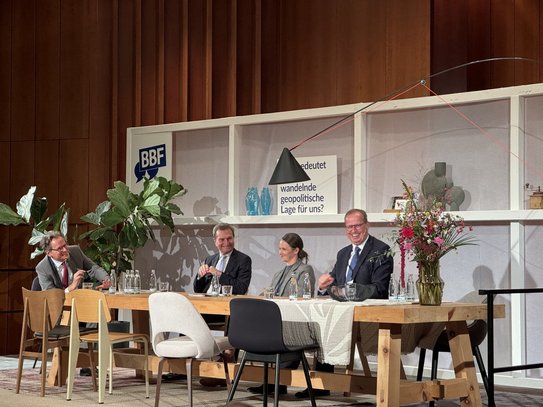
Bodensee Business Forum 2024
This year's Bodensee Business Forum 2024 took place on October 22, 2024 and featured a panel discussion entitled "Is the EU capable of acting in foreign policy at all?", which was moderated by journalist Ralph Sina. Prof. Dr. Maria Debre, together with the other participants Günther Oettinger, President of EBS University of Business and Law, and Dr. Jörg Stratmann, CEO of Rolls-Royce Power Systems in Friedrichshafen, looked at the EU's external relations and the geostrategic challenges for Germany.
Conferences & Workshops
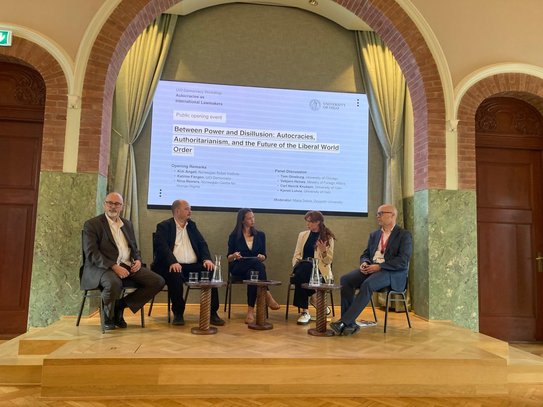
Workshop "Autocracies as International Lawmakers "
The workshop "Autocracies as International Lawmakers" took place at the Norwegian Nobel Institute against the backdrop of growing concerns about democratic backsliding and the decline of the liberal world order. Although these political shifts are receiving increasing attention, the question of how autocracies shape international law in concrete terms has so far been little researched and research is often limited to disciplinary boundaries. The aim of the workshop was therefore to foster a valuable dialog between experts from international relations, international law, comparative politics and comparative law in order to initiate a research project aimed at a more nuanced understanding of the role of autocracies as international legislators. The opening event at the Nobel Institute was a fitting and meaningful prelude. In a thought-provoking panel discussion, Tom Ginsburg, Kjersti Lohne, Carl Henrik Knutsen and Vebjorn Heines, and Maria Debre discussed the changing nature of international law-making in a changing global order - an order in which the rise of autocracies is challenging long-held assumptions about human rights, liberal legitimacy and global justice.
Further information on the workshop can be found here.
Section "Autocracies in Global Governance" @ General Conference of the Euroepan Consortium for Political Resarch in Thessaloniki
Prof. Maria Debre, Daniëlle Flonk, Jana Lipps and Mathew Stephen discussed key challenges for the liberal world order under the guiding theme of the growing influence of autocracies on global politics. The discussion focused on how authoritarian states are not only gaining influence in international forums, but are also actively establishing their own illiberal norms and standards. Another focus was on analyzing the possible reactions of democratic states, which have to balance between the poles of confrontation, cooperation and adaptation.
You can find more information here.
Participation in the conference "Decrypting Digital Authoritarianism" from 28-29.10.2024
Participation in the conference of the European University Institute (EUI) in Florence from 28-29.10.2024, which was organized by the Global Initiative on the Future of the Internet. Under the title "How the use of the Internet can threaten democracy and human rights", the conference aimed to bring together leading academics and encourage them to document digital authoritarianism worldwide, analyze its causes and effects and identify countermeasures.
Participation in the DVPW Congress from 24-27.09.2024
Participation at the Congress of the German Political Science Association at the Justus-Liebig University Göttingen with two papers on China's human rights policy and the role of autocratization in the review process of the International Human Rights Council.
Activities at Zeppelin University
Inaugural Lecture "International Organizations under Pressure"
In her inaugural lecture, Maria J. Debre addresses the question of how authoritarian regimes use and shape international cooperation and thus challenge the liberal international order. Her research focuses on "dictator clubs", regional organizations that serve to stabilize authoritarian rule, undermine democratic norms and spread illiberal values. Large international organizations such as the United Nations or the European Union are also struggling with the effects of autocratization and geopolitics. Looking at her current research, Debre sheds light on how international organizations can effectively deal with various challenges and what role autocratization plays for decision-making processes in international organizations, for the development of international law and the shifting of discourses around human rights (listen to the podcast here).
Feminist Foreign Policy Talk with Leonie Stamm (DGAP)
"What can a feminist foreign policy still achieve in a world in which authoritarianism and extremism are on the rise?"
Leonie Stamm (Research Fellow at the German Council on Foreign Relations) and the organizers Prof. Dr. Maria Debre and Clara Böning discussed this question at an event held in cooperation with the "Club of international Politics" on 8 April 2025.
Lecture on "International cooperation in times of autocracy and populism"
Lecture on "International Cooperation in Times of Autocracy and Populism" on the day before the US election as part of the public lecture series "Populism, Right-Wing Extremism and Democracy".
Profile
The discipline of International Relations deals with interactions among sovereign states, non-state actors, international institutions, and individuals across state borders. Key themes include globalization processes, global power dynamics, as well as conditions for cooperation and conflict. With a focus on understanding the complexities of global order, International Relations provides insights into the dynamics shaping our interconnected world.
The Chair of International Relations at Zeppelin University is situated at the intersection of international and comparative political sciences. Challenges posed by the autocratization of political systems, processes, and discourses, especially in established democracies and the rise of powerful autocratic regimes such as China, Russia, or Saudi Arabia, have gained significant importance in the last decade. Research and teaching at the chair address this central question of power concentration and legitimate exercise of power, along with the consequences for international politics and institutions.
The following focal points are offered at the chair:
- International Perspectives of Democracy and Autocracy
- International Organizations
- Regional Cooperation in the Global South
- International Sanction Politics
Teaching
The Chair offers both introductory courses on international relations and advanced seminars. Basic seminars include the teaching of central theoretical concepts and the genesis of research on international relations as well as the empirical analysis of different types of international cooperation, the central state and non-state actors and suitable research methods.
Advanced seminars deal with the topics of international organizations as central arenas of international cooperation, the role of democracy and autocracy in international politics as well as current geopolitical challenges and transformations of multilateral cooperation.
In all seminars, the focus is on understanding qualitative and quantitative methods and on dealing with regions of the Global South.
As part of its research focus, the chair also offers supervision for final theses. Consultation appointments by individual arrangement by e-mail.
Courses regularly offered at the Chair:
- Critical Approaches to International Relations and Global Governance - Gender, Power, Populism (Clara Böning)
- Critical Perspectives on Global Governance (Clara Böning)
- Autocracies in International Politics (Maria Debre)
- Sanctions in International Politics (Maria Debre)
- Introduction to International Relations (Maria Debre)
- Global Governance (Maria Debre/Clara Böning)
Research interests
Current projects
Bad Neighbors, Good Company?
This project, funded by the Fritz Thyssen Foundation (2025-2027), investigates how regional organizations (ROs) contribute to autocratization processes - especially in the Global South. While ROs are often seen as guarantors of stability, the project introduces the concept of hybrid regional organizations: organizations in which democracies and autocracies coexist and spread authoritarian practices within the membership and beyond. The focus is on disputes over content control, freedom of expression and the role of the state in the digital space. Using a mixed-methods approach that combines statistical analysis, discourse and case studies, the project shows how ROs promote autocratization through the legitimization of digital sovereignty practices- and what consequences this has for political development and digital governance. A first project paper on the role of regional organizations as a place for policy transfer and learning is available in 2025 in Comparative Security Policy (with Stephen Hall).
Autocracies as International Lawmakers
This project (2024-2025), funded by UiO:Democracy (University of Oslo) in collaboration with Nina Reiners, is located at the intersection of international relations and international law. Building on the growing concern about the emergence of "authoritarian international law", the project analyzes the behavior of autocratic states within the United Nations (UN). To this end, a comprehensive data and text corpus was created to examine when and on which topics autocracies submit resolutions to the UN's Sixth Committee (Legal Committee), which resolutions they support as sponsors and which they block. As part of the project, a workshop was held at the University of Oslo and the Nobel Institute Oslo in June 2025.Autocracies in Global Governance - ECPR Research Network
While democracy has long dominated debates in international relations, the role of autocracies is gaining urgent attention. Our network brings together scholars exploring how authoritarian regimes shape global politics-from challenging international norms and reshaping institutions to creating rival alliances and disrupting peace and security. We examine how rising authoritarianism is transforming global governance-and why it matters.For more information, follow us on LinkedIn or become a member to get regular updates about activities (you only need an ECPR account, no membership).
Autocratization, Policy Preferences, and the Performance of International Organizations (APPIO) (with Thomas Sommerer)
The DFG-funded project (2026-2029) investigates how the autocratization of membership structures of international organizations affects their performance and legitimacy. APPIO combines innovative methods such as automated text analysis, survey experiments and interviews with classical statistical methods and case studies. The project develops three data sets on the political output performance of 72 IOs, on the performance of international bureaucracies in the form of scientific publications, and on the voting behaviour and sponsorship of resolutions by autocratizing states comparatively across 72 organizations. The project thus contributes to a better understanding of the question of whether and how IOs remain capable of acting and legitimate under the pressure of autocratization. A first project paper has been published in 2025 in Cooperation and Conflict.
Hollow Multilateralism
This project (2026-2028), funded by the Japan Society for the Promotion of Science (JSPS) and led by Daniëlle Flonk (Hitoshubashi University Japan), investigates the role of autocratic states as international norm-entrepreneurs. We analyse how autocracies try to influence discourses within international organizations in order to legitimize autocratic practices and thereby undermine liberal values. The focus is on two policy areas: the regulation of the internet as a new, dynamic policy field and international human rights protection - in particular the protection of civil society participation rights - as an established field. Case studies, discourse and document analyses are used. An article on the concept will be published in 2025 in International Affairs was published in 2025.
Finished projects
The Decline and Death of International Organizations
More information on the project can be found here

About Clara Böning: Teaching & Research
Clara Böning has been working as a research assistant at the Chair of International Relations since September 2024. She studied Political Science and International Law at the University of Tübingen with a stay abroad in Haifa, Israel, and International Relations at Freie Universität Berlin, Humboldt Universität Berlin and the University of Potsdam with stays abroad in Morocco and Spain. Before coming to ZU, she worked for 2 ½ years as a consultant for the United Nations Population Fund (UNFPA) in the field of gender and human rights. At ZU, she teaches critical theories of international relations with a focus on feminist theory and intersectionality, as well as the introductory course Global Governance. Her doctoral research focuses on the global polarization of international norms on gender and sexuality and its impact on the United Nations.
Professor
| Phone: | +49 7541 6009-1411 |
| Room: | SMH Semi | 0.03L |
Research Fellow

Assistance

Student Assistant


Venmann, Philipp
Bachelor student
send e-mail