Unpredictable
If you exchanged a few words first with the student and then with Nicolas Bühringer, you would meet two people with different interests. With a strong interest in sociology and politics and less in economics, he started at ZU with the SPE bachelor's degree. Starting with a programming course, he switched to the CME bachelor's degree, became a fan of quantitative methods and is now about to complete a master's degree in statistics. He has also made the previously unthinkable a reality in sport.
Growing up in the middle of Munich in an apartment building, Nicolas Bühringer felt neither analyzed nor influenced, even though his father is a psychology professor. "Instead, my parents gave me all the freedom I needed to enjoy a carefree and carefree childhood and youth." Back then, he was more of a spontaneous city dweller who lived for the day without thinking much beyond it. It was mainly in sport that a certain ambition became apparent: Spurred on by an ex-professional basketball player who became a secondary school teacher after his career, Nicolas Bühringer played basketball for several years until an inflammation of his knee joint put him out of action for months. Unlike excuses, he then lacked the motivation to get back into sport - apart from a casual run, his sporting spirit was dormant.
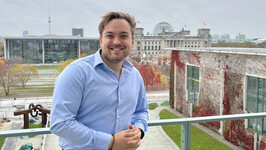
Nicolas Bühringer only showed more commitment towards the upper school. Once again motivated by a teacher, his interest in social and political issues grew to such an extent that he not only followed current affairs more closely, but also helped organize a "Day for Europe" at his school. But this interest alone did not stop there: "At some point, I was interested in just about everything, which only made choosing a course of study all the more difficult the closer I got to my Abitur," says Bühringer. As a result, he took the time he needed to decide what to do next and took a gap year after leaving school. After a job at a department store checkout, he completed an internship in the Berlin office of SPD MP Martin Gerster. "As the SPE bachelor's degree at ZU was already on the horizon, the internship in the Bundestag was just the right time to experience political work in practice," explains Bühringer.
Shortly before the coronavirus outbreak, Nicolas Bühringer got to know the university and its people in person. "Above all, I was surprised by the friendly, almost familiar atmosphere," reports Bühringer, "which was also reflected in the fact that the student vice president at the time, Hannes Werning, took me to the city station after the selection day."
Data Science Bootcamp as a turning point in the career
It was also the coronavirus pandemic that led Nicolas Bühringer to a groundbreaking rethink. "Instead of backpacking through South America, I took part in the online programming course 'Automate the Boring Stuff with Python', which was anything but boring and was incredibly fun," says Bühringer, who had to admit to himself at the beginning of his studies that sociological and political theories weren't for him. This realization led him to switch from SPE to CME. Before continuing his studies with a CME bachelor's degree, he attended a ten-week full-time data science bootcamp in Berlin. "This bootcamp was the turning point in my career," emphasizes Bühringer. "I discovered the topics that were to accompany me from then on, such as data management or machine and deep learning."
One programming language used at ZU for statistical and data analysis is R. "Thanks to my programming skills, I found it relatively easy to work with R," notes Bühringer. This also caught the eye of course instructor Professor Dr. Franziska Peter in a methods course, which in turn made him a tutor for the "Advanced Statistics", "Applied Statistics with R" and "Data Science" courses. "For me, the tutorials were not just an opportunity to expand my own skills. They were also a chance to familiarize my fellow students with a programming language," explains Bühringer, who was also actively involved in other aspects of student and university life as the event and initiative director of the Student Lounge e.V. and as the second chairman of university sports.
In order to deepen his knowledge of data science and statistics, Nicolas Bühringer spent two semesters abroad in his sixth and seventh semesters. First, he went to the Universidad Carlos III de Madrid. There he attended exclusively quantitative courses on data structures and algorithms, among other things. "The good thing about this university was that I had a free choice of courses," notes Bühringer. The situation was very different at the University of California, Berkeley, where existing students have priority when choosing courses, meaning that courses on data science or computer science, which are in high demand, are fully booked early. "That was a shame, but it didn't matter because it gave me the opportunity to explore new horizons," explains Bühringer. "And the courses on mathematics, astronomy and bioengineering were the best I've ever attended. The standard of the lecturers and students is at an incredibly high level, which spurs you on and allows you to surpass yourself at the same time."
Nicolas Bühringer knows what it feels like to overcome your own limits. "It all started with a documentary about the Ironman Hawaii," says Bühringer. From then on, he couldn't shake off the attraction of achieving the impossible. Plagued by knee problems during his first semester break in Berlin, he dared to jump into the pool of a nearby outdoor swimming pool after watching two YouTube tutorials on crawl style - with the aim of swimming one kilometer at a time. Although completely exhausted afterwards, he didn't let up, so that after the summer he stayed under the time required to swim half an Ironman - 1.9 kilometers in under 1 hour and 10 minutes.
The dream of Ironman Hawaii lives on
A year later, he took part in the Ironman 70.3 Zell am See-Kaprun and embarked on the 1.9-kilometre swim, 90-kilometre bike ride and 21.1-kilometre run. "It couldn't have been worse, because it poured down with rain all day," says Bühringer. More devastating than the weather was his fall on the last descent: heart rate down from 170 to 105, speed down from 35 to 0 km/h. The tracker did not record his speed for three minutes, and his memory was lost for even longer, until he gradually regained consciousness while running. Pumped full of adrenaline and with his last ounce of strength, Nicolas Bühringer made it to the finish line. "That was the hardest thing I've ever experienced," says Bühringer, who was taken straight to hospital after crossing the finish line: "Luckily nothing happened, in the end the broken helmet saved me from worse." He has remained true to the sport, even though he now prefers the sprint distance - 750 meters swimming, 20 kilometers cycling and 5 kilometers running. His record to date: participation in a European Championship and an amateur world championship, trophies in local competitions. However, the dream of standing on the starting line at Ironman Hawaii or Challenge Roth one day has never left him.
After returning to Germany after his semesters abroad, the only thing left to do was Nicolas Bühringer's Bachelor's thesis, which he wrote under Professor Dr. Franziska Peter. "Her department does a lot of research into the use of neural networks to predict share price fluctuations. The training efficiency of neural networks depends on the file sizes fed in. In my bachelor's thesis, I therefore tried to compress the respective size of the bars displayed in a diagram for the share returns - green for rising, red for falling," reports Bühringer, who succeeded in the "experiment" - as he describes his thesis himself.
With the money he has saved as a self-employed event and portrait photographer working at ZU and beyond, he originally wanted to take a longer trip around the world after his Bachelor's degree. However, he has now found his place in the world and has applied directly to statistics master's programs at European universities. "At ZU, I got to know and appreciate myself and my interests better. Even though there are many options open to you at university: You have to make your own decisions and go your own way. And I feel very happy with the decisions I've made so far and the paths I've taken so far."
More articles
 11/14/2024PeoplePioneer of the month
Otmar Böss: "It's worth venturing into the unknown"
At ZU, Otmar Böss learned to simply do what is good for him and others - and experienced that it is worth daring to try the unknown.- 09/30/2026PeoplePioneer of the Month
Ferhat Cicek: With Foresight into the Wide World
With an inquisitive nature and an extensive network, Ferhat Cicek set out from Lake Constance into the wider world—to Singapore, Doha, Istanbul, New York, and Washington, D.C.  08/26/2026PeoplePioneer of the month
Hannah Hartenstein: In Tune with a Culture of Empowerment
For years, Hannah Hartenstein worked behind the counter at the student café “Beton & Bohne”. At the same time, a unique interest began to take shape: an interest in the economic side of the healthcare system. 07/15/2026PeoplePioneer of the month
Leon Löchle: Life in a Highly Frequented Area
For Leon Löchle, getting involved is as much a part of life as the air he breathes. It means a great deal to him to stand up for others or to help them have a good time.