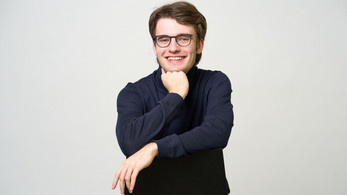
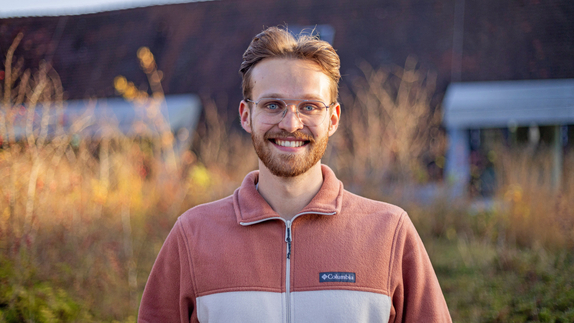
Otmar Böss: "It's worth venturing into the unknown"
That he would one day make a name for himself among his fellow students as a statistics tutor. That one day, as a CIP board member, he would be able to hold discussions with political and diplomatic figures on an equal footing and on a public stage. Sometimes Otmar Böss has to pinch himself to realize that all of this is now a reality. But at ZU, he has learned to simply do what is good for him and others - and has found that it is worth daring to try the unknown.
Otmar Böss comes from Nassereith. There are more cows than people in this Austrian community, which is idyllically surrounded by the Tyrolean mountains and less idyllically situated on the busy Fernpass to Imst. "Village life is very rural and traditional, and a lot of childhood and youth is spent in the young farmers' association, music band and sports clubs," says Böss. His parents not only built a house in the village, but also set up a company in advertising technology. "We created logos, produced car lettering and made advertising signs for companies in the tourism industry in particular," reports Böss, who had his own play corner in the company premises and was present at almost every installation. "My father, my mother and I were a well-rehearsed trio through and through," says Böss.
That changed abruptly when his father, who was always in perfect health and never went to the doctor, one day complained of severe headaches that eventually led to fainting spells. Otmar Böss immediately called the emergency doctor. A short time later, his father was admitted to hospital in Innsbruck with a brain haemorrhage. "My father was a strong person who knew everything and had everything under control. When I suddenly saw him lying in a coma in the intensive care unit, my world collapsed," remarks Böss.
His mother was his rock, who now took care of everything and supported her then 15-year-old son in continuing his life in an orderly fashion. "This difficult phase brought us even closer together," mentions Böss. When it became clear that there was no chance of recovery for his father, who had been in a vegetative state for several months, Otmar Böss had to learn to make his own decisions, take his own risks and seize his own opportunities.
Community service in a refugee shelter leads to a rethink
Otmar Böss followed in his father's footsteps until he completed his A-levels: from elementary school to secondary school to the Federal Commercial Academy for Business Informatics. "It was important to him that I had something solid in my pocket first. He was probably toying with the idea of me joining the family-run company later on and contributing my business skills there," explains Böss. However, he was actually more interested in the creative side of things and loved editing images and videos or creating logos and websites. "This led to the desire to study graphic design or architecture," adds Böss. His father's death led to the dissolution of the company. However, his civilian service, which he completed in a refugee shelter in Innsbruck, proved to be even more decisive for the rest of his life.
Shortly after completing his school-leaving exams and diploma with distinction, his job as the boy for everything suddenly consisted of pumping out the urinal in the refugee home and doing some real dirty work. "What put a psychological strain on me and made me think was the fact that refugees arrive full of confidence, but then wait so long for their decisions, crammed into the smallest of spaces, that they break inside," says Böss. "These injustices made me rethink things in the sense that I wanted to study something that would help me make the world a fairer place."
So he looked for a place to study that would quench his thirst for knowledge and not only tolerate critical thinking and questioning, but actually challenge it. In a tweet, he stumbled across the claim "between business, culture and politics" and, in Zeppelin University, a place where interdisciplinary study is possible. "I successfully applied for a place on the SPE Bachelor's degree course without talking to anyone or looking at the university in person," reports Böss. In August, he moved into a room in a shared flat and started at ZU in September.
"As a person who is enthusiastic about many things, it was and still is a dream to be able to deal with such a colorful and broad bouquet of topics between sociology, politics and economics," mentions Böss, who was fascinated by the open and previously unknown culture of discussion right from the start. On the other hand, student life was also overwhelming for him in the first two semesters, as a non-academic child who knew nothing about foreign words such as Kommiliton:in or Tutorium. "In my head, I was still in my familiar surroundings in my village for a long time because the university felt strange at first," says Böss, who went home every weekend for two semesters.
From statistics tutor to populism researcher
In order to get to grips with the student environment and everyday life, Otmar Böss had to let go of village life to some extent and leave it behind. "The feeling that I could do anything with hard work ultimately brought about the turnaround," explains Böss. A high level of aptitude and quick comprehension led to excellent grades - even in courses where the usual average grade is limited, such as statistics, empirical social research or macroeconomics, to name just a few examples. "One thing has changed fundamentally at ZU: Suddenly I found myself going deeper and deeper down a self-imposed rabbit hole with mathematics. Because a correct result is the perfect counterbalance to a socio-political debate that is like a box without a lid," says Böss.
A 1.0 in statistics was followed by an email asking whether Otmar Böss could imagine giving something that has since become a permanent part of his vocabulary: a tutorial. Initially afflicted by imposter syndrome, fellow students eventually convinced him to take on the statistics tutorial - because he had already explained one or two statistical methods to them convincingly during the examination phase. "When a professor confirmed that the university is a place where you can make mistakes, I agreed to do it," adds Böss.
After spending the whole summer preparing for his first tutorial, he stood in front of Master's students in his third semester and introduced them to both descriptive and inductive statistics. "It's incredibly fun to help my fellow students in this way," says Böss, who also gives private tutoring to navigate his fellow students through the uncertainties of statistics. After two further tutorials in statistics, he is now also leading a tutorial in macroeconomics this semester. But for many, Otmar Böss remains the statistics tutor - especially since he received the Best Tutor Award for one of his statistics tutorials. "Receiving this award was not only wonderful, but also a great appreciation of the work I have done," says Böss.
As an Austrian and also a member of the SPÖ party, he cannot understand why so many people from the working class voted for the FPÖ. "In my Bachelor's thesis, I want to take a closer look at which economic factors encourage populism and which narratives populists use to try and convince those who feel increasingly left behind," explains Böss. He is in constant contact with Professor Dr. Martin Elff's Chair of Political Sociology, where he still works as a student assistant, about his academic work and methodological approach.
"During my internships in the Tyrolean state parliament and the European Parliament, I learned that there are those in politics who campaign on the front line and make speeches in parliament, and that there are those who work on party programs in the background," says Böss. "This led me to the idea of compiling information and data through objective research and using this as a basis for developing ideas and solutions for the pressing issues of our time." He believes it is very likely that he will one day pursue further research in a Master's degree in the USA or Europe, followed by a doctorate.
More articles
 09/25/2025PeoplePioneer of the month
Augustin Renz: Juggler with three standing legs
Augustin Renz likes the roles of the lobbyist in university politics, the bachelor student between sociology, politics and economics and the qualitative and quantitative researcher.- 06/26/2025PeoplePioneer of the month
Lara-Maria Mixdorf: On the path from plate carrier to sustainable entrepreneur
Studying sociology, politics and economics has given Lara-Maria Mixdorf every opportunity to pursue her dream of becoming a sustainable entrepreneur. - 09/26/2024PeoplePioneer of the month
Helena Rothfuß: Enthusiastic about the interplay between economics, politics and philosophy
While Helena Rothfuß spent a lot of time in nature and with books in her childhood, today she is enthusiastic about the interplay between economics, politics and philosophy.  07/15/2026PeoplePioneer of the month
Leon Löchle: Life in a Highly Frequented Area
For Leon Löchle, getting involved is as much a part of life as the air he breathes. It means a great deal to him to stand up for others or to help them have a good time.