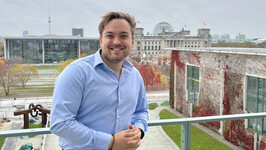

Julius Ostermann: On the best way to becoming a cultural manager
Julius Ostermann has a clear goal in mind: to take on a significant position in the cultural sector as a cultural manager and, in the best case scenario, to help decide where the music is played. On the way there, the enthusiastic saxophonist gained in-depth experience, particularly during his bachelor's degree at Zeppelin University - where he learned more about how to launch a music initiative, set up a festival and keep a band going.
Why is studying at ZU particularly suitable for creative people?
Julius Ostermann: The CCM degree program at ZU offers creative people unique opportunities to express themselves. The combination of economic and cultural content and the large number of initiatives enable students to put their creativity into practice immediately. What is particularly impressive is how much ZU encourages its students to get involved in projects, such as the airship chapel, and to realize their own ideas. The enthusiasm for these opportunities is so great that you can't help but join in and develop your creative talents.
What do you think is the key takeaway from your studies?
Ostermann: My key takeaway from my time at ZU was not the creative outlet, but the importance of communication and critical thinking. At ZU, it was a matter of course for me to actively participate in social and academic life and to constantly stay in touch - be it with fellow students, lecturers or in the initiatives. This culture of open dialog and constant questioning has had a lasting impact on me. The ability to think critically and have the courage to express my opinion has become an essential part of my professional life. I find this lesson from my student days incredibly valuable.
You were a student senator during your time at ZU. Did this position help you in your career choice and were you able to gain experience that is now helping you in your professional life?
Ostermann: My time as a student senator at ZU was incredibly formative. The responsibility I had towards the students challenged me and strengthened my project management and teamwork skills enormously. The work in the committees was often frustrating, but also instructive and showed me how important it is to keep at it and convince others of my ideas. The collaboration with the other senators was intensive and enriching - an experience that had a lasting impact on me and that I wouldn't want to miss. The office didn't really support me in my career choice, but I simply learned a lot for real life and voluntary activities, such as in associations.
What experience do you particularly remember from your time at ZU?
Ostermann: The most formative experience of my time at ZU was definitely the project management of the Seekult Festival. With a great team of eleven highly motivated and creative minds, we managed to put together an incredibly successful and fun festival despite all the challenges and crises. The synergy within the team was unique and made us work until we dropped - with a result that exceeded all our expectations. This experience was simply incredible and will remain unforgettable. We still keep in touch from time to time because we bonded so strongly during that intense year of working together.
You are currently between jobs. What did you pay particular attention to in your job search, what was important to you?
Ostermann: In my first job in the music industry, I concentrated in the traditional way on what I had learned and was passionate about. In my second job, I was more relaxed and only concentrated on event and project management, but that turned out to be a mistake. Although the promotion opportunities and pay were good, I lacked passion. This taught me how important it is to listen to your heart and choose something you are truly passionate about. For me, that's culture and that's why I'm now moving back in that direction. I have realized that a job should not only pay well, but also bring fulfillment. I simply need a cultural purpose in my job.
Do you see yourself in the cultural sector in the long term or more specifically in the music sector?
Ostermann: In the long term, I definitely see myself in the cultural sector, ideally in music. Even if there are challenges there, such as lower salaries, my goal is to achieve a significant position in the cultural sector. My dream is to take on a role as managing director or artistic director of a festival theater or similar. Even if the path to this can be bumpy, it is important to me that my work brings long-term cultural fulfillment. That is my clearly defined goal and what I focus on in my job.
What would you recommend to someone who is currently looking for a job?
Ostermann: If you are looking for a job and are unsure whether a job is right for you, remember: no salary in the world justifies an unhappy job. I've experienced this myself. For example, I once did an internship that paid well and offered interesting tasks, but wasn't the right fit for me as a person. That showed me how important it is that the job suits me and that I feel comfortable there. It's not just about the salary, but also the work content, colleagues and working environment. Make sure that you can get along well with the job and the environment. Everyone has to find out for themselves what is important - for me, personal contact in the office is crucial, while others may prefer to work from home. The key is that you feel comfortable in your job and that you're not just slogging through it or working for the next payday.
To what extent is your own musicality compatible with your professional life? Do you have enough time to devote to music despite your work?
Ostermann: My musicality is a great passion for me, which fortunately I can live out as a hobby. I've been a musician for 20 years and have always been able to combine my musicality with my professional life, even if my current job has little to do with music. For me, music is a question of time management: I make sure I practise regularly and play in various ensembles, be it jam sessions, bands or orchestras. Music is a kind of balance for me and an important part of my life, it opens many doors and helps me to network socially and culturally. Even if everyday working life is sometimes stressful, I always find a way not to neglect my musicality - music is simply a part of me.
Are you still in contact with the alumni community and your former fellow students?
Ostermann: Yes, I still have a lot of contact with people from my time at university. The friendships I made back then are very valuable to me. Even though I'm no longer in touch with everyone on a daily basis, I'm always happy to see old friends again. The connections I made at ZU really are for life. Especially on occasions like summer parties or anniversaries, when you meet up, you realize how strong these bonds are. It's also great to give each other advice, especially on professional matters, because you've known each other for a long time and can assess each other well.
What are your music recommendations for our community?
Ostermann: If you're looking for music to study or think to, I have two great recommendations. Firstly, "Sleep" by Max Richter - a composition that lasts as long as a sleep cycle: eight and a half hours. Perfect for relaxing, studying or even falling asleep. The melodies are beautiful and very calming. Secondly, "Symphony No. 4" by Philip Glass - This symphony is repetitive and meditative, yet very emotional and stimulating. Ideal if you just want to clear your head or think deeply. Both works are great and offer a special musical experience.
More articles
 10/16/2025PeoplePioneer of the month
Jil Tischer: Do it yourself - but together
The dynamic and energetic environment at ZU encouraged Jil Tischer to think big and realize even bigger projects. 07/15/2026PeoplePioneer of the month
Leon Löchle: Life in a Highly Frequented Area
For Leon Löchle, getting involved is as much a part of life as the air he breathes. It means a great deal to him to stand up for others or to help them have a good time. 03/26/2026PeoplePioneer of the month
Emilia Bös: Naturally energetic
Emilia Bös has an idea of what ZU has done to her and with her so far. She has grown as a person because she has grown into roles and tasks from which she has emerged stronger.- 01/29/2026PeoplePioneer of the month
Jan Ennker: The art of doing what you want
Jan Ennker only realized what he really wanted to do in life during a lockdown. Since then, a life without art has been unthinkable for him.