Yelyzaveta Rudnieva: Reaching the goal through detours
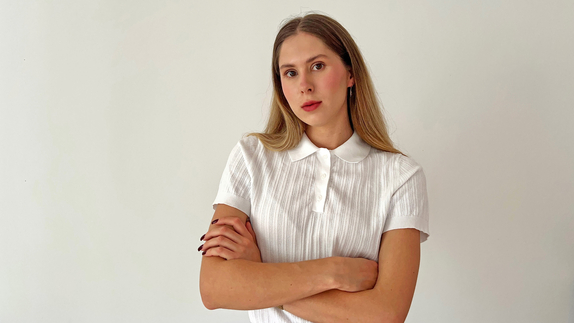
When Russia's war of aggression against Ukraine broke out, an odyssey with an uncertain outcome began for Yelyzaveta Rudnieva, her younger brother and her mother. They made their way from Kiev via Lviv and Warsaw to Berlin and from there, via several detours, finally to Ravensburg. Attracted by the scholarship for Ukrainian refugees, Yelyzaveta Rudnieva's path led her to ZU. Here she found new hope and pursued a new dream.
Yelyzaveta Rudnieva grew up sheltered and protected in Kiev. As it was customary in Ukraine at the time to attend school for eleven years, she had to decide at the age of 16 what her future career would be. "Taking a gap year was not an issue anywhere, but rather it was common practice to start an apprenticeship or study. However, this always leads to many young people starting with one thing and finishing with something else," notes Rudnieva. She herself followed the path of her mother, who studied English and worked as a language teacher.
With her school-leaving certificate in her pocket, Yelyzaveta Rudnieva went to the Kyiv National Linguistic University to study English and German language and literature. It is worth noting that although she had English lessons throughout school, she only really learned German at university. "Studying was particularly interesting because, in addition to grammar, syntax and phonetics, you were also immersed in the development of a language or were taught what is important in interpreting and translating," reports Rudnieva. "However, this deep understanding of languages was essential in order to be able to teach them to others." After completing her bachelor's degree, she continued to follow her mother's path by teaching language courses - both as a private tutor and as a teacher at a language school.
Own fashion brand as a long-cherished dream
At the same time, she turned a long-cherished dream into reality: "As a small child, I always wanted to be a fashion designer, and as a teenager I attached great importance to stylish clothing. I have always been fascinated by fashion because it is able to express something without having to say anything," explains Rudnieva. Together with her best friend from childhood, she finally founded a fashion brand: Bental' Brand. "We made the perfect combination: while she is a gifted draughtswoman, I am good at keeping an eye on the finances and providing a roadmap," explains Rudnieva. As is widespread in Ukraine, they sold the specially created and customized garments via an online store on Instagram - later they also displayed and exhibited their fashion in rented showrooms and pop-up stores. "The business went so well that it could have developed into something," says Rudnieva.
Outbreak of war and decision to flee
But then came February 24, 2022. "Although there were already a lot of rumors in circulation calling on people to prepare for an emergency and to make sure they had a survival kit with documents, a passport and money, I was relatively sure that nothing like that would happen - which in retrospect was of course naive," says Rudnieva. Intuitively, she simply took a precautionary measure by withdrawing money from her account two days earlier and exchanging it for US dollars.
She still remembers the night of February 23-24 as if it were yesterday. "It was 5 a.m. when friends called me and told me that the war had started," says Rudnieva. She remembers how, despite everything, she calmly packed her things and freshened up in the bathroom until her father stood in the doorway to pick her up. "Outside, I saw a completely different picture: There were people everywhere with suitcases and bags, it was chaos," reports Rudnieva. "In complete contrast to the two weeks that followed, during which my life and that of many others in Ukraine came to a complete standstill." A time that she spent together with her younger brother and her father, who had since separated from their mother, in the basement of a multi-storey apartment building - waiting for what might come next.
Meanwhile, her parents came to the decision that it would be best for the family if Yelyzaveta Rudnieva left the city with her brother and mother. From Kiev station, they took a crowded train to Lviv in the west of Ukraine and from there an overcrowded bus to the Polish border. "I remember exactly how warmly and lovingly we were welcomed there," says Rudnieva. The next destination was Warsaw, following the route to the west. "It was only there that we decided that it would make the most sense to travel on to Berlin because of my language skills," mentions Rudnieva. Once they arrived in Germany, they stayed with friends of friends, sometimes here and sometimes there for a week or even longer.
"I found out from my best friend that a friend of mine lives with her sister and mother in Weingarten and that there is a family in Ravensburg who would be willing to take us in for a longer period of time," says Rudnieva. There was sympathy on both sides right from the start, so that everything finally fell into place: "After the constant hardships of traveling, we were overjoyed to finally feel that we had arrived in one place." Even though many of her friends and acquaintances have since fled Kiev, her father still lives in the same multi-storey apartment building. "We miss him terribly, but we console ourselves with the knowledge that he is needed more than ever as a craftsman in Ukraine," says Rudnieva.
Arriving in Ravensburg and heading to Zeppelin University
As soon as she arrived in Ravensburg, Yelyzaveta Rudnieva returned to work as a language teacher and led an introductory German course for Ukrainian refugees. Until she started her studies at ZU. "The idea of continuing my studies came up when a neighbor who worked at Weingarten University of Education asked me if I would like to study to become a teacher there so that I could then teach at a school," explains Rudnieva. "But it was clear to me that a career as a teacher was out of the question, that I had to try something new. And the way the geopolitical war had affected my life, it had to lead to studying political science," Rudnieva remarks.
The impetus to try the PAIR Bachelor's degree at ZU ultimately came from her host family's son, who, as a CME alumnus, told her about university and student life and also about the scholarship for Ukrainian refugees. "What I particularly liked about the selection process was that it wasn't just a question of whether the university would suit you, but whether you would also suit the university," explains Rudnieva.
Yelyzaveta Rudnieva admits that, despite her knowledge of German, she had difficulties getting through the academic lectures and texts in the first few weeks and months. A lot of follow-up time, sometimes late into the night, was required before she fully understood the content of a seminar. "That gave me the energy to firmly believe that I could complete my studies," mentions Rudnieva. In several projects and assignments, she has looked at what has been happening in Ukraine for more than two years from different angles - in order to be able to better describe and understand the processes herself. "I am particularly interested in the relationship between Ukraine and the European Union, but also between Ukraine and individual European countries. Equally exciting are questions that revolve around the field of political economy, be it the effects of sanctions or customs policy," explains Rudnieva.
Aware that the war in Ukraine has also led to a drastic rethink in European energy policy, Yelyzaveta Rudnieva has been working as a student trainee in the energy sector for some time: initially in the field of wind power expansion at Caeli Wind GmbH and currently in the field of energy trading at Syneco Trading GmbH. "In both companies, I gained valuable insights into what it takes to develop or expand new energy sources, but also what is needed to protect the infrastructure from attacks of any kind," says Rudnieva.
Hope for a peaceful life in Ukraine
Yelyzaveta Rudnieva has had a new dream since starting her PAIR bachelor's degree: "If Ukraine ever joins the European Union, my ambition would be to run for a seat in the European Parliament, in other words to represent my country where my vote counts." However, as long as a fierce war rages in Ukraine, there is still a long way to go. "The hope of returning to my home country and of a peaceful life in Ukraine is always with me, even if a foreseeable end to the war is a long way off," mentions Rudnieva, who last visited her father in Kiev two years ago and saw people on the streets who, although scarred by everyday life in the war, are trying to stay strong and enjoy every day as best they can. And she adds: "However, I am not someone who will turn my back on Germany as soon as the war is over. I'm far too grateful to Germany, the university and the people who support me in everything and believe in me."
More articles
 09/30/2026PeoplePioneer of the Month
Ferhat Cicek: With Foresight into the Wide World
With an inquisitive nature and an extensive network, Ferhat Cicek set out from Lake Constance into the wider world—to Singapore, Doha, Istanbul, New York, and Washington, D.C. 08/26/2026PeoplePioneer of the month
Hannah Hartenstein: In Tune with a Culture of Empowerment
For years, Hannah Hartenstein worked behind the counter at the student café “Beton & Bohne”. At the same time, a unique interest began to take shape: an interest in the economic side of the healthcare system. 07/15/2026PeoplePioneer of the month
Leon Löchle: Life in a Highly Frequented Area
For Leon Löchle, getting involved is as much a part of life as the air he breathes. It means a great deal to him to stand up for others or to help them have a good time.- 06/18/2026PeoplePioneer of the month
Julia Sonntag: Always One Step Ahead of Stagnation
Julia Sonntag is what people generally call a loyal soul. She feels a deep connection not only to the Lake Constance region, but also to the initiatives and jobs she’s involved in.