Lecture series - annual topic #nofilter
The theme of the year 2025 takes the inconspicuous hashtag #nofilter, which is often used on social media such as Instagram, as an opportunity for a general questioning of the present. The initial observation or working hypothesis is that lack of immediacy, lack of distance and an insistence on authentic experiences are virtually a sign of our times. This impression can be gained in the most diverse areas of culture; for example, in newer social media applications such as "BeReal", in reality TV shows, in the Instagramization of everyday life through to the disturbing life streams of war and violent excesses. In addition to the prevailing lack of distance in terms of time, space and emotion, the "realness primacy" of hip-hop culture seems like a harmless cliché. In contemporary literature, for example, an almost extractivist relationship to the actual reality of life can be observed. When the Norwegian writer Karl Ove Knausgård describes his novel cycles as a "personal encyclopaedia of things from my immediate surroundings", this is also accompanied by a violent indiscretion - to the point of exploiting the lives of others as literary material. The literary scholar Anna Kornbluh describes it similarly. She speaks of a transition to unfiltered immediacy, which she recently analyzed as a new cultural style: "Immediacy asself-substantiation metabolizes many flights of late-twentieth-century theory: authentications ofsituated knowing, elevations of personal experience, suspicions of grand narratives, transpositions ofpolitics into ethos, and promotion of autoethnography across the disciplines." This includes areas such as marketing, education, self-help groups and even university creative writing courses. They all follow a culture of speaking truth and immediacy, which in Kornbluh's eyes has grown into a kind of confession industry. In academia, as the legal and political scientist Bernard Harcourt put it, "every one of usmust write in the first person". Kornbluh calls this "unrepresentative personalism" in which everyone becomes an "epistemic silo".
The appeal to the immediate, somatically and affectively felt reality, which was made strong by feminist theory and marginalized anti-racist, indigenous and queer groups for good reasons and also found expression in rich performative practices - above all to help one's own, dissident standpoint gain social justice - is expanded to include a radicalized here and now. In academic circles, this focus on one's own situational somatic sensations is accompanied by widespread hyper-awareness.
The field of politics also seems to be caught up in this new kind of transfiguration of the unmediated, which seems to be increasingly immunizing itself against objectifying argumentation, second or third-order observations (as the sociologist Niklas Luhmann would call them) or representations. But what is so tempting about the evidence of subjective impressions and one's own involvement? What is so attractive about articulating them directly and "unfiltered" in the here and now - like Claudia Roth's tweet at the Berlinale? Is it about - as the director of the Anne Frank Educational Center put it - primarily manifesting the significance of one's own point of view in a hyperactive political statement market instead of engaging in an argument?
In the context of the annual theme outlined here, we would like to shed light on the phenomenon of immediacy, realness and lifeness, not only using media, art, literature and film examples. The events will examine the widest possible range of phenomena: from (young) artists who feel compelled to constantly communicate their own person and state of mind, to the hyperactive activist mode of political debate, in which divergent world views clash abruptly, irreconcilably, full of resentment and no longer communicatively catchable, to the contrasting relationship between the desire for authenticity and "unrepresentative personalism". unrepresentative personalism" and the rapid development of artificial intelligence with its deep fakes, its digital filters and its ability to merely feign unfiltered authenticity.
What exactly is expressed in the desire for the immediate here-and-now experience? What does the constant need to present oneself directly and as truthfully as possible in public have to do with a thoroughly digitized present? What is articulated in the new hyper-awareness that is more than the reproduction of prefabricated psychologisms, as fabricated by the icons of reality television and advice literature? What access do we even have to our own sensitivities?
One of the paradoxes of the immediacy phenomenon is that it has to be staged. What's more, considerable effort is required to articulate an immediate experience.
We assume that the dictum of immediacy is more than a narcissistic rebellion of a selfie-obsessive generation-me. We therefore want to ask which aesthetics are used to stage immediacy, immersivity, radical contemporaneity and authenticity. How is immediacy conveyed? Is there a mediality of the immediate? And is there immediacy in the digital?
Form of event
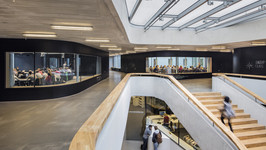
The lectures start at 19.15h in the Black Box on the ZF Campus of Zeppelin University. Audio recordings of the lecture series will be published in the ZU podcast.
Events in detail
| Tuesday, February 4: "On Immediacy" (panel discussion) Armen Avanessian, Karen van den Berg (professors at Zeppelin University) German
| Tuesday February 11: "Climate Counteraesthetics: Middling Mediations In A World Ablaze" Anna Kornbluh (Professor University of Illinois Chicago) English
| Tuesday February 25: "Inverted Charisma" Eva Illouz (Professor Hebrew University of Jerusalem, École des hautes études en sciences sociales, Zeppelin University Friedrichshafen) English
| Tuesday, March 4: "On Curating & Filtering" Mohammad Salemy (artist and curator, Berlin), Cécile Malaspina (directrice de program Collège International de Philosophie, Paris) English
| Tuesday, March 11: "Ban on pauses - On the expulsion of silence from music"
Joachim Landkammer (Zeppelin University) German
and
"Consensual Dissolution of Boundaries - On the Expulsion of Alienation from the Theater" Rahel Spöhrer (Zeppelin University) German
| Tuesday, March 18: "#nofilter" Tom McCarthy (author, London) in conversation with Armen Avanessian (Professor at Zeppelin University) English
| Tuesday March 25: "Day of the tweet or the clandestine mediality of hate" Dominic Brakelmann (Zeppelin University) German
and
"Space for utopia? Social virtual reality put to the test" Felix Krell (Zeppelin University) German
| Tuesday, April 01 "Complex Immediacies: Thinking about, thinking in, thinking with and thinking as" Jan Söffner (Professor Zeppelin University) German
| Tuesday, April 8 "Immediacy. Genealogy of a plausible desire" Hans Ulrich Gumbrecht (Stanford University, Hebrew University Jerusalem, Zeppelin University) German
Other articles
 07/24/2026
New Publication in the Journal of Organizational Behavior
The article "Rewarded to Reject? Exploring Motivational Roots of Idea Rejection in Teams" has been accepted for publication in the Journal of Organizational Behavior. 06/09/2026
New publication in Policy Studies Journal
Stefanie Rueß shows in the Policy Studies Journal that regional migration coverage influences job center decisions and welfare sanction rates. 05/10/2026
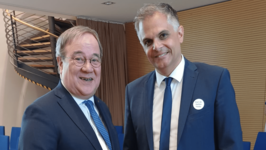
Europe Day with Armin Laschet, MdB, and Prof. Dr. Steffen Hurka
At the ceremonial event marking Europe Day at the Friedrichshafen Music School, presentations were given, among others, by Armin Laschet, Member of the Bundestag, and Prof. Dr. Steffen Hurka. 03/28/2026
Academy of Management Annual Meeting 2026
The ZEPPELIN-Chair for Innovation Management and Transformation is delighted to present results of its research activities at this year's Annual Meeting of the Academy of Management in Copenhagen. Two research reports will be presented at ...