What does a Europe that can hold its own in the global community look like?
At the start of the Lake Constance Youth Conference, the future viability of the EU is discussed. From the fight against right-wing extremism to the question of competitiveness - the discussion at the ZF Campus shows: Europe's unity is being put to the test, but the hope for a common strength lives on.
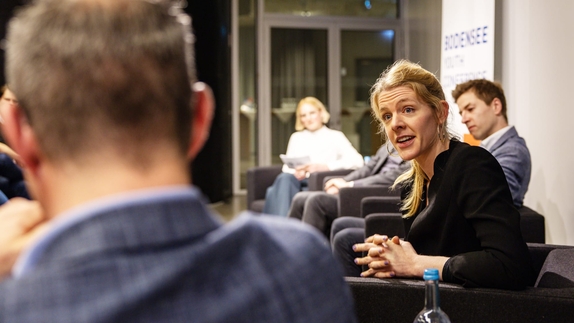
Leading figures from politics and business gathered at the Colsmann Forum at Zeppelin University last week for a panel discussion moderated by Chiara Trautner on the future of Europe as a business location.
Among the panelists were Prof. Dr. Steffan Reik from the SPD, Raimund Haser from the CDU, Kai Lücke from the ZF Group and Rebekka Müller from VOLT. Despite their different political and professional backgrounds, they were united by the common goal of developing strategies for a competitive Europe.
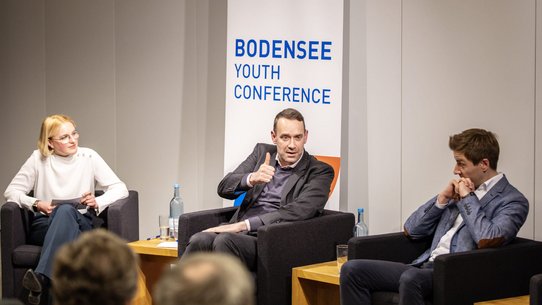
The debate, which began in a moderate tone, quickly gained momentum as the participants presented their specific views and solutions. Lücke put it in a nutshell: "Europe is learning to use its common strengths and power", a sign of the continent's progressive development.
At the same time, Müller, an alumna of Zeppelin University, made it clear that the idea of a return to the borders of nation states belonged to a bygone era, emphasizing the indispensability of European unity.
Reik added a critical note to this discourse by highlighting the principle of unanimity as an obstacle to the EU's ability to make decisions. The discussion revealed a variety of opinions, all of which, however, led to the conviction that far-reaching improvements are essential in order to master Europe's challenges. This improvement is the key to strengthening and further developing Europe's position as a dynamic and competitive player on the world stage.
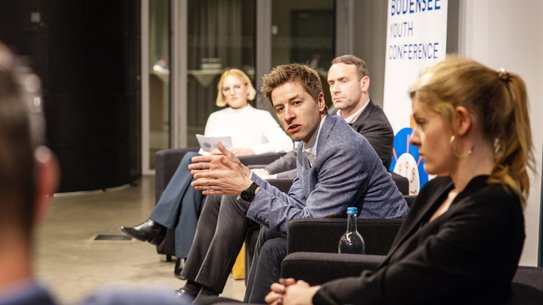
Brexit can be analyzed objectively
In an era in which the world stage appears ever more compact, the question of our European identity is becoming increasingly urgent. Against this backdrop, Reik reflected on the elusive benefits of the EU, a consideration made particularly concrete by Brexit.
From the macro level, the debate led back to individual perspectives and concerns about increasing protectionism, which was seen as an echo of the rise of right-wing extremism.
Here, at this focal point of social debate, a new consensus emerged: the absolute necessity of civil society involvement. "Our democracy is not indestructible", a sentence by Reik, became the emotional highlight of the discussion.
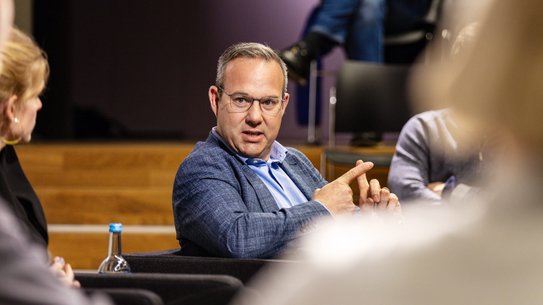
In this context, Haser warns against certain types of discussion: "Every debate on bans is an economic stimulus program for the fringes".
Despite some divergent views, the common goal of a strong, sustainable Europe remained. While Müller outlined the vision of an EU federal state, Lücke emphasized the need to pragmatically strengthen Europe's industrial base.
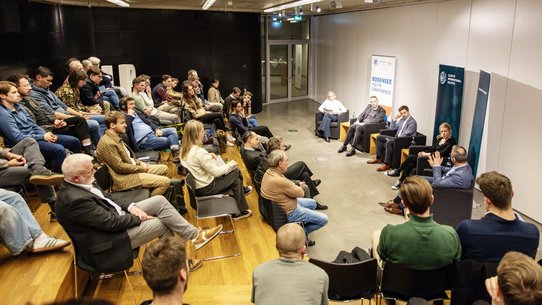
At the end of the discussion, there was a consensus among the participants that, despite its challenges, Europe can look back on a number of strengths that give cause for pride.
The panellists agreed on the urgent need to tackle current shortcomings, even if their approaches varied from calling for a reduction in regulatory barriers to the fundamental reform or modernization of institutional structures.
The whole discussion in the live video
More articles
 02/13/2025LifeGlobal Talk
Former ambassador Martin Erdmann on Europe's security in transition
In the Global Talk, Martin Erdmann shed light on the challenges facing NATO, transatlantic relations and Turkey's geopolitical role.- 10/08/2026LifeVillage Hub
Starting a business is a matter of practice
This year's Village Hub focuses on the question: If AI makes companies smaller, flatter, and faster—what skills do founders actually still need? - 09/28/2026LifePhoto Gallery
ZU Summer Festival, themed “Beyond borders.” featuring a diverse program and many guests
Zeppelin University opened its doors and invited anyone interested to meet, exchange ideas, and celebrate together.  08/17/2026LifeInvestor Summit Bodensee
Why Good Ideas Need the Right Connections
For founders seeking funding, the Investor Summit Bodensee is about much more than just a pitch on stage. After all, the most valuable connections are made afterward.