When feelings make politics: Iran between domestic crisis and world politics
How is the situation in Iran developing - and why is it so difficult to make predictions? At the RCDS discussion evening, Prof. Dr. Simon Koschut and ZU alumnus Manouchehr Shamsrizi will talk about how the regime, opposition and international actors are acting. It will become clear how fear, uncertainty and different narratives influence politics.
"Mixed feelings" - this is how Prof. Dr. Simon Koschut, holder of the Chair of International Security Policy at ZU, describes the mood that evening, especially in the Iranian diaspora: joy and relief at Khamenei's death, but at the same time sadness and anger at the many victims.
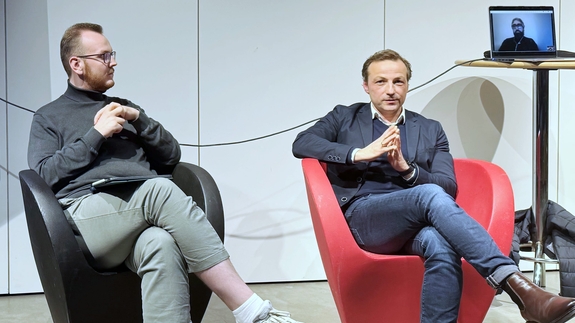
Manouchehr Shamsrizi, ZU alumnus and Associate Fellow of the German Council on Foreign Relations (DGAP), joins us via video. As part of the German-Iranian diaspora, he complements Koschut's analytical perspective with a view that is tangibly close to the experience of the Iranian people - and is presented in a correspondingly emotional, pointed and direct manner.
For Shamsrizi, the Islamic Republic is not a nation state, but a political project that wants to secure its religiously based order and export it to the world. Negotiations with the regime are also always a legitimization of the existing order. This is why the regime "ticks" differently than Western foreign policy often assumes.
To make this tangible, he explains the security structures: alongside the regular army, which is responsible for national defense, there is the IRGC Revolutionary Guard. It was set up after the revolution to protect the system - and, according to Shamsrizi, to carry this revolution to the outside world.
Iran and its "cognitive warfare"
A key term used by both experts is "cognitive warfare". This refers to the attempt to influence debates, reinterpret terms and steer public opinion. Shamsrizi explains that the regime is very good at immersing itself in discourse and turning it in its favor. He cites the description of criticism of the regime as "Islamophobia" as an example: when criticism is framed in this way, it is easier to delegitimize it. This is not just about arguments, but also about how emotions are addressed and channeled in the discourse.
Koschut adds to this point from a security policy perspective: Iran is trying to achieve a big impact with as little effort as possible - not only militarily, but also psychologically and economically. Images of drone attacks or ships under attack spread quickly, stick and are intended to create uncertainty. The idea behind this: If you create fear and uncertainty, you can influence decisions - among governments, companies, the public and people.
Controversy over international law
The question of international law comes up in the audience discussion. A ZU student asks both Shamsrizi and Koschut for their assessment of the actions of the USA and Israel - after all, it was an "illegal war of aggression".
Shamsrizi responded with strong criticism: the West had not taken its obligation to protect seriously for far too long. The norm had been adopted internationally - not just by the West. He then goes into more detail and asks: What has international law achieved for the people of Iran if the regime is simultaneously gaining influence in the UN system? In his opinion, there were all the signs of a humanitarian intervention in Iran.
Koschut puts the brakes on - and focuses on the rules according to which action is taken: Even if many may think the overthrow of a regime is a good thing - if you break the rules to do so, it has consequences beyond this one case. Once it becomes clear that rules only apply when they fit, they are easy to break again the next time.
That is why an action without a UN mandate, "without even trying" to get one, is a problem. If breaking international law becomes "okay" because the result is pleasing, a precedent is set - and the next time the result may no longer be pleasing. Then there is a threat of lawlessness.
USA, Europe: Who is acting - and who is standing on the sidelines?
For Koschut, a look at the international dimension of the conflict is also key. He describes the USA as an actor that is not only driven by strategy, but also by domestic politics: upcoming midterms and poor approval ratings increase the pressure to show strength in foreign policy. At the same time, he emphasizes a factor that is often underestimated in security policy debates: the emotional memory of the USA since the hostage-taking in Tehran in 1979/80 - a trauma that, according to Koschut, has "burned itself into US politics and society". In other words, emotions are also becoming a decisive factor in Western foreign policy.
And Europe? "We are once again on the sidelines," says Koschut about the role of the EU and Germany. Instead of shaping things properly, Europe is caught between evacuation issues and "defensive support". Europe is reacting more than helping to determine where the situation is heading.
However, Koschut remains deliberately cautious in his predictions. A regime can be shaken - and still continue to function. Large protests are not automatically proof that a system is toppling. The Iranian regime still has sufficient weapons and personnel at its disposal. In addition, according to Koschut's assessment, the opposition is not a unit and does not currently have the necessary means to actually overthrow the system, which he says is still "firmly in the saddle".
The discussion evening shows that it is not easy to predict how stable the Iranian regime is and how the situation will develop. But it sharpens our awareness of something that is neglected in many debates: security policy is not just a question of weapons, sanctions and agreements. It also depends on which emotions are mobilized - and which narrative ultimately carries the day.
More articles
 03/24/2025LifeGraduierung Spring 2025
Surprise speech by a proud father at the graduation ceremony: "Over the years, we have become ZU-ers ourselves"
ZU bids farewell to the class of Spring Semester 2025 at the gala dinner in the Dornier Museum. All the speeches are thought-provoking. The surprise speaker's speech is something for the heart. 10/08/2026LifeVillage Hub
Starting a business is a matter of practice
This year's Village Hub focuses on the question: If AI makes companies smaller, flatter, and faster—what skills do founders actually still need?- 09/28/2026LifePhoto Gallery
ZU Summer Festival, themed “Beyond borders.” featuring a diverse program and many guests
Zeppelin University opened its doors and invited anyone interested to meet, exchange ideas, and celebrate together.  08/17/2026LifeInvestor Summit Bodensee
Why Good Ideas Need the Right Connections
For founders seeking funding, the Investor Summit Bodensee is about much more than just a pitch on stage. After all, the most valuable connections are made afterward.