Augustin Renz: Juggler with three standing legs
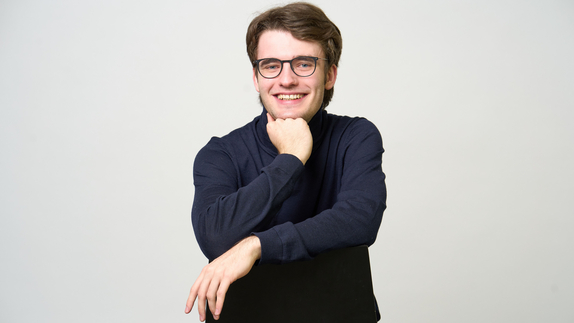
Augustin Renz enjoys the role of lobbyist. Whether in school or university politics, he sees it as his job to powerfully represent the interests of others, but also to mediate between interests. As a Bachelor's student, he combines the world views offered to him by sociology, politics and economics. Based on this, he ultimately searches for ways to solve current problems as a qualitative and quantitative researcher.
Augustin Renz grew up in the extended suburbs of Stuttgart. A region in which the Renz family business also has its postal address. The company, which was founded by his great-grandfather exactly 100 years ago in Kirchberg an der Murr, is very familiar with letter and parcel deliveries, as it manufactures mechanical and digitally networked letter and parcel box systems. "For as long as I can remember, the company has been an integral part of the family, but always in a positive and non-intrusive way," remarks Renz, whose father has been running the business for several years and has been instrumental in driving forward the Europeanization of the company. "My father knew how to introduce me and my siblings to the family business and allow us to participate in it without placing any expectations on us."
It was important to her mother to familiarize her children with the world of art and culture at an early age. "Regular visits to museums and concerts have led to me being particularly enthusiastic about classical music and opera to this day," mentions Renz, who describes himself as a passionate amateur violinist and lover of literature and art. However, this is only part of his range of interests: "Another hobbyhorse of mine was and is social, political and economic analysis." The trigger was a radio that he got his hands on at the age of ten. He flipped through the frequencies and got stuck on Deutschlandfunk. Years of excessive listening have left their mark. Even today, he knows the broadcasting schedule by heart - and: "I wanted to understand what I heard on the radio. That's why I also discussed the topics discussed on the radio with my family."
Sense of responsibility and willingness to contribute have always been present
Following a certain tradition in his family, Augustin Renz attended a Waldorf school - from the first grade right through to his A-levels. If something doesn't suit him or he encounters grievances, then for him it's not enough just to complain - he wants to call a spade a spade, get things moving and, at best, change them. "I've always had a sense of responsibility and a willingness to help shape things," explains Renz. Just like the tenacity to stick to goals once they have been set. If he was defeated in an election for class representative or on the state student council, he didn't hang his head and tried again. And his persistence paid off when he was finally elected class representative or member of the regional student council.
"Pointed and provocative, but also constructive": this is how Augustin Renz describes the basic program of the 15th State Student Advisory Council, which he was in charge of developing. The demands set out in it, for example for teacher grading, more everyday lessons or ethics instead of religion, generated a national media frenzy, with even the Süddeutsche Zeitung newspaper reporting on it. "It's not so easy to master the balancing act of wanting to be constructive on the one hand and having to be insistent on the other," mentions Renz. "Anyone who has experienced me on committees knows that I can sometimes be pointed and polemical. But I only do that to wake others up and get my demands across."
Before, during and after his A-levels, Augustin Renz knew that it would lead to an interdisciplinary degree. However, there was a very pragmatic reason - at least initially - why he chose a Bachelor's degree at ZU: if he had left the state of Baden-Württemberg to study straight after his Abitur, he would have had to resign from his position on the state student council. In order to carry this out conscientiously until the end of his term of office and to gain more clarity on questions of study choice, he took the Kompass course for a semester. "Because I liked the enormous intellectual breadth so much, I then deliberately opted for a Bachelor's degree in sociology, politics and economics. In my opinion, it's the links between the different ways of looking at the world that are incredibly stimulating and enriching," explains Renz.
From school to university policy
Deeply convinced by ZU, it wasn't long before Augustin Renz became actively involved in university politics. In the first two semesters, he sat on the Student Council as a representative for the Zeppelin Year. He also remained a member of this council overlapping and subsequently as PES program spokesperson - only now he was joined by the Faculty Council, the Program Council and the Teaching Council. "The first two positions gave me an insight and a feel for university politics and the relevant committees. But I also wanted to be involved in the highest university body, the Senate," reports Renz.
In the fourth semester, Augustin Renz was ready for the next step: the office of one of four student senators. "The committee work and coordination processes had taken on a much higher level with the new position. If we hadn't worked so well as a team, we would have reached our limits at times," says Renz.
Augustin Renz is not only multi-tracked in university politics, but also in his studies: from political philosophy and the history of economic theory to systems and organizational theory and quantitative methods. One topic that accompanies him throughout his studies is social housing. Starting with a Zeppelin project in which he looked at the future residential quarter in Fallenbrunnen Nordost in Friedrichshafen from a social perspective; continuing with a term paper in which he used data from the Socio-Economic Panel (SOEP) to investigate how the quality of housing and the living environment affect life satisfaction. "The topic of social housing interests me simply because the housing shortage is one of the central social issues of our time," emphasizes Renz, who has also gained insights into research as a student assistant over the past two years - first at the Chair of Political Science of Professor Dr. Joachim Behnke and then at the Chair of Sociological Theory of Professor Dr. Maren Lehmann. For the past year, he has also been a scholarship holder of the Stiftung der Deutschen Wirtschaft, a recognition of his student and voluntary work.
Semester at UC Berkeley also means a break from university politics
After six years of continuous involvement in school and university politics, Augustin Renz is now taking a break. For the past few weeks, he has been living and studying at UC Berkeley, where he is working on issues relating to populism, bureaucracy, social inequality and artificial intelligence. "It's an ambivalent feeling. On the one hand, I'm happy to leave university politics behind me for the time being. Also because I'm convinced that a change in personnel is always associated with a change in perspective, which is simply necessary from time to time. On the other hand, I am a little sad because there are so many ground-breaking things happening at the university at the moment that I would like to be involved in and help shape," comments Renz. And he adds with a laugh: "I already miss the microcosm of hyper-excitement."
What Augustin Renz will do after his studies is still open - but he has outlined three possible life paths for the more distant future: "I can either stay true to interdisciplinary science or join the family business after completing a Master's in Management. It is also possible that my path will lead from school to university to professional politics."
More articles
 11/14/2024PeoplePioneer of the month
Otmar Böss: "It's worth venturing into the unknown"
At ZU, Otmar Böss learned to simply do what is good for him and others - and experienced that it is worth daring to try the unknown.- 11/13/2025PeoplePioneer of the month
Gabriel Hoensbroech: Enduring more opinion
"Stand up for what you believe is right": Gabriel Hoensbroech takes this to heart in everything he does and says.  10/16/2025PeoplePioneer of the month
Jil Tischer: Do it yourself - but together
The dynamic and energetic environment at ZU encouraged Jil Tischer to think big and realize even bigger projects.- 06/26/2025PeoplePioneer of the month
Lara-Maria Mixdorf: On the path from plate carrier to sustainable entrepreneur
Studying sociology, politics and economics has given Lara-Maria Mixdorf every opportunity to pursue her dream of becoming a sustainable entrepreneur.