How does disinformation endanger our democracy?
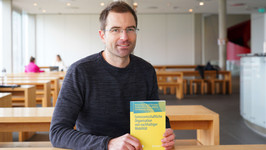
Freshly graduated from Zeppelin University with a Master's degree in International Relations & Global Politics | IRGP, ZU alumnus Leon Erlenhorst recently published a book. In "Putin's Attack on Germany - Disinformation, Propaganda and Cyberattacks", he and former German diplomat Dr. Arndt Freytag von Loringhoven, who has worked in Poland and Russia, explain how Russian propaganda works, why Germany in particular is in the crosshairs and how Germany can protect itself in the future.
How did your interest in the topic come about and how did you come to write this book together with Dr. Arndt Freytag von Loringhoven?
Leon Erlenhorst: Since my bachelor's degree in Berlin, I have been interested in the entanglement of media and propaganda. In the Culture and Technology course with a focus on philosophy, I found an excellent, interdisciplinary course that offered me a great deal of freedom. In this context, I wrote my Bachelor's thesis on ancient Chinese state leadership and its influence on contemporary indoctrination and propaganda. In general, I find it very exciting how information spaces are designed and what influence you can have on them.
I wrote my master's thesis at Zeppelin University on how propaganda generally works in today's media spaces. The key feature of our media public sphere structure is that there is no pronounced asymmetrical relationship between sender and receiver. There is simply an enormous number of senders. As a result, propaganda functions completely differently in this fragmented public sphere than it did before the age of social networks. Russia in particular knows how to exploit this new media playing field.
During an internship at a political and communications consultancy, I met Dr. Arndt Freytag von Loringhoven, who worked there as a senior advisor. My boss at the time encouraged Arndt and me to write a book about Russia based on Arndt's many years of experience and my Master's thesis. That's how the contact came about and the idea for the book project was born. In particular, the complementary nature of our two areas of expertise - Arndt as a former vice president of the Federal Intelligence Service and an expert on German and Russian politics and me as an expert on current digital propaganda - encouraged us to go ahead with our project.
How did you go about researching the book?
Leon Erlenhorst: There was a long research phase and discussions with a large number of experts. Arndt has held a number of positions in his professional career - including Assistant Secretary General of NATO, where he was responsible for intelligence cooperation. We were able to benefit greatly from his network.
We spoke to many high-ranking representatives of German politics and the German intelligence services. For example, there is a new working group at the Federal Ministry of the Interior and for Homeland Affairs that deals with hybrid threats. In addition to the domestic entities that deal with hybrid warfare, we have been in contact with the French state agency "Viginum" and the Swedish Agency for Psychological Defense, both of which were founded to identify and combat disinformation campaigns. Unfortunately, there is nothing comparable to these two institutions in Germany. One of our core demands in the book relates to the creation of institutional bodies in Germany that deal holistically with the topic of disinformation or, more precisely, Foreign Information Manipulation and Interference (FIMI). In addition to political and civil society actors and institutions, we also wanted to talk to representatives of Meta, TikTok, X and all the other platforms mentioned in the book. Unfortunately, we did not receive a single response to our inquiries.
And yes, after the research, you still have to write the book. That was a lot of long days and nights in the library.
From reading your book, we know that state disinformation is carried out by around 80 countries. What makes Russian disinformation so special?
Leon Erlenhorst: First of all, you have to distinguish between advocating a point of view and disinformation. The former happens in the competition of free opinions and must therefore be categorically distinguished.
There are other autocratic states that use similar methods to Russia, such as China. Nevertheless, disinformation from Russia is currently the most serious in Germany. If you now ask yourself how disinformation from Russia differs from that of other autocratic states, you can say on the one hand that there is a certain standard toolbox that is no different. What makes Russia special is the particular quality of this toolbox. Moscow has perfected propaganda strategies over decades and has not stopped weakening the West with the weapons of information manipulation since the Cold War. We are completely underestimating the new intensification of this digital attack.
Incidentally, the concept of disinformation was invented in the former Soviet Union in the context of the KGB. At that time, the term was introduced as a method attributed to the Western capitalist media. The invention of the term itself was therefore already disinformation.
Why do the narratives from Russia find fertile breeding ground both there and in Germany?
Leon Erlenhorst: That's a big question. Many factors play a role in why people believe what they believe. In Russia, you have to bear in mind that state propaganda has a long tradition. Media control and censorship have been a constant feature of Russian territory for decades.
The situation in Germany is different. Although we have also had experience with a totalitarian state that ran propaganda and regulated information, we now live in a pluralistic, liberal society. At present, factors of insecurity play a significant role. The psychology of propagandistic means is explained in more detail in our book. It is highly complex and multi-layered. In short, it can be said that propaganda is most effective where people feel left behind and unappreciated.
The breeding ground for propaganda and disinformation is particularly strong in Germany, as many parts of the population do not feel represented by local politics for various reasons. Conspiracy myths in particular - which must be distinguished from propaganda and disinformation, but often go hand in hand - offer what is known as epistemic anchoring because they are self-contained thought constructs in which it is very clear what is true and what is not, who is good and who is bad.
The Germans' supposed expertise on Russia also leads to a distorted picture of Moscow's intentions. For years, so-called Russia experts sat on talk shows and spoke apologetically about Putin's machinations, some of whom were paid directly by Russia.
Are there areas in Germany where we are exposed to manipulation that we may not even know about or be aware of?
Leon Erlenhorst: Yes, there are. Above all, you have to understand that the campaigns from Russia are not just aimed directly at people's political positions and attitudes. I follow many propaganda channels on Telegram every day, and it is very exciting to see that these channels also target completely non-political areas. It is reasonable to suspect that there is a tactic behind this. In principle, every area in which people are emotionalized offers a suitable breeding ground for gradually introducing narratives that benefit one's own politics. Be it Russian cooking recipes, esoteric topics or vaccination fears.
The Gaza war is another area in which massive manipulation is being carried out by the Russian regime. You might ask yourself: what does the Gaza war have to do with Russian interests? Positions on both sides - pro-Palestinian and pro-Israeli - are being reinforced. The general aim of the manipulations is to reinforce differences within our society. The aim is to take away any chance of productive debate. On Instagram, for example, pro-Russian and anti-Semitic narratives are spread to more than 250,000 subscribers via the "redstreamnet" account. The account always focuses on the handling of the Gaza war in Germany and the German protest movement.
In addition, there are a variety of topics on which Russia manipulates our information base. Be it migration policy, Covid19, the AfD, the BSW, the Ukraine war, gender debates or so much more. Explaining all of this would go beyond the scope here.
In your book, you distinguish between the primary effects of propaganda (what does the false report do in terms of content?) and secondary effects (what loss of trust does this false report cause in the leading media and democratic institutions?) In your opinion, which effect is the stronger?
Leon Erlenhorst: First of all, it is important for me to say that in our country and protected by our constitution, every citizen has the right to consume any information narrative they like. We must not make it our goal to prohibit people from having certain points of view. It should never be about that.
With regard to the primary effect, it can be said that the problem is not that an individual spreads a false report on social media, but that tens of thousands of automated bots structurally manipulate the information space by fabricating millions of inauthentic posts every day. The sheer quantity is a huge problem. When it comes to this strategic, mass manipulation of information, we need to stop these mechanisms. This primary effect takes away people's ability to make decisions based on facts. Election results are certainly influenced by this.
However, it is probably the secondary effect, i.e. the loss of trust, that causes the greater damage. In the long term, faith in social cohesion and our liberal ideals is lost. However, this is more difficult to observe because it happens more slowly.
In your opinion, what is the most important message of your book?
Leon Erlenhorst: The intention of Russian manipulation is to weaken our democratic values, to weaken the West in general. Any ignorance and any ignoring of this strategic, everyday and all-encompassing manipulation will lead to a further increase in the damage that is being done. It is imperative that this threat be seen as a matter of national security. It cannot be dismissed as something that happens in the digital space and has no effect in the "real" world. It is a major threat. The only way to tackle it as a whole is to raise awareness of it and then introduce targeted countermeasures, which we have developed in our book.
More articles
 03/12/2026ScienceGuest article by PD Dr. Martin R. Herbers
Kick-off without a blueprint: What the state election in Baden-Württemberg reveals about the super election year 2026
After the state elections in Baden-Württemberg, the search for the "great lesson" begins. Is it just a revealing prelude or even a blueprint? 12/16/2025ScienceMobility cooperatives
Better to share than (not) own
Innovation researcher Matthias Weiss talks in an interview about the potential, opportunities and challenges of mobility cooperatives. 11/25/2025ScienceDigital technologies in communication
Trust is about understanding
PD Dr. Martin R. Herbers explains how the digital transformation is challenging our democracy and how communication science can meet this challenge. 01/28/2025ScienceDemocracy and the Office of the President
Pen strokes and felt-tip pens for the people
What we are currently seeing in the USA shows how populism imagines political leadership and problem solving.