Diving, flying, researching: How ZU's new VR lab is pushing the boundaries of reality
ZU's new virtual reality laboratory invites students to experience virtual worlds, develop their own projects and help shape the future of education. But how can students use the lab for themselves?
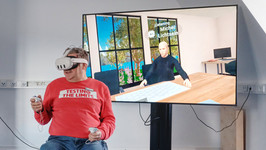
A small, blue UFO flies through the ceiling and lands on the table in front of me. The seminar room, previously inconspicuous with tables, workstations and shelves full of technical equipment, suddenly transforms into a stage for a completely new world. A purple universe shimmers through the hole in the ceiling through which the UFO had just flown in, plush aliens storm towards me and I shoot them down with some kind of futuristic weapon. Minutes later, the room is riddled with holes like Swiss cheese, and Professor Raphael Zender laughs with amusement as I take off my VR goggles. Welcome to the Immersion Lab at Zeppelin University - a place where reality and virtuality merge.
The Immersion Lab, an initiative of Prof. Raphael Zender, combines modern virtual reality technology with research and teaching. Immersion refers to the immersion in an environment or an experience in which a person is completely absorbed by the experience and largely blocks out the real world. Zender, a computer scientist and head of the ZF Endowed Chair for Virtual Reality Systems, focuses his own research on the question of how VR can be used in education. His goal for ZU is to offer students and researchers a platform to experience immersive technologies, develop their own projects and think beyond the boundaries of disciplines.
Simulations in themselves have always existed, he explains, but virtual reality allows us to train things in a way that was hardly possible before - for example, social skills. The lab already offers a variety of applications, including courses that teach the basics of VR. In future, the range is to be expanded, for example with courses in which students can program their own virtual worlds.
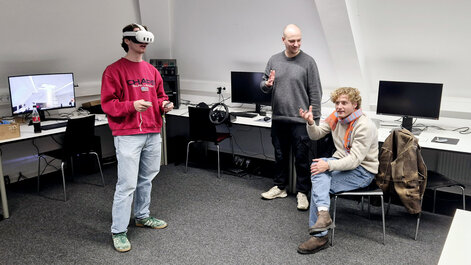
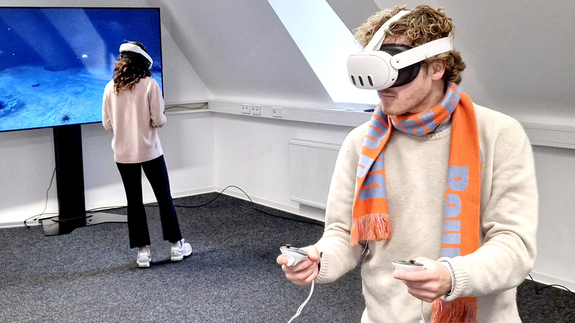
During my visit, I get to explore different virtual realities myself. While in the world of the aliens I can still see the real space I am in and the other people in the room are also included in the world infested with plush aliens, in other games you can immerse yourself completely in a new reality that is generated entirely virtually. For example, deep into the ocean. In this simulation, I can swim with various sea creatures. Both the animals swimming around me and the rest of the underwater world, including coral reefs, shipwrecks, shells and rock formations, are close enough to touch and seem incredibly real. The only thing I didn't do was get wet. However, there are also curious moments in this virtual world: my brain sees the water around me and wants to swim, but my legs move normally - an unusual contradiction, but one that my body seems to get used to quickly.
The new VR technology at the university will be available to students in particular. They can use the Immersion Lab for courses and research projects as well as privately. At the moment, the department offers courses that teach the basics and possible applications of immersive technologies such as virtual and augmented reality. However, this offering is to be expanded in the coming semesters: Courses are planned in which students can learn to program their own virtual realities. They will also be encouraged to think beyond the boundaries of their own discipline and explore the interactions between VR and other subject areas.
The brain plays along surprisingly well with virtual reality
Even though the lab is still new and in the start-up phase, it already offers an exciting place to try out VR glasses and get to know the various applications. The fun factor should not be underestimated: Immersing yourself in virtual worlds and experiencing games on a whole new level is not only a lot of fun, however, but also opens up new perspectives. It is just as entertaining to watch others move around in virtual reality - with the VR headset on their heads, they flail around awkwardly or walk aimlessly through space like blind chickens - immersed in their own world, be it swimming with sea turtles, floating through the solar system or balancing on a narrow plank at a dizzying height.
The effect of the virtual world is particularly impressive in this very exercise. I suddenly find myself balancing on a narrow plank that seems to be attached to a skyscraper at a dizzying height. Although I know that I am only a few centimetres above the floor of the seminar room, I find it incredibly difficult to take a step forward. My heart is racing, my hands are getting sweaty - and stepping into the void feels like a real leap from a high tower. Even though I land safely in the seminar room after the "jump", my body instinctively prepares itself for the virtual impact. Impressive proof of how deceptively real VR works on our instincts.

Prof. Zender explains how this instinctive reaction can be used far beyond games. For example, in paramedic training or in teacher training: teacher training students often only have minimal contact with real classrooms. VR could be used to simulate such situations realistically - including disruptive factors that are often very difficult to simulate in real life and to which they have to react accordingly.
In future, ZU students will have more opportunities to use the lab for their own projects. A recent survey will help to find out which technologies are most relevant and bring the most added value to users. "We hope that people will come here to use the lab for their ideas," says Zender. "We can advise in all areas and want to encourage inspiration across different disciplines." The long-term plan is to integrate the Immersion Lab more closely into research. Students will be able to use it for their Bachelor's and Master's theses as well as for research projects. At the moment, the focus is still very much on games, which Zender certainly supports. Nevertheless, the aim is to increasingly use VR as a tool for scientific work and as a research subject.
More articles
 12/01/2025ScienceApplied science
AI and VR help job center advisors practice difficult conversations
ZU students have used VR and AI to simulate job center consultations. The Friedrichshafen case managers are enthusiastic about the potential. 09/21/2026ScienceThree Questions for Simon Koschut
Security. Europe. Responsibility.
How Europe's security order is changing, what role transatlantic relations play in this process, and what responsibilities academia and universities bear in a new security landscape. 07/16/2026ScienceThree Questions for Anja Achtziger
More Than Just Studying. Motivating. Making Decisions. Taking Responsibility.
Why Zeppelin University emphasizes judgment, responsibility, and interdisciplinary thinking, and why these skills are more important than ever before. 06/25/2026ScienceInternational Spring School
Conflict as a Resource for Cultural Policy
Young cultural policy makers from around the world gathered at ZU. They discussed spaces for negotiation within cultural institutions through pluriversal participation and conflict resolution.