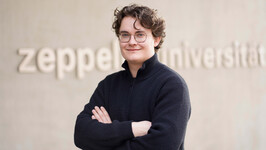
Starting out as a documentary filmmaker has become more difficult, but filmmaker Max Langfeldt gives tips on how to succeed
Max Langfeldt began his professional career with a degree in humanities and arrived in the film industry via detours. He teaches documentary film at ZU.
Let's start at the beginning to get to know you. Do you remember the first video you made yourself?
Langfeldt : The first video I made was during my studies at Humboldt University in Berlin, around 2007 or 2008. At the time, I attended a documentary film seminar with Professor Christina von Braun - that was part of my cultural studies course. The seminar lasted two semesters, and in the second part we did practical workshops, including on camera work and editing. That's when I filmed myself for the first time.
It was exactly during this transition period from analog to digital. Back then, we filmed on mini DV tapes - that was already HD, but still on cassettes. We then had to transfer them to the computer in real time in order to be able to edit them digitally. This meant connecting the camera, pressing play and then the material was recorded in real time. It was all quite complicated back then.
But looking back, it's of course exciting that I got to know it like that. In any case, that was the first time I understood that filmmaking was a profession that I could achieve with my degree.
And the fascination for filming was so great that you then wanted to do it professionally?
Langfeldt : It took me a long time to figure out what I actually wanted to do with my studies. As a humanities graduate, you often have exciting topics, but the question remains: how does that translate into a career? It helped me a lot to get a concrete perspective - that there are actually professions that are related to my studies and that interest me. Photography was an early topic for me: my mother gave me an analog camera when I was six, which I still have today. Since then, I've actually always taken photographs and pictures.
After the seminar with Christina von Braun, I bought a camcorder myself, which I simply took with me on my semester abroad. I then made my first short documentary film as part of a project for the German embassy in Havana. In 2010, I was even able to edit a journalistic publication for Zeit Online - that was the starting signal for me. After that, it was clear that I wanted to go in this direction.
Of course, I also took some detours: Press work, applications to journalism schools, traineeships. But I quickly realized that I wasn't interested in pure press work - I didn't just want to report on what others were doing, I wanted to work creatively myself. Storytelling with a camera, editing and design just felt more right to me. So I started producing videos for cultural institutions and RBB at the same time and eventually applied to a production company.
Does that mean that a degree in the humanities, which is actually theoretical, is also a good way to start a practical career in the media industry?
Langfeldt: I think in the end it all depends on what you really want to do. If you want to go in the direction of film and documentary, you will benefit greatly from studying content - whether in the humanities or in another subject. This is because it teaches you to understand complex topics and translate them so that you can tell stories later on. For longer formats and storytelling, I think it makes a lot of sense to study content. If you're more interested in traditional journalism, you can also take the direct route via journalism schools.
Of course, there is a lot of pressure on the market today: you have to get into journalism schools and traineeships young, which is not always easy. I myself have found that it is often helpful to have completed a degree beforehand. It's also common at film schools for applicants to have studied something else beforehand and therefore have experience and a certain maturity. I still think that makes sense, especially because it helps you to develop your own content with substance. At the same time, it's important to simply get started yourself - with today's technology, it's possible to implement your own projects early on, whether through internships, production companies or your own experiments.
However, if you want to get more into traditional journalism, the route via journalism schools and broadcasters remains an option. However, the market has become more difficult: After a boom due to the streaming wave, less is being produced today, especially smaller formats in the public service sector. The hurdles for newcomers are therefore higher than they were a few years ago.
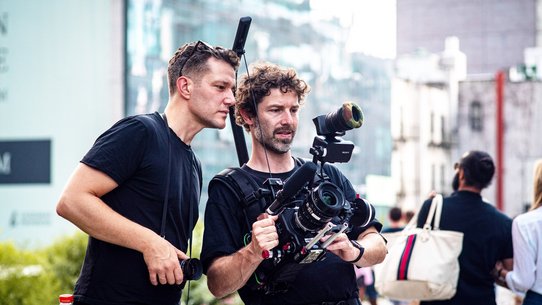
Documentaries are no longer just a supposed "objective depiction of the truth"
There are also changes at the public broadcasters. Traditional documentary channels are to be abolished. There is less money and less airtime.
Langfeldt : I started out as a junior editor and author for formats at ZDF Kultur - e.g. ZDFkulturpalast with Pegah Ferydoni. Our editorial team was also nominated for the Grimme Award for this program. It was an exciting time because the channel was trying out lots of new formats and young people were given a platform. Unfortunately, the whole thing was later discontinued due to cost-cutting measures and the fresh approaches disappeared again. That was a real shame. But then later came "Funk" - which actually made more sense because content was brought to where young viewers actually are: on YouTube or social media. But the industry and the media market really are constantly changing.
When I went freelance in 2017, it wasn't at all clear whether there was still a future for documentaries in Germany. Back then, there were almost only two types of productions: on the one hand, these classic history documentaries or edited news sequences, and on the other, the long-established documentary filmmakers who had been working for certain broadcasters for decades. These were people who could afford to put a lot of time and effort into a new project because they already knew where they could place their films, because they were firmly established in the system. Apart from that, there were really only older formats such as "Terra X", which had already been around for decades. There seemed to be few opportunities for newcomers or younger filmmakers at the time.
With the advent of streamers, a whole new field has opened up for me: Early Netflix documentary series like "Chef's Table" demonstrated that documentary film could also be cinematic storytelling, with much higher standards of visual design, and that you could also reach a young audience. I was lucky enough to slip right into this development. One of my first projects as a freelancer was "Streetphilosophy" for Arte, produced by the small Berlin company "Weltrecorder". It was an unusual black-and-white format that recognized early on that there was room for something new: Young people in their early 20s asked big philosophical questions and sought the answers from late-night sales clerks as well as real philosophers. The film was shot digitally, but with old vintage lenses, which gave the whole thing a special look. The production even won the Grimme Award, and for me that was an important starting point from which many other projects emerged. The big media library boom also began during this phase: suddenly the broadcasters no longer just wanted to show secondary exploitation, but wanted to produce their own content - similar to the streamers. That was a huge opportunity, even if the situation has since changed again.
Today, as with the streamers, less content is being produced overall, but it is still of a higher quality. It's difficult to say exactly where the documentary market is heading. But one thing is clear to me: documentaries are no longer just a supposed "objective depiction of the truth". It is a cinematic genre that tells stories - close to life, but also open to narrative means and a certain overlap with fictional storytelling.
What would you recommend to young people who would like to start a career as a documentary filmmaker?
Langfeldt: Well, the question of how to get into the industry is really difficult. I think you perhaps need a bit more courage and determination these days. Simply because the hurdle between training and career starters and the projects on offer on the market has become bigger. One possible way would be to go to a film school with a good network, such as the DFFB in Berlin or the one in Ludwigsburg, after training or studying the content. If you get in through advertising or fiction, you can gain a foothold in the industry at a relatively high level through the contacts you have made. From there, the path to other formats, such as documentaries, is easier.
The other way would be to get into a production company or a broadcaster through your own practical experience. So first a degree in a content area, then your own projects, then an internship or traineeship at a TV station or newspaper. In this way, you can slowly work your way into the documentary world via traditional TV journalism.
In the end, in both cases it's about gaining experience and building up contacts so that you can pitch your own projects at some point. I don't think there is a one-size-fits-all approach. As I said, everything is constantly changing - even more so now with AI. I myself was a career changer. And if you know exactly where you want to go, it can still work today.
How do you deal with the use of artificial intelligence as a documentary filmmaker?
Langfeldt: Well, I think it's about making yourself an expert in the use of AI tools to improve your own product. It makes you more efficient and faster. But only if you know how they work. And by that I don't mean how they are used in practice, but how they get their results. You can of course use AI for research. But, in the spirit of enlightenment, you always have to critically question and understand the results and the tools and always use your own mind - for example, always check the sources of AI chatbots.
But I also experimented early on with visual tools such as Midjourney and Runway and created storyboards as well as backgrounds for interviews and the like. The real core skill is to shape a good story out of a complex topic. You have to make yourself irreplaceable by doing things that an AI can't do. For example, the ability to link different complex topics and questions together. Or to use a supposedly simple anecdote as the key story to a much bigger question and so on.
As a humanities scholar, I can work my way into anything - whether it's semiconductor technology for an interview with a physicist, the biology behind plant-based food for a documentary about the food of the future or an interview with an engineer about carbon capture. So the message is: we must not rely on the "busywork" or junior positions that AI will take on. Instead, we need to be able to act on a meta-level, to be a bridge between the AI and the end product, so to speak. Incidentally, this applies not only to the media industry, but to most other professions as well.
More articles
 05/21/2026PeoplePioneer of the month
Max Baier: Between bakery and library
Max Baier is studying for a CME Bachelor's degree at ZU. And has learned something new: Just like in the bakery trade, you also have to penetrate the subject matter in business studies in order to understand it.- 09/30/2026PeoplePioneer of the Month
Ferhat Cicek: With Foresight into the Wide World
With an inquisitive nature and an extensive network, Ferhat Cicek set out from Lake Constance into the wider world—to Singapore, Doha, Istanbul, New York, and Washington, D.C.  08/26/2026PeoplePioneer of the month
Hannah Hartenstein: In Tune with a Culture of Empowerment
For years, Hannah Hartenstein worked behind the counter at the student café “Beton & Bohne”. At the same time, a unique interest began to take shape: an interest in the economic side of the healthcare system. 07/15/2026PeoplePioneer of the month
Leon Löchle: Life in a Highly Frequented Area
For Leon Löchle, getting involved is as much a part of life as the air he breathes. It means a great deal to him to stand up for others or to help them have a good time.