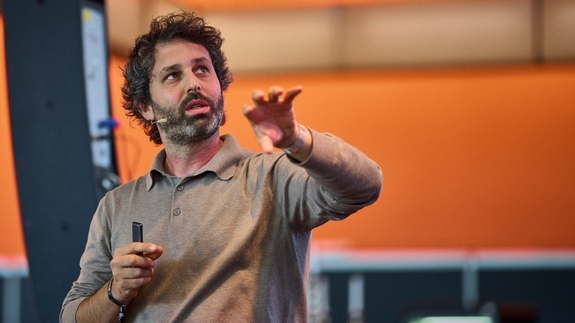
Steffen Erath: It's all about entrepreneurial viability
Sustainability is not a matter of opinion for companies, but a question of self-preservation. Steffen Erath, Head of Innovation at the Hansgrohe Group, comes to ZU's Transcultural Leadership Summit to reignite enthusiasm for sustainability issues.
Mr. Erath, you deal with sustainability. How did you come to this topic yourself? Through work, i.e. through the Hansgrohe company, or was it a topic that you wanted to research beforehand?
Erath: I've been working in the field of innovation for 20 years. In other words, I would describe my own focus as innovation. And innovators love nothing more than relevant problems. On the user side, however, the problems are just running out. And that's why the field of sustainability came up for me. I also believe that we have much bigger social and planetary problems than user problems. The aim should be to solve these major problems. As an innovator, there is no way around sustainability. However, my solution approach is not aimed at defending, i.e. minimizing risk. Instead, I see sustainability as an opportunity and adopt an attack strategy, so to speak. With the aim of doing good and doing business. I think you can combine the two. If we manage to do good with innovation, then suddenly the lever of the market economy becomes our biggest transformation lever. For me, that's the core and that's why innovation and sustainability go hand in hand.
Hansgrohe's "Green Vision" aims to reduce energy consumption in bathrooms and kitchens by 90 percent. When I think of energy, I always think of wind turbines and solar panels, but not my own washbasins. Do we still have some catching up to do?
Erath: Definitely. We have a water crisis, an energy crisis and a climate crisis - and the bathroom contributes to all three issues. When it comes to water, we will have 40 percent more demand than supply by 2030. In southern Germany, we have lost groundwater the size of Lake Constance over the past 20 years.
Where do you learn to really appreciate the value of water? It's in the bathroom, when you shower every day, when you brush your teeth. We need to raise the value of water again. That can't be done through the price. 1000 liters cost 5.50 euros. With this concept bathroom, we want to show that it is possible to save 90 percent of energy, CO2 and water and still feel good. That they can still enjoy going to the bathroom, taking a shower and brushing their teeth and save another 500 euros a year. Nobody can have anything against that.
Away from "competitive advantage" towards "collaborative advantage"
Is sustainability now a business model at Hansgrohe?
Erath: I believe it is the basis of every company. After all, the aim is for the company to still exist the day after tomorrow. It is therefore a question of entrepreneurial viability. That's why we have to leave out this dogmatic and political sustainability - ESG (*Environmental, Social and Governance) and CSRD (*Corporate Sustainability Reporting Directive). In the end, sustainability is nothing more than the radical and consistent application of common sense. The commercial duty of care requires every entrepreneur to operate sustainably.
This idea motivated me to write a book and develop a methodology called "Planet Central Innovation". Of course, we are already trying to apply this at Hansgrohe. But it will only work if everyone is moving in the same direction. So we have to move away from "competitive advantage" to "collaborative advantage". In other words, if we want to save water but the pipeline suppliers end up flushing the pipelines with fresh water. Again, we haven't learned anything systemically. We need to take an ecosystem approach to the issues. Then we will also be better off as a society as a whole and businesses will be able to generate growth.
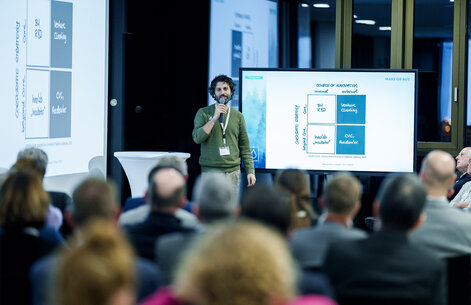
The Transcultural Leadership Summit (TLS) will once again take place at Zeppelin University in November. The basic idea is to approach topics from different perspectives and cultural and linguistic areas. If you want to do business internationally, you have to understand how others see your business. How does Hansgrohe, which operates internationally, bridge the cultural barriers?
Erath: We sell our products in over 140 countries around the world. We experience the global North with a lot of water consumption. We have to save here. However, there are also many regions in the world where there is still too little water, which requires a different cultural understanding. It would make no sense to reduce water consumption in countries where the average water consumption is 20 liters per person per day. A decent life requires more like 50 liters per day. Perhaps we don't need 127 liters in Germany, but less than 100 and more than 50. These are two different problems and require different understandings. And not the assumption that the global North knows how to solve the problems of the global South. For example, if we say to the Global South "Don't drink dirty water", it's like them saying to us "Don't eat such greasy food". Although we know our own problems, we do it anyway.
We currently have a project in the global South. It's not about selling water filters or kettles. Rather, we want to enable people to master their everyday lives, to offer dignified hygiene so that people have time to take care of more important things in order to raise their own standard of living. But that only works if you do it locally and find out from people what they need. This is the only place where innovation works - especially social innovation. The aim cannot be to offer a soda from us 10 euros cheaper. It's to develop the soda they need there. But to do this, we have to be on the ground. There is no other way.
Sustainability currently defined too much as a referee discipline
What will you be focusing on at the TLS in November? Would you like to give an outlook?
Erath: I'm introducing sustainability as a field of innovation. I am interested in reframing sustainability. That we look at it from a different perspective, also interculturally. We're not going to look at the sustainability problem from the perspective of sustainability managers, but from the perspective of innovators.
We suddenly have a completely different setting, a completely different game. And I maintain that more people want to play this game than the previous one. It's a bit like when referees try to play soccer. Referees are good at setting the rules. But those who play are usually not referees, and I think most people want to score goals and not follow soccer rules. In my opinion, sustainability is currently defined too much as referee discipline. In my opinion, that's the reason for "green fatigue". I want to counteract this. Not with ideology and a warning finger. But in a very rational and opportunistic market economy way. I am convinced that this is the only way to achieve a majority at the moment. We need majorities in our democracy, otherwise nothing will change.
More articles
 08/26/2026PeoplePioneer of the month
Hannah Hartenstein: In Tune with a Culture of Empowerment
For years, Hannah Hartenstein worked behind the counter at the student café “Beton & Bohne”. At the same time, a unique interest began to take shape: an interest in the economic side of the healthcare system. 06/26/2025PeoplePioneer of the month
Lara-Maria Mixdorf: On the path from plate carrier to sustainable entrepreneur
Studying sociology, politics and economics has given Lara-Maria Mixdorf every opportunity to pursue her dream of becoming a sustainable entrepreneur.- 09/30/2026PeoplePioneer of the Month
Ferhat Cicek: With Foresight into the Wide World
With an inquisitive nature and an extensive network, Ferhat Cicek set out from Lake Constance into the wider world—to Singapore, Doha, Istanbul, New York, and Washington, D.C.  07/15/2026PeoplePioneer of the month
Leon Löchle: Life in a Highly Frequented Area
For Leon Löchle, getting involved is as much a part of life as the air he breathes. It means a great deal to him to stand up for others or to help them have a good time.