Studied, founded, awarded: ZU alumnus Thorin Wäschle remembers the founding of HALM
HALM wants to bring sustainable construction to the masses. The ZU alumnus' company was honored with the KfW Entrepreneurs' Award for its idea of working with natural resources.
Dear Thorin, let's start at the beginning: When did you study, what did you study and why did you study at ZU?
Wäschle : That's a good question, I'll have to think about it for a moment! Well, I studied at Zeppelin University on Lake Constance between 2012 and 2016. I actually started with the Corporate Management & Economics (CME) course. The idea at the time was: business is the engine, business moves and changes the most. That just sounded like the most important thing.
The first two semesters were great because Zeppelin University has a very broad focus - that was also a reason for my decision, because I wanted to get a taste of other areas. I then realized that my interests quickly went in a different direction. As early as the third and fourth semester, I chose my courses in such a way that I drifted strongly in the direction of Sociology, Politics & Economics (SPE).
I then officially switched to SPE in the fifth semester. The reason was clear: what really grabbed me was not pure microeconomics or the strict economic models. It was the interfaces. Courses like 'Money and Markets', where a connection was made between sociology, politics and economics and you could see the whole thing in a wider context. That was incredibly fun and satisfied my curiosity.
This macro perspective on the overall system was really the cool thing about SPE. Sure, I always found entrepreneurship exciting too - that's probably why I'm self-employed - but this broader view was simply a benefit. Incidentally, I later heard that this switch from CME to the broader study programs like SPE was not so rare there! The broad offer was simply very tempting.
Your training has a lot to do with theory. But you deal with house construction. How did you get from the blackboard in the lecture hall to the straw in the house wall?
Wäschle: After my Master's degree, I had had enough of theory and science. The turning point came when my two brothers and I ended up on a huge 14-hectare estate by chance - our uncle had bought it unseen at auction. The brothers are craftsmen and architects. That brought me back to my master's questions: how do forms of land use that are oriented towards the common good work? We thought a lot about cooperatives in order to organize ourselves away from traditional structures.
We started practically: Refurbishing buildings and organizing workshop festivals in the summer that mixed crafts, art and theoretical discussions about property.
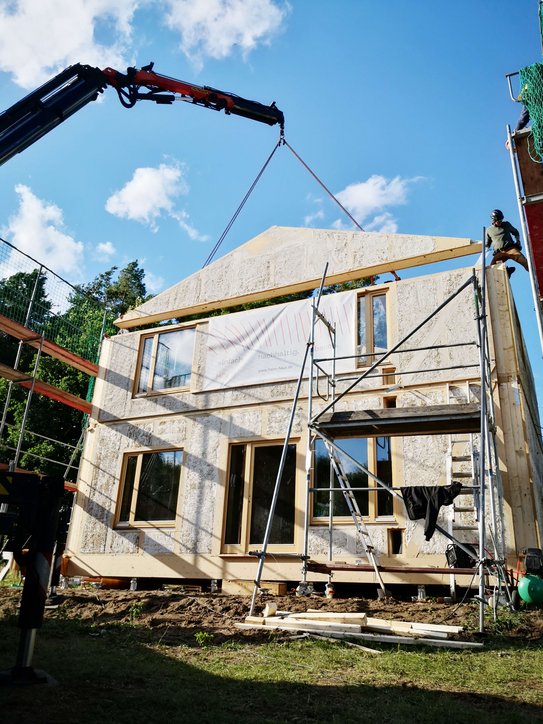
Based on our background in architecture and our experience in ecological construction, we came up with the idea of setting up a production facility for sustainable prefabricated houses. This would create the economic basis for the place. Building was a shock for me when I saw the figures: two thirds of CO2 emissions and 80% of waste are caused by construction. And then there was a construction method that does exactly the opposite: we bind around 20 tons of CO2 in a detached house, using rapidly renewable, recyclable raw materials.
There are big differences in the construction industry: a lot of high-tech, but also a lot of stone age. Ecological construction in particular was often limited to participatory building sites (e.g. straw construction) and therefore not suitable for mass production or easy to buy. We saw an opportunity to change this.
Did you already have the idea of starting your own business during your studies? Or did that come later?
Wäschle : During my studies, I had founding a company as an option in the back of my mind, but it wasn't a firm plan. I wasn't just waiting to get away from university to get started straight away. It came more from the specific project here on the estate. Everything suddenly fell into place: the project, my desire to get really involved and, above all, the right people. We were six founders in total, including my two brothers, and had been working intensively on it for two to three years before we officially founded the company.
Incidentally, in the time between university and founding the company, I worked in a small GGmbH, a foundation, the FINC Foundation. It was all about these issues: Land use for the common good, organic farming and networks. It was a very small, agile structure that my boss had founded himself because his old organization was too sluggish for him. He was a 'common good entrepreneur', so to speak. That inspired me a lot.
Once the project with the right people and this specific idea was here, it was clear: now we're going to do it!
What was the founding process like for you?
Wäschle : The founding process was not a headlong rush. We had a longer pre-foundation period; we didn't take the full risk. For example, I was still half-employed by my foundation. We only officially founded the company with the first order and then gradually built it up over time.
But the first two years were bumpy. We were caught in the middle of the interest rate shock in the construction industry. Out of six planned projects, there was suddenly only one left - that was tough! Fortunately, we only had one permanent employee on top of us at the time; today we already have 15 people.
My part wasn't building, we have master carpenters and architects for that. I was heavily involved in funding acquisition and financing and had to get to grips with all organizational areas, from HR to structure. I definitely took this agility and the ability to quickly familiarize myself with new, complex topics and combine short-term decisions with a long-term vision with me from my studies. I also learned how to confidently convince others, whether for funding applications or awards - that was a great school at university!
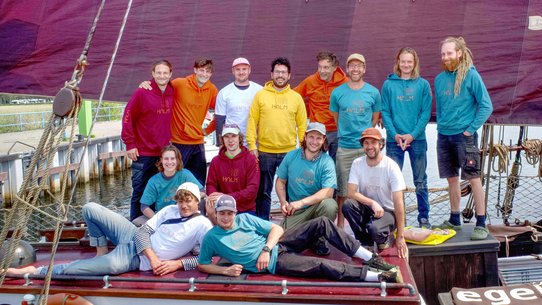
Your company is called HALM. What exactly does HALM offer?
Wäschle: In principle, Halm offers a 'shell plus' that is as sustainable and healthy as possible. The special feature is the prefabrication and assembly service.
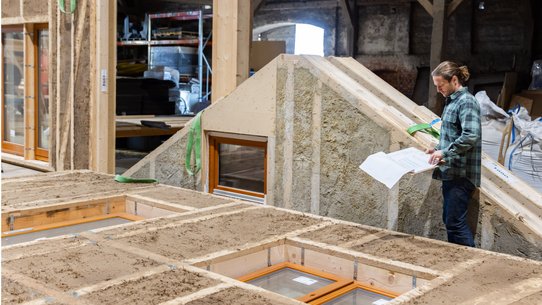
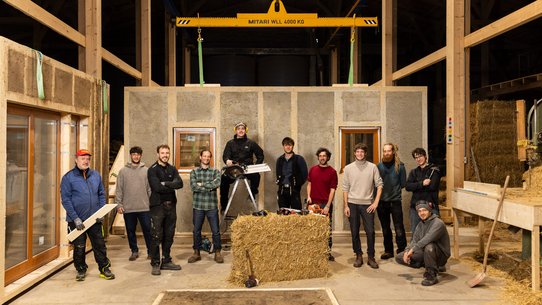
We use a classic timber frame construction system, whereby the gaps are filled with straw as an insulating material. The straw is almost unprocessed. We provide the elements with finished surfaces in the factory, for example wood or clay plaster - this is the most environmentally friendly option.
This combination of prefabrication is new! We deliver the elements to the construction site, and assembly for a detached house only takes about two crane days. In total, we are ready on site in a week, including the installation of windows and doors.
We therefore take on around 30 to 40 percent of the total construction volume - the rest, such as the roof and interior fittings, is done by others. But: our part is extremely predictable. We have never had any problems with cost increases or postponements. That gives our customers great security!
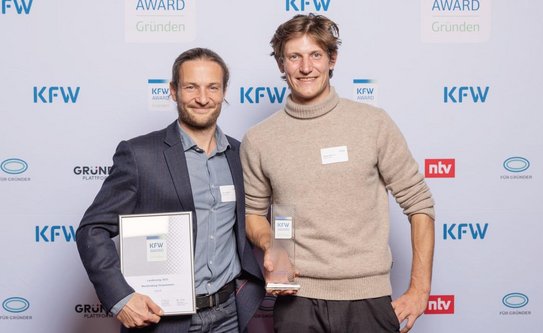
You have now been honored with the KfW Award Gründen. Congratulations. What did you actually receive the award for?
Wäschle : The award we received recognizes a mixture of very promising, young start-ups - I believe the companies must be a maximum of five years old. The focus is on sustainable business models.
What was really exciting was that they don't just recognize a specific industry, but a very broad field. There really was everything at the awards ceremony! From 3D-printed shoes to start-ups in the field of artificial intelligence to an app for children with neurodermatitis.
Innovation plays an important role. Although sustainability-driven business models like ours were also explicitly recognized, that is not the only condition. The award simply recognizes companies that have taken the first successful step with an innovative, future-proof concept.
What does the award mean to you?
Wäschle: We are delighted to receive the award, as it is above all a confirmation. It shows us and confirms our own feeling that we are on a good and sustainable path. It's just great when someone from the outside says: 'Wow, this is a great startup, it has a future!
At the same time, the award is primarily a tool for us to generate attention. Not only for Halm as a company, but also for the way we build. We want to show: There are already climate-neutral and sustainable solutions in the construction industry that now need to be used and scaled up.
Of course, we hope that this label will inspire confidence in us - especially among new customer groups. We build with straw; although the material has been certified as a building material for almost 20 years, it is still new to many people. This award should help to strengthen this trust so that people say: 'Okay, we'll try it out, we'll invest in it!
Take part and support Thorin Wäschle!
And the audience award, that's still running?
Wäschle: Exactly! Voting for the Audience Award will continue until the end of November. The €5,000 is nice, but that's not what we're primarily interested in. More important is the attention that we can draw to our foundation, our topic and ecological building for a month.
Speaking of organization: we have thought a lot about company forms and are currently organized sociocratically. Our main goal is to become a responsible owner. This means that the company is more or less owned by itself, is managed by the employees and profits are reinvested. This blocks an exit.
What really drives us is getting ecological construction out of its niche. Every vote for the Audience Award helps to support this goal and spread the word. That's why it would be great if we could share this
More articles
 09/30/2026PeoplePioneer of the Month
Ferhat Cicek: With Foresight into the Wide World
With an inquisitive nature and an extensive network, Ferhat Cicek set out from Lake Constance into the wider world—to Singapore, Doha, Istanbul, New York, and Washington, D.C. 08/26/2026PeoplePioneer of the month
Hannah Hartenstein: In Tune with a Culture of Empowerment
For years, Hannah Hartenstein worked behind the counter at the student café “Beton & Bohne”. At the same time, a unique interest began to take shape: an interest in the economic side of the healthcare system. 07/15/2026PeoplePioneer of the month
Leon Löchle: Life in a Highly Frequented Area
For Leon Löchle, getting involved is as much a part of life as the air he breathes. It means a great deal to him to stand up for others or to help them have a good time.- 06/18/2026PeoplePioneer of the month
Julia Sonntag: Always One Step Ahead of Stagnation
Julia Sonntag is what people generally call a loyal soul. She feels a deep connection not only to the Lake Constance region, but also to the initiatives and jobs she’s involved in.