"I have grown a lot personally" - Emilia Bös looks back on her time in office as SVP
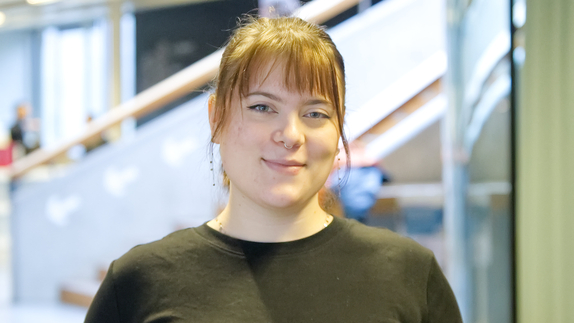
As soon as you've settled in, the end is already approaching. After a year, Student Vice President Emilia Bös draws a conclusion. What did she like most, what least? And above all: Would she extend for another year if it were possible?
Emilia, you are approaching the end of your term as Student Vice President. Why did you want to become SVP back then?
Emilia Bös: That's a question I've actually been asked a lot this year - and I still don't have a perfect answer. I think there were many factors.
On the one hand, you have to know: I was previously an assistant in the office for two years. That means I've already gotten to know a lot - how Orientation Week works and what the work is like overall. I was also already in the Senate, so I was already involved in university politics.
And I'm just a person who can't sit still. I don't just want to watch everything go by, I always have the urge to do a bit more. At some point, I thought: where better to help shape things than directly on the Executive Committee?
There were a few things that bothered me. And that's why I thought to myself: then I'll go to the Executive Board, look into it and try to change something - so that the university will hopefully be a bit better for everyone.
What did you like best about your job?
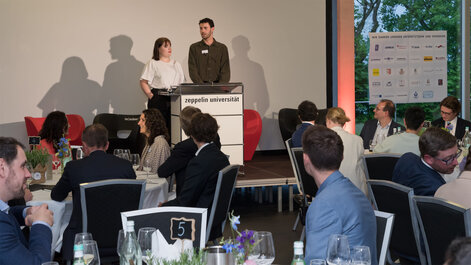
Emilia Bös: I think it's a bit of a cliché, but for me it was really working with the people - the environment here in general. We have such an interesting and special community, both among the students and the staff and professors. There are super exciting people to work with at all levels.
That was always very enriching, because you'd be sitting at the canteen table talking about something after an appointment - and suddenly new ideas would emerge. Then we had a look: What can we do with them? What's the best way to implement it?
Whenever I thought: "Now it's getting a bit tough, I need a break", I had a meeting - and I was immediately motivated again. I really enjoyed that.
And of course the OrientationWeeks: they are always very exhausting, but also incredibly fun.
What didn't you like so much?
Emilia Bös: I think it was a few decisions in the last few weeks and months - and above all the way there. This realization process: "We really can't avoid it now, it's really the only option and unfortunately it has to be like this." That was a lot of sleepless nights for me.
And then this knowledge that you can never please everyone - that's just difficult sometimes. We are not just a few people. Even though we are a comparatively small university, there are still a lot of people that you have to somehow manage.
The fact that it sometimes doesn't work out perfectly was also a challenge. But I think that's part of it when you take on so much responsibility.
What was your biggest challenge?
Emilia Bös: I think my biggest challenge was time management. Filing things away, writing things down, creating concepts. Especially when you're totally motivated and want to implement something new and cool, you still have to juggle your weekly tasks and priorities.
And then you also have to think your way into the academic world of professors. In some places, when we talk about topics, we have a very different understanding of how something works and what terms are used.
We once had a long discussion about the term "management". I said: When I say management, I mean guiding and directing people - and that doesn't necessarily have to happen in a business context. But the professor said: No, management is either business studies or economics, it's a purely economic discipline. And I was like: No, it doesn't have to have anything to do with economics. We actually spent 15 minutes talking about it because we simply come from different worlds of thought.
You have situations like this from time to time. That's when you realize: they're just used to different things than I was used to in my environment.
Would you extend for another year?
Emilia Bös: Well, I would be lying if I said no. Somehow I would - because I have the feeling that you just need a while to get into a job like this. And now I'm at the point where I can say: I have an overview, I'm settled in the role.
And right now I have so many things I'd still like to do - but the end is getting closer. I know I only have about a month and a half left. That means I can only initiate a lot of things, but I can't see them through to the end. And even with projects that I've already started, I know that I won't be able to see them through to the end. It's difficult to just let them go.
On the other hand, I also know that this is part of the job. It makes sense that the position is limited to one year. At some point you have to say: period. Now a new person can take over.
Were you able to achieve everything you set out to do?
Emilia Bös: I think I at least tried to do everything I set out to do. When you take on a position like this, you always have great ideas and lots of things you want to achieve.
And then you realize in everyday life: there are also tasks that I didn't choose myself, but which are extremely important. I definitely did something in all the areas where I had planned to do something. But I was already aware that you can't change your entire path in one year.
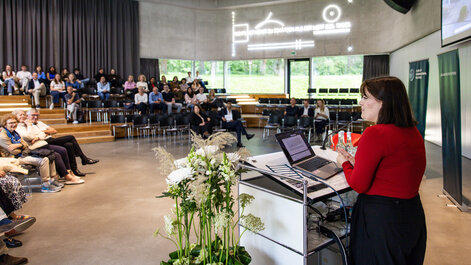
Were you always able to incorporate or implement the students' wishes?
Emilia Bös : Contribute - always. That was never a problem. If I heard something somewhere or someone told me something, I was always able to pass it on.
Implementing it is another question, of course. I think we were able to implement a lot of points in the way that many students wanted. But sometimes you have to look: What do the students want - and what is actually possible? You have to find a middle ground.
We have made many things possible, but sometimes university law or other restrictions simply say: "That's not possible." If there was a hurdle that could be removed quickly and easily - then immediately, why not?
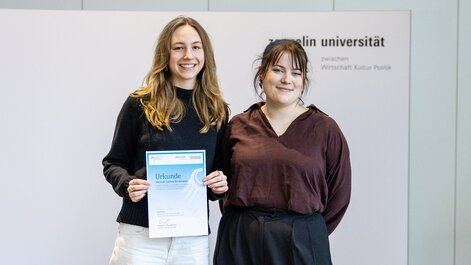
What will you take away from this year?
Emilia Bös: So much - that's why it's difficult for me to boil it down to one thing. In any case, I've met a lot of really nice new people who I really enjoy working with.
And also: how do you deal with people in such positions? Even at a small university, there's a lot of politics involved. So: Who do I talk to? What is the best way to get results? Where do I get the information from? I've learned an incredible amount - things that I'm already taking with me into other areas of my life and can continue to use.
I got to know the university from a completely different perspective - both the professors, because the relationship simply changes, and the university itself in terms of content. In the meantime, I've become like a running university Wikipedia: I know the ASPOs, the FSBOs, all the documents. That's not entirely impractical for the last few years of study.
I have grown a lot personally. The university has grown even closer to my heart. So yes - I couldn't pin this down to just one thing.
Anything else you want to say?
Emilia Bös: It was a great year. It's really hard for me to let go of it all. But it's all part of it, and I'm also looking forward to handing it over to a new person. I'm sure they'll do something great again.
But I think it will also be an exciting change for me. I've never done anything else before. I was here for a semester before I started to get involved with the whole university politics issue. And now I've made a firm decision: No more university politics for now. It's going to be exciting - a new everyday student life that I can really experience.
More articles
 03/26/2026PeoplePioneer of the month
Emilia Bös: Naturally energetic
Emilia Bös has an idea of what ZU has done to her and with her so far. She has grown as a person because she has grown into roles and tasks from which she has emerged stronger.- 11/14/2024PeoplePioneer of the month
Otmar Böss: "It's worth venturing into the unknown"
At ZU, Otmar Böss learned to simply do what is good for him and others - and experienced that it is worth daring to try the unknown. - 09/30/2026PeoplePioneer of the Month
Ferhat Cicek: With Foresight into the Wide World
With an inquisitive nature and an extensive network, Ferhat Cicek set out from Lake Constance into the wider world—to Singapore, Doha, Istanbul, New York, and Washington, D.C.  08/26/2026PeoplePioneer of the month
Hannah Hartenstein: In Tune with a Culture of Empowerment
For years, Hannah Hartenstein worked behind the counter at the student café “Beton & Bohne”. At the same time, a unique interest began to take shape: an interest in the economic side of the healthcare system.