
Lilli Kim Schreiber: In the role of the social observer
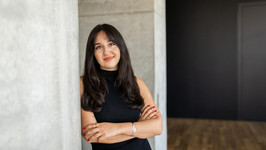
Lilli Kim Schreiber was heading towards journalism when she started her CCM Bachelor's degree at ZU - with the aim of learning as much as possible about communication and media in order to be prepared for a journalistic traineeship. Aha moments in the middle of her studies changed everything: when she came across explanations for different everyday observations in Pierre Bourdieu's sociological writings; when she experienced what cultural policy is and what it does in international research networks.
Lilli Kim Schreiber was of kindergarten age when her parents, who worked in the textile industry, moved to Appenzell from southern Germany, close to the border with Basel. Her mother gave her an artistic and creative streak in the cradle, so to speak, as she used to design fabrics professionally as a textile designer and had spent a lot of time in front of the easel in her youth. "We often visited museums and art exhibitions together when I was very young," Schreiber mentions.
Like her mother, Lilli Kim Schreiber started painting at an early age - and also writing stories. The latter culminated in her school days when she not only edited the school and A-level newspaper, but also wrote a crime novel as part of a book project. Encouraged in everything at her grammar school, she eventually developed a particular soft spot for the humanities and languages. In addition to German, history and art, her favorite subjects included English and French, as well as Latin and Ancient Greek. "I was particularly interested in the historical background of Roman and Greek poetry and epic poetry," adds Schreiber.
Particularly fascinated by Roman law, she switched to the University of Lucerne to study law after completing her federal baccalaureate. "Even though I was quite taken with courses such as History of Law and Philosophy of Law, I had to realize after the first semester that law wasn't right for me. I missed the critical questioning," admits Schreiber.
The joy of writing led her to an internship in the local editorial office of the Appenzeller Zeitung, a small offshoot of the St. Galler Tagblatt. "They threw me straight in at the deep end, had me conducting interviews and publishing articles from day one - but that gave my self-confidence a huge boost," reports Schreiber. The offer of a journalistic traineeship was already on the table at the time. "But first I wanted to acquire more knowledge about communication and media in a degree course," explains Schreiber, whose decision in favor of ZU and the CCM Bachelor's degree was made in the summer before the start of the course in September. "A real stroke of luck", as she says herself. "ZU was the only university in the area that combines culture and communication in one degree program," notes Schreiber.
From journalism to Pierre Bourdieu's sociology
In practice, she remained loyal to journalism. She completed her first summer internship at the St. Galler Tagblatt again, but this time in the city and culture editorial department. She also worked as a freelance journalist until August last year, initially for the Tagblatt and later for the eastern Swiss culture magazine Saiten. She gained her own curatorial experience by working for a year as an assistant at artsprogram during the week and as a working student at the Kunsthalle Appenzell at weekends, as well as curating the digital poetry exhibition "in|:stag:|e" in cooperation with the Literaturhaus Vorarlberg.
The idea of doing a traineeship in journalism after her bachelor's degree has since receded far into the background. This was because sociology and cultural studies were increasingly becoming her focus. This was triggered by an introductory sociology seminar on the phenomenon of fashion. It was there that she met Franz Schultheis, a sociologist who has accompanied her academically to this day. "Even then, I fell in love with Pierre Bourdieu's sociology," remarks Schreiber. "How a certain clientele behaves in public spaces such as art museums or galleries: Social behaviors and a group-specific habitus, which I frequently observed during my time as a journalist, suddenly became scientifically ascertainable and understandable."
Coincidentally, Franz Schultheis was looking for a new student assistant at the time. "Nothing benefits me more than our conversations, from which I draw almost all of my knowledge about Pierre Bourdieu and his research - the two sociologists were very close due to their work together in Paris," explains Schreiber. She became increasingly involved in her professor's research work, was entrusted with the editing of two publications and was able to participate in a DFG project on the visualization of sociological practice. "It was about analyzing a journal published by Bourdieu that dealt with scientific standards in a very experimental way," says Schreiber.
Pierre Bourdieu took his first sociological steps on his trips to Algeria - with a camera in his luggage. In a comparative study, Lilli Kim Schreiber investigates how the resulting photographs were staged in worldwide exhibitions after his death in 2002 - whether as research material or as photographic art. "Building on this, my bachelor's thesis will analyze the aesthetic reception of the photographs on the part of the visitors to these exhibitions - in other words, how the aura of the photographs is manifested and passed on through public discussion," explains Schreiber.
New perspectives on societies thanks to sociology and cultural policy
Who appropriates which public spaces and how: These and other sociological questions were also the subject of interviews and surveys conducted by Lilli Kim Schreiber and Jil Tischer in Friedrichshafen when it came to developing a concept for a 13th edition of the Seekult Festival, which they were jointly managing. "This gave rise to the idea of bringing together the various groups within the city's population," explains Schreiber. Under the motto "Fluid spaces. A Festival for Decentralized Spaces", over 40 formats were realized at more than twelve locations; an anthology about the festival with texts by visitors as well as students and academics is soon to be published under the title of the same name.
She also gained a new perspective in a course on cultural policy taught by junior professor Meike Lettau. In the course of this and in the further course of her studies, Lilli Kim Schreiber went on an excursion to Kampala and research residencies in Beirut, Tunis and Cairo. As part of the "Tawasol" research network, she researches autonomous collectives and artistic practices in Tunisia and Egypt. She even recently published her first academic essay on the shifting role of the curator in an anthology co-edited by Meike Lettau and published by the renowned academic publisher Routledge. "One important reason why I chose ZU was also the unique opportunity to conduct student research," emphasizes Schreiber, who deepened her sociological and political knowledge during a semester abroad at the Institut d'Etudes Politiques de Paris (Sciences Po) in Reims.
Before continuing with a Master's degree in sociology or cultural policy in France, Lilli Kim Schreiber will first do an internship at the DAAD's Paris office after completing her Bachelor's degree. "I have the feeling that I have experienced a kind of new start at ZU: above all through the encounters and collaboration with academics, but also students, who have given me new perspectives on societies," says Schreiber.
More articles
 08/21/2025PeoplePioneer of the month
Ezgi Gülistan Gül: With focus against forgetting
Ezgi Gülistan Gül is not above stating uncomfortable facts. Her aim is to put knowledge into the world that is never instructive, but always enriching. 08/26/2026PeoplePioneer of the month
Hannah Hartenstein: In Tune with a Culture of Empowerment
For years, Hannah Hartenstein worked behind the counter at the student café “Beton & Bohne”. At the same time, a unique interest began to take shape: an interest in the economic side of the healthcare system. 10/16/2025PeoplePioneer of the month
Jil Tischer: Do it yourself - but together
The dynamic and energetic environment at ZU encouraged Jil Tischer to think big and realize even bigger projects. 09/25/2025PeoplePioneer of the month
Augustin Renz: Juggler with three standing legs
Augustin Renz likes the roles of the lobbyist in university politics, the bachelor student between sociology, politics and economics and the qualitative and quantitative researcher.