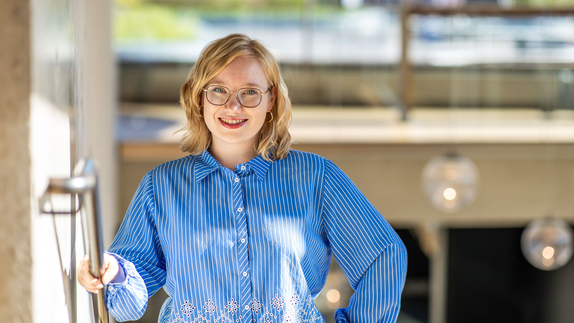
Lara-Maria Mixdorf: On the path from plate carrier to sustainable entrepreneur
Lara-Maria Mixdorf was still at elementary school when she decided what she wanted to do one day: "I want to be a manager at BMW!" Not an astronaut. Not a veterinarian. But BMW. Driven by her childhood dream, she went to Aachen to study mechanical engineering. She was fascinated by technology, machines and engines, but she also realized that technology alone is not enough to make a company work. So she moved on to Lake Constance to study SPE at ZU. She graduated with top marks from the course, which combines sociology, politics and economics. And it gave her every opportunity to pursue her dream.
Lara-Maria Mixdorf grew up in a village of 70 people near Wismar: thatched roofs, cobblestones, a cowshed in the village. Her family: a collection of vocations. Her grandfather became a horse farmer at the age of 14, and later a riding stable owner and trainer. Her father, a trained chef, founded a hotel with a restaurant and catering service. His brother is a farmer, his dream since childhood. And Lara-Maria Mixdorf? She lent a hand in her parents' restaurant business: no weekends in the village disco, but service at weddings, no vacations on the beach, but looking after guests, setting tables, carrying plates. "I spent most of my childhood and youth alternating between my parents' house, my grandparents' house, school and the family business. But what made up for it all were the many encounters and conversations with all kinds of people," says Mixdorf.
Even as a child, however, she was less interested in beautifully presented main courses than in powerful engines. On her parents' lap, steering wheel in hand - that was the beginning of an enthusiasm that never waned. The desire to not only drive cars, but to eventually run a company like BMW, was there early on - and remained. "I'm going to work at BMW!" It wasn't just a dream, it was a plan.
The path from studying mechanical engineering to the SPE Bachelor's degree
The path first to Aachen and later to ZU was not a straight one. To get closer to her dream job, Lara-Maria Mixdorf embarked on a Bachelor's degree in Mechanical Engineering at RWTH Aachen University. However, RWTH showed her that her fascination for processes and functionalities was less technical and more organizational in nature. "I'm just not the kind of person to lock myself in the library and bluntly beat the material into me," says Mixdorf looking back. She lacked the space for questions, for discussion, for questioning. "Despite my fascination with technology, I had to admit to myself that the engineering profession wasn't for me. Instead, I wanted to understand how the company behind it works," explains Mixdorf.
But before this idea could take shape, the coronavirus pandemic threw a spanner in the works - as did her mother's health, which deteriorated drastically due to a serious illness. "I had to support my father with the businesses and at the same time look after my mother intensively. It was a difficult time overall, but it brought us closer together as a family," says Mixdorf.
In the midst of these challenges, the question of what to do next for her personally once again came to the fore. Her thoughts revolved around the future, responsibility - and all the conversations she had picked up over the years in the family business. For example, when, after a successful summer party, a managing director stood at the bar at half past one in the morning with a beer and complained that the accounting department was to be outsourced: "These experiences made me want to understand: How do our society and our economy work? What responsibility do companies have for society and why do they make certain decisions?"
To answer these questions, she looked for a suitable degree course. In the end, she opted for the SPE Bachelor's degree at ZU. "An online information event, where the last doubts were dispelled, encouraged me to choose the course. Before that, a private university was like a closed book to me," explains Mixdorf. "And even then I felt that ZU was exactly the place where I could be myself."
She found what she had been missing before. "I was particularly impressed by the mix of sociology and economics, because we didn't just simply learn by heart in the courses, but discussed complex problems in an interdisciplinary way," Mixdorf mentions. In a course with Professor Dr. Maren Lehmann, she then received a decisive offer: "Also because I got on well with Maren Lehmann personally, I kept the prospect of a Humboldt project supervised by her in the back of my mind." First, however, she wanted to put her theoretical knowledge into practice. Something she had long lacked in Aachen. She made the connection between organizational theory and practice in a variety of ways, for example at ZU's umbrella initiative, StudentLounge e.V., where she established and developed structures and processes in various positions.
While organizing an edition of the career event zu|taten, she came into contact with the consulting firm Egon Zehnder. This was followed by an internship semester in Hamburg, later on by periods abroad in Budapest and Sweden and a student trainee position. "Put simply, my job there was to fill management positions in German industry," says Mixdorf. What she experienced there time and time again, however, was disillusionment. "What I repeatedly encountered in my work were decisions that were not geared towards the long-term success of a company," says Mixdorf. And she adds: "I still believe that it is possible to plan ahead for the long term and think economically at the same time. However, in order to be successful in the long term, you sometimes have to accept short-term losses."
"I might want to be the person who inspires companies to think more long-term."
This inspired her to write her Humboldt project entitled "From quarter to decade: The management problem of corporate sustainability as creative destruction". "Based on the concept of sustainability and the entrepreneur according to Schumpeter, I have provided evidence that sustainability is nothing other than the core of entrepreneurial thinking. Reducing sustainability to the ecological level alone is not only short-sighted, but even negligent," Mixdorf describes.
She also pursued this idea in her bachelor's thesis: "Long-term thinking is strategic thinking. And so, in my bachelor's thesis, I designed my own model for strategic transformation and pointed out that a transformation consists of many small steps and is never complete." At the end of her studies, she returned to the initial question: Why do companies make the decisions they do? "Maybe I want to be the person who inspires companies to think more long-term," Mixdorf remarks.
And another circle has been closed: Lara-Maria Mixdorf is doing an internship in Organizational Development at BMW to bridge the gap between her Bachelor's and Master's degrees. "I'm absolutely delighted with the internship because I can see how the structures work in the background across the company and how processes can be changed to tackle the crisis in the automotive industry."
What comes next? "I only know one thing: in ten years' time, I want to either be able to lead myself or advise managers."
More articles
 09/25/2025PeoplePioneer of the month
Augustin Renz: Juggler with three standing legs
Augustin Renz likes the roles of the lobbyist in university politics, the bachelor student between sociology, politics and economics and the qualitative and quantitative researcher.- 11/14/2024PeoplePioneer of the month
Otmar Böss: "It's worth venturing into the unknown"
At ZU, Otmar Böss learned to simply do what is good for him and others - and experienced that it is worth daring to try the unknown. - 06/18/2026PeoplePioneer of the month
Julia Sonntag: Always One Step Ahead of Stagnation
Julia Sonntag is what people generally call a loyal soul. She feels a deep connection not only to the Lake Constance region, but also to the initiatives and jobs she’s involved in. - 02/26/2026PeoplePioneer of the month
Clemens Englert: With contacts to entrepreneurial spirit
An initiative led by Clemens Englert for many years is in contact with former students so that they can transfer their entrepreneurial spirit to current students.