Cross-border cultural practice: The final week of the TAWASOL project in Tunis
The project brought together artists from Germany, Tunisia, Egypt and Lebanon. However, the intensive final week revealed challenges that could turn the future of cross-border cultural practice on its head.
What does cultural exchange mean in a geopolitical context characterized by inequality, postcolonial continuities and regional instability? The TAWASOL project, initiated by Zeppelin University in cooperation with the Institut Supérieur de Musique de Tunis and the Université Saint-Joseph de Beyrouth, understands exchange not as a symbol, but as a form of work.
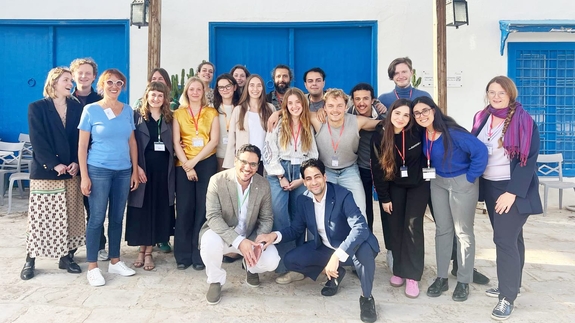
Since 2023, it has been bringing together artists, researchers and cultural actors from Germany, Tunisia, Egypt and Lebanon in a dialogical process. Funded by the German Academic Exchange Service (DAAD) and supported by local and international partners, the project concluded with an intensive week of work in Tunis.
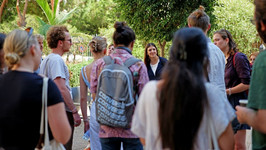
The week began with a visit to the Moment Residency in Ghar Al Milh with cultural actor and artist Soufïa Bensaïd, which offered space for personal reflection and collective thinking. Junior Professor Dr. Meike Lettau led a workshop on cultural policy in times of global crisis and Claire Partsch presented the Lebanese Zoukak Theater's "Letters from the Ground" - an examination of cultural responsibility in the face of the genocide in Gaza and the war in Lebanon.
Artistic productions between representation and resistance
Two documentary films made as part of the TAWASOL Arts and Science Residencies provided insights into the creative scene in Cairo and Tunis. Chiara Keßel's film was dedicated to young female artists in Tunisia and questioned their visibility in the cultural field. Aaron Vilkama, Mohamed Ali Kechiche and Wajih Bejaoui presented a multi-layered portrait of the Egyptian jazz underground scene as a place of musical freedom under a repressive system.
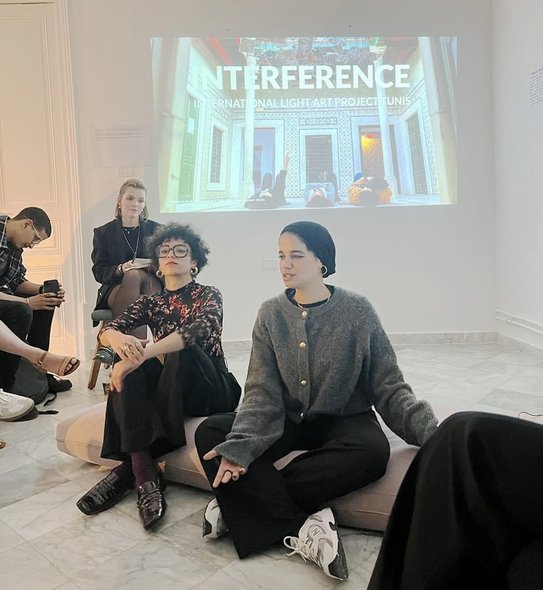
The project "Collectivise: About Commoning in Arts and Culture", curated and developed by Lilli Kim Schreiber, Bahman Iranpour, Meriam Bettouhami and Julian Kraemer, focused on the political and aesthetic potential of collective forms of work. The exhibition was accompanied by a research paper, a digital platform on collective artistic networks and a lecture by the Interference collective on its light installations in Tunisia.
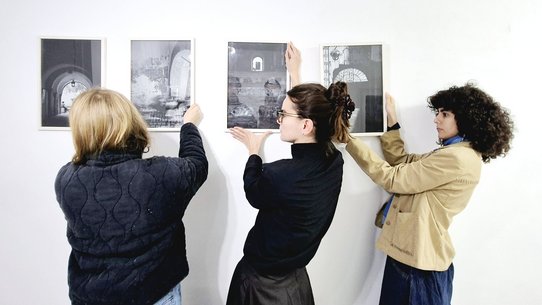
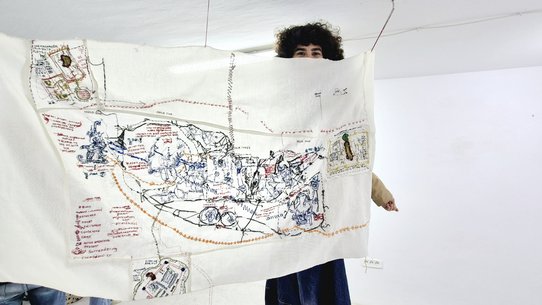
The exhibition "Places in the In-Between" was realized by Ricarda Hommann, Julia Hartmann and Jan Ennker together with the artists Aisha Azab (Cairo), Mehdi Temessek (Tunis) and Caro Jost (Munich) at the RSCL Gallery in Le Kram.
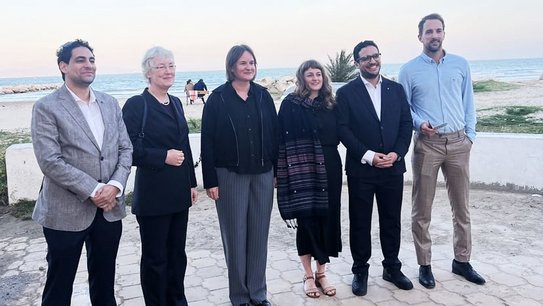
The work was dedicated to transitional spaces between geography, identity and political localization. The visit of the German ambassador Elisabeth Wolbers at the vernissage underlined the diplomatic and cultural relevance of such projects.
Cultural infrastructures and their implementation in practice and policy
In addition to the artistic contributions, several formats focused on questions of institutional conditions, funding logics and international responsibility. Albert Schmitt and Sina Perkert from the Deutsche Kammerphilharmonie Bremen presented the Zukunftslabor - a model project that combines musical excellence with educational and social work.
A further impulse came from Ouafa Belgacem, founder of Culture Funding Watch. Her workshop not only offered practical strategies for project funding, but also a critical look at global power relations in cultural funding. Her message was that cultural work must be aware of its own structures and exclusions in order to have a truly sustainable impact.
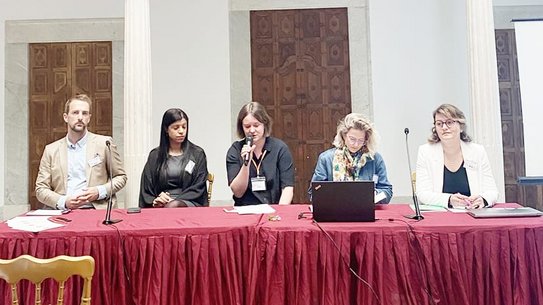
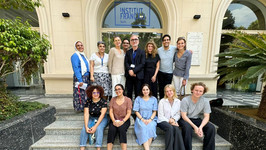
A panel discussion at the Ennejma Ezzahra Palace in Sidi Bou Saïd showed how such issues are negotiated at diplomatic and institutional level. Representatives from the German Embassy, the Institut Français, Tunisia88, Elyssa Tunisia and Zeppelin University spoke openly about the opportunities and tensions of international cultural partnerships.
Afterwards, two former Tunisian culture ministers discussed the developments in cultural policy since the 2011 revolution - a conversation about visions, setbacks and the need for new political alliances in the cultural sector.
Knowledge production, networks and new forms of cultural practice
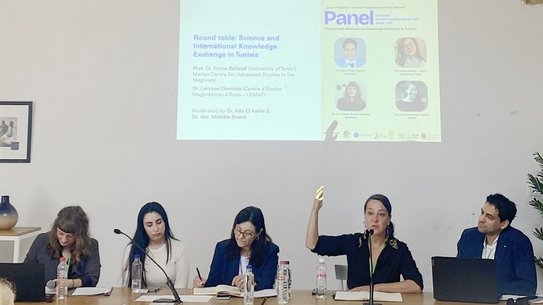
Several contributions made it clear that cultural practice today also works through media, digital and research. Tawasol fellows Hiba Kammarti and Souha Bachtobji presented their video podcast on music production in Egypt and Tunisia - a platform that makes local producers, networks and challenges in music production visible. Prof. Dr. Emna Beltaief (Merian Centre for Advanced Studies in the Maghreb) and Dr. Laryssa Chomiak (American Institute for Maghreb Studies) provided the theoretical framework.
In the discussion about the role of research as cultural infrastructure, it became clear how closely knowledge production is linked to questions of power, access and cultural responsibility and how important local anchoring and archiving are in transnational work.
Finally, Salma Kossemtini spoke about her curatorial practice in the Global South. Between scarce resources, political pressure and aesthetic demands, she negotiated how curatorial work can be made relevant, respectful and effective.
What remains of this week is more than a thematically dense program. A network has grown from conversations, shared experiences, new ideas and concrete plans. Friendships have been formed, perspectives have shifted and bridges have been built between institutions that will carry on.
TAWASOL has shown that transcultural cooperation is a process based on relationships, trust and mutual listening. And this is precisely where its lasting power lies.
More articles
 04/04/2025ScienceExperience report
What can art achieve? The Tawasol project in Tunis and Cairo
Two participating ZU students talk about their experience of the "Tawasol" research project and the cultural productions that have already been published. 06/06/2024ScienceJuniorprofessur für Cultural and Media Policy Studies
Tawasol network supports democratization in the WANA region
Artists and cultural practitioners have contributed to democratization processes in many countries in the WANA region (West Asia and North Africa). The network تواصل [Tawasol] examines this socio-political dimension of artistic formats ... 03/12/2026ScienceGuest article by PD Dr. Martin R. Herbers
Kick-off without a blueprint: What the state election in Baden-Württemberg reveals about the super election year 2026
After the state elections in Baden-Württemberg, the search for the "great lesson" begins. Is it just a revealing prelude or even a blueprint? 01/14/2026ScienceGuest article by ZU alumnus Said D. Werner
The US economy faces an institutional test
US outlook 2026: Four areas of risk shape the economy - from fiscal policy to trade, with consequences for inflation and employment.