What can art achieve? The Tawasol project in Tunis and Cairo
Two participating ZU students talk about their experience of the "Tawasol" research project and the cultural productions that have already been published.
After the first two workshops on cultural policy and artistic production and cultural organization in Lebanon and Germany in 2023, the 20 fellows came together in smaller project groups in which they developed their project and research plans.
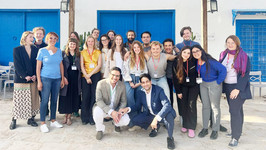
The implementation of the cultural projects and research now took place in the summer of 2024 during the one- to two-month "Arts and Science Residencies" in Tunis and Cairo, during which the groups had the opportunity to immerse themselves deeply in the art and cultural scene of the cities. In this article, we as a fellow and project scholarship holder and a student assistant of the project would like to record our experiences and give the university community a little insight into our time in Tunis and Cairo.
Tunis: One institution follows another
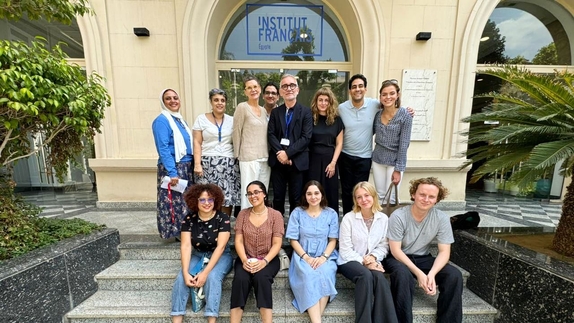
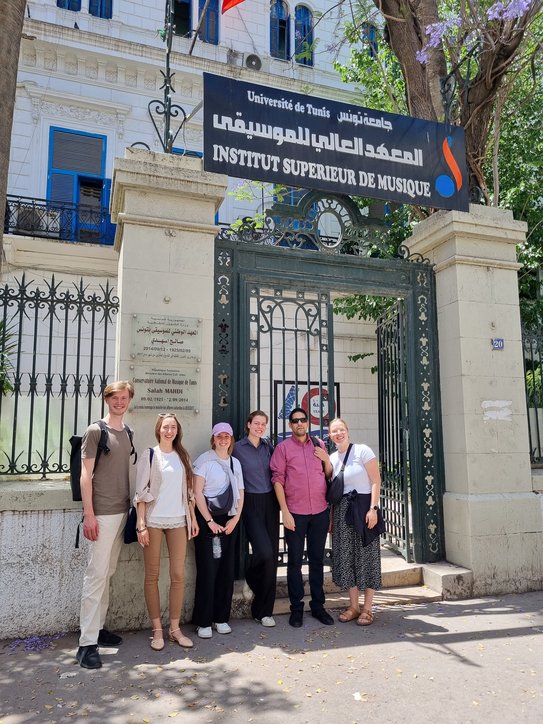
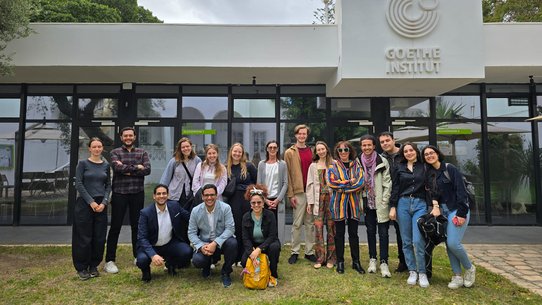
The first residency in the Tunisian capital Tunis began in May 2024. After a welcome at the Institut Supérieur de Musique (ISMT), the Tunisian partner university, we visited the Institut Français next door, which has changing exhibitions and programs, such as a bilingual cinema series. The next day, we met the director of the German equivalent of foreign cultural policy - the Goethe Institut Tunisia - for a discussion and a tour of the institute's program, projects and building.
Over the next few days and weeks, we also got to know the Cité de la Culture - a cultural center in Tunis, which also houses a museum, the MACAM. Here we also met a young art student who invited us to the bachelor presentation of his photo series at the Université des Beaux-Arts. During this time, we also visited the Ennejma Ezzahra, Palais de Baron d'Erlanger in Sidi Bou Said several times, where concerts of traditional Tunisian or Egyptian music are often played.
Also L'Art Rue, a collective and cultural space in the Medina of Tunis, which carried out projects such as the Dream City Festival - a multidisciplinary art festival in the city of Tunis, which takes place in the historic city center and deals with social and political issues, such as public space through art.
We were able to make many new contacts and expand our local network, including meeting the ElWarcha collective, which some of us already knew from their exhibition at Documenta Fifteen, to learn more about their artistic practice and their collective approach to cultural production in conversations and interviews.
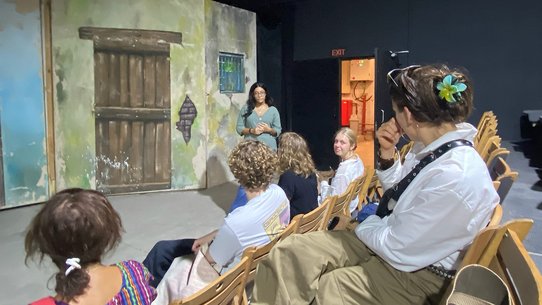
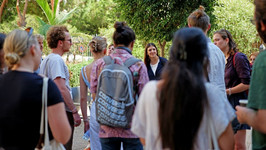
During the eight weeks we spent in Tunis, we continued to work on our projects, meeting with artists from theater, film, music, orchestra, dance, visual arts, curation, cultural activism and cultural mediation to interview them and talk to them about various topics, such as their role as artists in society, the current political and social situation in Tunisia and their own challenges in the art and cultural production scene in Tunis. It was amazing to see how interconnected and intertwined the art scene in Tunis is.
We went into the residency with a research interest in the intersections and interactions between politics, social processes of change and art and culture and wanted to explore the role of artists, especially young artists, in post-revolutionary society in Tunis. During our stay in Tunis, we adapted the question somewhat and also included the current developments in Tunisia as well as the conditions of the local art and culture scene in Tunisia.
Of course, there were also challenges and science is often measured by its results. In Tunis, however, it became clear that research sometimes lives more from its processes, the encounters, misunderstandings and new perspectives that made up this residency.
In addition to cultural production and the exchange with organizations, artists and collectives, we also got a new insight into cultural policy through our acquaintance with the cultural attaché of the German Embassy in Tunis, who kindly welcomed us afterwards for a coffee and conversation at the embassy.
He spoke, for example, about the effects of the Israel-Palestine war in Tunisia and on the cultural projects of the Goethe-Institut and the Federal Foreign Office, and the organizations they support, as well as about his personal career path and his work as attaché of the German Embassy - an experience that impressed us all very much. The visit to MECAM, the Merian Center for Advanced Studies in the Maghreb, was also very enriching. The center conducts interdisciplinary research in the fields of social, cultural, political and natural sciences. This enabled us to exchange information about each other's projects and plan future collaborations.
Overall, participating in the Arts and Science Residency in Tunis had a lasting impact on my perspective on the importance of art and culture as a resource for social change, as well as the dynamics of the MENA region and international cultural cooperation.
Cairo: Diving into the underground
In September 2024, the second research stay of the DAAD-funded تواصل [Tawasol] project began in the Egyptian capital Cairo. As a student assistant, I, Camilla Bischoffshausen, had the opportunity to accompany junior professor Meike Lettau and the project fellows for a week. Cairo plays a central role in the MENA region - both as a historical and cultural hub and as a dynamic place for contemporary art production.
Our first meeting was with the organization Underground Social, which looked after the fellows on site. They see themselves as a creative collective and were the point of contact and connection to the world of local cultural practitioners. As the name suggests, the focus of the collective is not on a commercial way of cultural production, but rather they focus on smaller artists from the underground scene in Cairo.
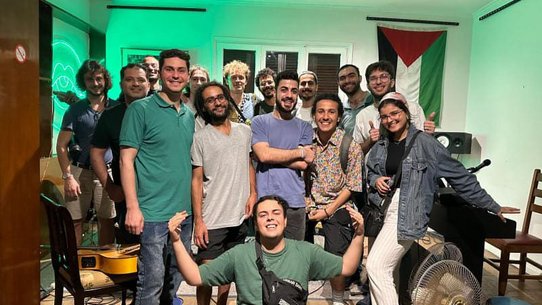
One of the project groups was dedicated to the tension between memory, intercultural and intergenerational knowledge transfer. The focus was on questions such as: How do we remember history? What role do artistic forms of expression play in this process? And how can these topics be depicted in a transcultural exhibition?
Discussions with local artists and cultural workers such as Farida Nader (Head of Operations at Underground Social) and Sarah Sarofim (curator and author) highlighted the challenges associated with an exhibition on these topics. A recurring theme was the danger of a colonial view of memory processes and the need to integrate diverse transcultural perspectives into the curatorial approach.
Other student groups also explored community-oriented practices in the cultural sector in Tunisia and Egypt in exchange with local cultural workers or created a dialog on the topic of music distribution and event management in the context of the two countries by creating a video podcast. In addition to interviews with individual artists, the Tawasol Fellows also met with representatives of the Goethe-Institut, the Institut Français, the German Embassy and the organizations Orient Productions, Mahatat for Contemporary Art and the "Theater is a Must" festival.
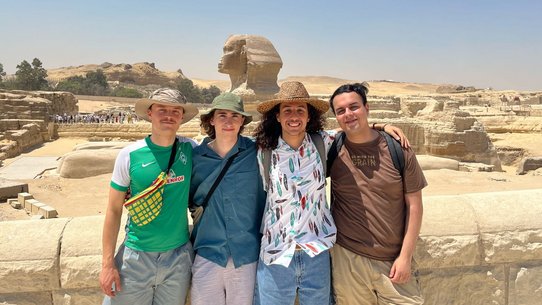
At the same time as our stay in Cairo, the "Cairo International Festival for Experimental Theatre" was also taking place in the city for the 31st time. In the course of this, Junior Professor Dr. Meike Lettau gave a workshop on "Cultural Policy and Transformation". I had the pleasure of accompanying and documenting it. In her input, Meike Lettau first presented central questions of cultural policy, including: What is cultural policy? What instruments and strategies are available? How can cultural policy be understood as social policy? How does cultural policy influence the entire arts and culture sector?
The input was followed by an open discussion with the workshop participants, who came from very different areas of the arts and culture scene: Actors, directors, cultural managers, scenographers, art critics, students of art criticism, legal scholars with an interest in cultural policy and representatives of UNESCO.
Overall, my stay in Cairo was an impressive experience. Projects such as the تواصل [Tawasol] - Cultural Production and Policy Network not only offer a platform for transcultural encounters and knowledge transfer, but also make an important contribution to the further development of participatory cultural policy.
Exhibition in Tunis
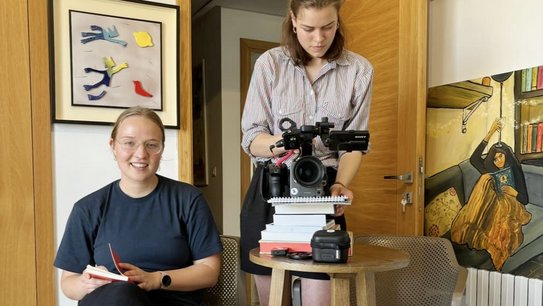
As part of تواصل [Tawasol], interdisciplinary teams have created film, podcast and research projects as well as an exhibition on site in Tunis over the past three years.
In April 2025, the results will be presented at a symposium in Tunis and on a website as an interactive knowledge exchange platform in order to be accessible to the general public and also serve as a starting point for further projects.
However, this is only one part of the success; another, perhaps just as important, can be found in the personal learning processes, conversations held and experiences gained, which go beyond the understanding of art, culture and research as theory and enable new connections in practice.
If you would now like to find out more about the experiences, adventures and results of the Tawasol Fellows' projects, you can find them on the Internet from April 2025 at www.tawasol-culture.de
More articles
 07/08/2025ScienceExcursion
Cross-border cultural practice: The final week of the TAWASOL project in Tunis
The project brought together artists from Germany, Tunisia, Egypt and Lebanon. However, the intensive final week revealed challenges that could turn the future of cross-border cultural practice on its head. 12/10/2024ScienceSustainable corporate culture
Gamechanger men: why equality only works with them
The study "Gender Equality - the role of male managers in transformative corporate culture change" by Linda Suhm calls for a rethink of gender equality. 06/06/2024ScienceJuniorprofessur für Cultural and Media Policy Studies
Tawasol network supports democratization in the WANA region
Artists and cultural practitioners have contributed to democratization processes in many countries in the WANA region (West Asia and North Africa). The network تواصل [Tawasol] examines this socio-political dimension of artistic formats ... 09/21/2026ScienceThree Questions for Simon Koschut
Security. Europe. Responsibility.
How Europe's security order is changing, what role transatlantic relations play in this process, and what responsibilities academia and universities bear in a new security landscape.