Digitization for all
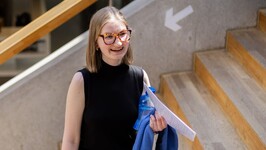
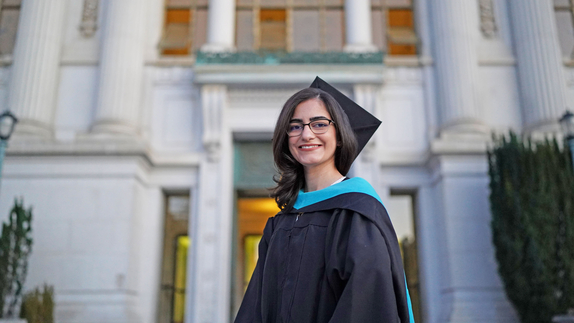
For Miray Salman, it is by no means just a research question, but much more: how can marginalized groups participate in technologies and algorithms? After all, she emphasizes that it is precisely the equitable shaping of digitalization that is groundbreaking for democratic progress. And so she has made it her life's work to identify gaps in the digital world and develop online solutions for everyone. After completing her CCM bachelor's degree at Zeppelin University, she recently completed her Master of Public Policy at the University of California, Berkeley; a doctorate may soon follow.
What was your motivation for wanting to study at ZU?
Miray Salman: That's a good question. Back then, it was a combination of gut feeling and logic. Roughly speaking, I still make my decisions based on this balance today. And of course it's not easy to decide against ZU once you've seen the lake.
What do you remember most about your time at ZU and how did it shape your further education?
Salman: The initiative landscape shaped me the most. Studying at ZU motivated me to work hard on the issues close to my heart and to implement honest and well-researched solutions in a fun and collaborative way with fellow students and stakeholders, often as pilot projects in research and practice. I learned at ZU that I can realize my passion with rigorous quality. And learned how collaboration, assertiveness, patience, persistence and constant joint iteration of ideas and solutions lead to great results that are first and foremost for people.
You wrote about the digital gender gap in an article for ZU|Daily. How did you come to deal with this social problem?
Salman: I reflected a lot on what it means to be a strong and competent woman with a migrant background in places where people with such (intersectional) backgrounds are underrepresented and why that is the case. I experienced and observed many prejudices and many challenges and points of friction. New technologies and programming languages were like a hobby for me, which was not very easy to access. I was curious because I was aware of the potential for change that algorithmic decision-making processes can have. It was a no-brainer for me that the transition to new, algorithm-driven systems would be dangerous for those who are excluded from their design.
I looked at the figures. In Germany, we had one of the world's largest AI talent pools at the time and were also among the top 3 countries with the largest digital gender gap in that pool. In combination, this meant that we were basically pursuing very one-sided innovation. I was very moved by one of my interviews for my Humboldt thesis. When asked why my interviewee couldn't imagine acquiring more digital skills despite being interested in technology, the answer was "I'm just not made for it". This shocking statement made me question how we had managed to make 50 percent of the population believe that they are biologically incapable of something.
Democratic progress can only be achieved safely and profitably for all if everyone has access and accessible ways to co-create technologies and algorithms. At the time, I identified the participation of marginalized groups in technologies and algorithms as one of the most important issues in the world and for Germany.
You recently completed your Master's degree at the University of California, Berkeley. Where do you see the differences to your ZU studies and what made you decide to go to Berkeley?
Salman: Berkeley is a great place and I loved living and studying there (Go Bears!). A big advantage at Berkeley is the access to rigorous quantitative, technological and analytical courses that are designed to be very inclusive. At ZU, there were comparatively only a few options for me to look at topics from a quantitative perspective or learn programming languages at the time. In addition, the equity focus at UC Berkeley stands out in particular. Almost all professors have a focus at the interface with equity - be it in Applied Econometrics, Computational Social Science or Politics and Public Policy. This integrative equity focus and the access to quantitative learning opportunities made me want to study at UC Berkeley. And as luck would have it, I was again studying by a beautiful body of water - this time the Pacific Ocean.
You are aiming for a doctorate after your master's degree. What appeals to you about academic work and what topics are you dealing with today?
Salman: What excites me about academic work? I have a very boring answer to that: I love research. This has always been the part I have enjoyed the most in each of my practical experiences.
I want to address invisibilities and gaps in AI, algorithms and critical technologies to help develop and implement them safely for everyone. The focus of my work is on access to healthcare for all with a particular focus on women's and refugee health. Making algorithm-driven solutions safe for all is a human right, because safety means safety for all.
I am currently working academically on topics such as human-machine interaction, automation bias and invisibilities and security in AI. Previously, I worked with a research team at Stanford to pilot an AI solution for cancer screening for refugees, developed online solutions for refugee health capacity in Germany using a participatory approach, and developed a report with recommendations for addressing data justice metrics for a California state department.
How are you still connected to the ZU network?
Salman: I am still connected with ZU members and meet them all over the world. Sometimes I facetime with my friends from the ZU days. I really enjoy meeting people from ZU again. I'm also still in contact with my former tandem coach and my BA supervisor. Last year we met again for lunch in San Francisco.
If you were asked about the ZU alumni network: Which formats do you particularly like and what else would you like to see?
Salman: I like the fact that the alumni network invites you to the summer party or other on-site events from time to time. As I currently live in the USA, I would also be very happy about online formats. I would also love to be able to see more of the alumni and alumnae as well as current students, for example through a list of names and links to websites or LinkedIn profiles.
What is your favorite quote or life motto that has accompanied you on your career path?
Salman: "Honest and hard work always pays off." I have experienced this myself. No matter how I perceived the problems at the moment and how many hurdles there were - whenever I did honest and hard work, I was happy with the results.
What podcast or book suggestion do you have for the alumni community?
Salman: Fei-Fei Li - The Worlds I See: She is a professor and co-director of Stanford's Human-Centered AI Institute. She has significantly advanced the field of AI, especially in the areas of computer vision, deep learning, and natural language processing. Her book presents wonderful narratives between diversity and technology. She is a great role model for me.
Joy Buolamwini - Unmasking AI: She explores bias in AI from technological and poetic perspectives. Her work on Bias in Facial Recognition is fantastic evidence and proof of concept that we don't have to accept algorithms as a black box - an argument whose deus ex machina function is far too often accepted for the technology sector.
More articles
 04/22/2026PeoplePioneer of the month
Laura Knobloch: Extremely focused
What began as an interest in politically and religiously motivated extremism has developed into the central focus of Laura Knobloch's academic work. 11/13/2025PeoplePioneer of the month
Gabriel Hoensbroech: Enduring more opinion
"Stand up for what you believe is right": Gabriel Hoensbroech takes this to heart in everything he does and says.- 11/14/2024PeoplePioneer of the month
Otmar Böss: "It's worth venturing into the unknown"
At ZU, Otmar Böss learned to simply do what is good for him and others - and experienced that it is worth daring to try the unknown. - 09/30/2026PeoplePioneer of the Month
Ferhat Cicek: With Foresight into the Wide World
With an inquisitive nature and an extensive network, Ferhat Cicek set out from Lake Constance into the wider world—to Singapore, Doha, Istanbul, New York, and Washington, D.C.