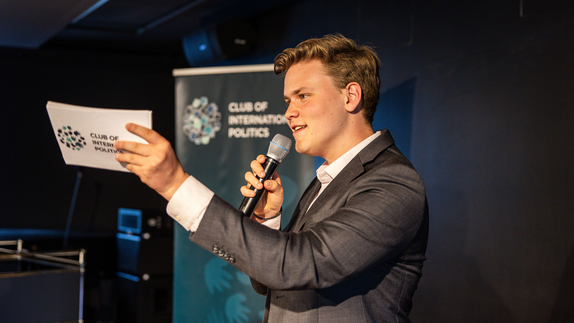
Gabriel Hoensbroech: Enduring more opinion
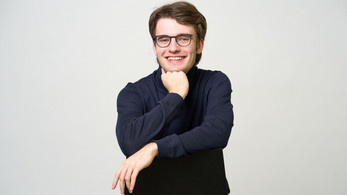
"Stand up for what you believe is right": Gabriel Hoensbroech takes this to heart in everything he does and says. Whether in his volunteer work in Eastern Europe and the Middle East, in his positions as Chairman of the Club of International Politics e.V. and District Chairman of the Junge Union Bodensee or in the seminars in the PAIR Bachelor's program: Gabriel Hoensbroech stands by his convictions, but remains open to new perspectives.
Born in Munich as the eldest of five siblings, Gabriel Hoensbroech moved from one big city to the next during his childhood and youth, from Munich to Cologne and Berlin to Dortmund. "It wasn't always easy because I had to build up a new environment with every move. But these experiences taught me that it is always possible to settle into a new environment," says Hoensbroech, who experienced his first politicization when he moved from Cologne to Berlin: "The Berliners were much more advanced in certain school subjects than the NRWers and vice versa. That was the first time I asked myself: Why is that? I then found the answer in education federalism."
Gabriel Hoensbroech gained further political insights when one of two socially engaged and politically active grandfathers took him to the election parties of the FDP, CDU and SPD on the evening of the 2017 Bundestag elections. "We generally have a very close and intimate family relationship, so a lot of my family's political interest rubbed off on me," explains Hoensbroech. However, a semester abroad at the Lycée Montaigne in the Lebanese capital Beirut was to be far more formative - he was in Lebanon at a time when there were nationwide protests against the government and everything came to a standstill for two weeks. "We stood side by side with the Lebanese on the streets and witnessed how the youth in particular rebelled against injustice and corruption and how the country with 18 recognized religious communities became one. For a short time, nobody cared whether you were Catholic, Maronite, Sunni, Shia, Druze or anything else," reports Hoensbroech.
Volunteering: one-to-one support for people with disabilities in Lebanon
This sparked his interest in foreign policy and Hoensbroech has since become addicted to the Middle East region, which is also reflected in the fact that he has been supporting Malteser International's Lebanon project for years. In summer camps, international volunteers spend up to three weeks with people with disabilities in the Lebanese mountains, providing them with one-to-one care that cannot be guaranteed in homes. "Ultimately, it's about giving them human closeness and appreciation and making their dignity tangible," adds Hoensbroech, who also spent two months volunteering in the Syrian capital Damascus and near the western Syrian city of Homs: "It's incredibly depressing when you stand in the middle of destroyed districts and can hardly imagine what has happened there." He can now incorporate much of what he experienced into his studies: "This has given me the drive to do my bit later on to ensure that something like what happened there happens as little as possible. However that may succeed."
Politics: CDU as party political home
The older Gabriel Hoensbroech became, the more his party-political convictions crystallized. "The CDU is my political home. Especially when it comes to basic values and the Christian view of humanity, which plays a special role for me as a devout Christian. The basic conviction to see every person as an individual and integral member of society, but at the same time to recognize that the individual is obliged to contribute to it," explains Hoensbroech. Consequently, he joined the Junge Union at the beginning of 2021 and the CDU shortly before the following general election. And as soon as time allowed, he got involved in street campaigning: whether for local and state elections in North Rhine-Westphalia and Saxony or for the federal elections. "It's bad enough that you have to expose yourself to more and more bullying," Hoensbroech remarks. "You can tell that the political fringes are getting stronger. That is damaging to democracy. The political center should unite instead of constantly attacking each other."
Even before graduating, Gabriel Hoensbroech went to the German Bundestag for an internship in the office of CDU politician Paul Ziemiak. In his very first month, he accompanied the MP on a trip to a country he knew well: Lebanon. "Through meetings with the prime minister or party leaders of the Christian parties and a visit to a refugee camp, I got to know the country from a completely different, no less exciting side," says Hoensbroech. The contact remained, as he became a student assistant to Paul Ziemiak shortly after starting his studies and has been involved in speechwriting, committee work, preparing appointments and communicating with citizens ever since. "Paul Ziemiak is a political role model for me. I learned from him how to communicate political ideas convincingly, build bridges and stand up for others politically. And, of course, a much broader, more practical understanding of politics," explains Hoensbroech.
Gabriel Hoensbroech knew long before he graduated from high school that he wanted to study the PAIR Bachelor's degree at ZU. "My mother, who also works as a student advisor, played no small part in my decision: she knows what makes me tick and recommended the PAIR Bachelor's degree and ZU to me," explains Hoensbroech. "What makes the university so special is that it teaches you to form and defend your own opinion, but also to tolerate other opinions. It is the different perspectives on one and the same topic that make studying enriching." He is all the more excited about what awaits him during his semester abroad at UC Berkeley: "Being thrown together with people from all corners of the world offers a wonderful opportunity to learn a lot of new things."
Research: How democracy can be shaped and protected
Gabriel Hoensbroech will also be able to delve deeper into the questions that are currently of particular concern to him: When does statehood break down and what are the possible consequences of this? How can fragile statehood be prevented or a stable democracy be formed from a politically fractured state structure? And how can our own democracy be protected from internal enemies? "It is shocking to see the pressure our democracy is under. It is high time that Berlin found a productive way of dealing with the threats to our democracy," comments Hoensbroech.
This is also the focus of events organized by the student-run Club of International Politics e.V. (CIP), mainly with guests from politics and diplomacy. "When I first became more involved with the university, it was clear to me that I wanted to play an active role in shaping the work of the association," says Hoensbroech. After a year as an assessor, he was elected Chairman for the year 2025. And the first major challenge promptly followed when the coalition with the traffic light system suddenly collapsed and new elections were called - and several discussion rounds on the election campaign and the outcome of the 2025 general election had to be organized on an ad hoc basis. "It only worked because the team stuck together and worked so well," remarks Hoensbroech, who can already look back on a successful year: The number of members has risen by almost 60 people to more than 360; and the CIP events alone will have attracted more than 2000 guests to ZU this year. "That makes you really proud," says Hoensbroech. A special highlight awaits him at the end of his work on the Executive Board: when Gregor Gysi, one of Germany's best-known politicians, is expected to give a Global Talk in the near future - and he will host the evening event, which is fully booked with around 400 guests.
Gabriel Hoensbroech does not yet know where he will go after his Bachelor's degree. Either way, he definitely wants to continue his voluntary work: "Volunteering is a matter of honor for me. This is also due to the values that my family has passed on to me. I want to make my contribution to society wherever I can. Whatever that may look like."
More articles
 04/22/2026PeoplePioneer of the month
Laura Knobloch: Extremely focused
What began as an interest in politically and religiously motivated extremism has developed into the central focus of Laura Knobloch's academic work. 09/25/2025PeoplePioneer of the month
Augustin Renz: Juggler with three standing legs
Augustin Renz likes the roles of the lobbyist in university politics, the bachelor student between sociology, politics and economics and the qualitative and quantitative researcher.- 02/26/2025PeoplePioneer of the month
Luca Julie Kuhlmann: Building bridges for international cooperation
To strengthen international cooperation and make the world a more peaceful place: Luca Julie Kuhlmann is well on the way to achieving her goals. - 11/14/2024PeoplePioneer of the month
Otmar Böss: "It's worth venturing into the unknown"
At ZU, Otmar Böss learned to simply do what is good for him and others - and experienced that it is worth daring to try the unknown.