
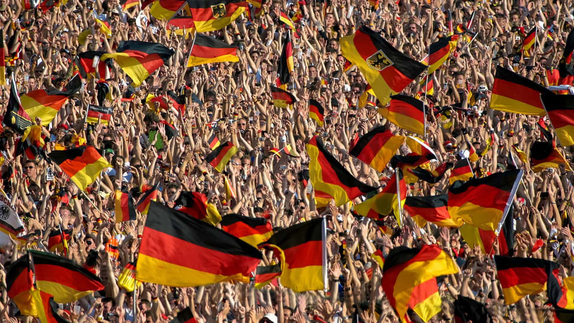
Kicking under national colors - or why "international matches"?
The national togetherness criterion, which makes no sense in soccer terms, is intended to hide the fact that unity and cooperation can only be the product of preparation, training and match practice.
However the playing quality of this tournament and the sometimes rather subdued enthusiasm of the spectators will develop, one thesis should already be ventured now, even at the risk of being (apparently) refuted by the further course of the major summer slump event - a thesis that is formulated as a question to be on the safe side: Could it be that the mediocre to poor, indeed sometimes subterranean, playing quality of what is shown on all screens is linked to the fact that in this eminent team sport, the "wrong people" simply have to play with each other (and then, yes, against each other)? Does the shuffling of the ball by superstars earning millions often only just reach district league level because they have to play together in a more or less ad hoc collective that is not, like their respective (often: foreign!) "home clubs" through months of daily training and regular weekly matches, but which only comes together under the pressure of a public heated up with questionable emotions and only according to the most random and outdated of all conceivable criteria: namely the same country of birth or passport. In other words: Is it not here, as so often elsewhere, the national that is fatal?
No halfway sensible coach in the world, if he were interested in the realization and implementation of a strategy and a playing idea, i.e. in a truly unified, well-matched "team", would pay attention to such an extrinsic and yesterday's common characteristic as the national affiliation of each individual when putting together his team. Just as sensibly as according to the same national origin, one could try to form teams of men with the same hair color, with the same blood group, with the same star sign or with the same first letter in their last name - or even with the same preference in the question "Butter under the Nutella - yes/no?". If, for example, men with conspicuous teeth were being sought to form a team (then sponsored by a dental supplies company), one could currently recommend a North German center forward...
How useful are national teams?
Katrin Göring-Eckhardt's enthusiastically naïve (and quickly deleted) tweet, which wanted to express that the skin color diversity of the German national team is a factor of sporting success and that a "purely white" team would probably be much worse off, is problematic not only because of its subliminally racist anti-racism, but also because it obviously does not ask the fundamental question about the at least equally questionable legitimacy of the national affiliation of the "selection". Why are only young(!) men(!) allowed to wear the same jerseys together, whose identity cards include the word "German" alongside other random entries such as "Roman Catholic", "1.85 cm", "maroon" and "gray-blue"?
It is precisely the extravagant rhetoric about the supposedly creative abilities of coaches to "form" a team from the players they have brought together (many of whom do not even live and work in the country they are supposed to "represent") that says what true soccer experts have always said and known: Really serious soccer is only club soccer at both national and international level, i.e. the clash of teams that have played together for years and have grown together through permanent cooperation, daily contact and well-tested and proven joint playing experience. On the other hand, an embarrassment heap knitted together with a hot needle under the temporary pressure of a national attention hype can only ever be convincing in purely footballing terms by chance (the term "tournament team" is then pulled out of the phrase box for this coincidence) - and today only hopeless nostalgics and amateur tabloid journalists dare to speak seriously of "national" soccer styles anyway.
In comparison to the advanced, varied, differentiated and highly developed soccer of the big clubs, self-confessed connoisseurs (if they had the courage to tell the truth) would actually have to describe all national team soccer as a populist degeneration, a crude ball-kicking game for the beer-drinking, or, to put it less bluntly, as a "low-threshold" entertainment program for the whole family, football light in contrast to the difficult-to-understand weekly club competition for the more refined connoisseurs. The European Championship would then be like an open-air summer festival for so-called "classical" music: André Rieu fiddles Mozart in front of five thousand people on the Waldbühne, the audience has sandwiches and beer cans with them and always claps in the wrong places.
But even on this side of such elitist expert arrogance, if "national" teams are actually nonsensical from a technical point of view, we can ask ourselves what socio-technical function they actually fulfill instead; and we will relatively quickly find other irrelevant justifications and motives, namely those that we cannot really approve of either. The popular term "commerce" probably only refers to the surface phenomenon that benefits from the underlying mass attitudes and needs and, of course, also promotes them with all the marketing tricks. However, the desire to identify with and the enthusiasm for a team sport that is presented under such objectively inappropriate conditions and restrictions, which only satisfy the "national feeling", should perhaps give cause for concern, especially against the background of the current political "shift to the right" in Europe.
You still have to find a way as a soccer team
Of course, this is not about spoiling the game by prematurely discovering the "ugly face" of nationalist revanchism and the assertion of ethnic superiority behind the rituals of power and violence disguised as "fan cultures". It is about the questionable assumption, suggested by the national game mode, that something like unity and community performance can be achieved simply by bringing together individual "players" according to arbitrary criteria of togetherness, putting the same colored shirts on them and having them compete under the same flag. Every unsuccessful, boring, ineffective performance of the so-called "national teams" that can be seen every evening these days could only be instructive insofar as it shows that joint, uniform, coordinated and successful action by players who are united by nothing other than the same nationality and the external expectation that they will succeed is highly unlikely.
Sport demonstrates ad oculos, in its real (in)-efficiency that refutes all talk before and after the game, that it is not enough to wear the same colors in order to act together in a meaningful way. And this is just as true for the three colors of any flag as it is, for example, for the three colors of a traffic light: The same people who constantly reproach the current governing coalition for how inconsistent, uncoordinated, heterogeneous, contradictory it expresses and acts, and who therefore prefer to run to protest parties that propagate homogeneity, unity, clout and "doing instead of discussing" as an "alternative" to this alleged "chaos", then generously overlook the fact that the eleven men competing "for Germany" on the lawn manage even much less coordination and cooperation. The black-red-gold ennobles every weakness and lack of imagination, while the red-yellow-green is blamed without inhibition for everything that doesn't work in the country.
These days, it takes a magazine and a website of its own to remind us in its very title that we have to be "eleven friends" to play soccer and that a good dose of self-deprecating critical distance "would do the game good", to use the commentator's phrase. Normally, however, we are neither in the mood for permanent jokes nor are we "friends" with each other (and don't even want to be), but we still have to find a "common" path together somehow. And that's what many soccer matches are from the spectator's perspective, especially those played in national colors under inflated expectations: unsightly, boring, inefficient, unimaginative.
The pointless national togetherness criterion in soccer is intended to hide the fact that real and effective unity and cooperation can only be the product of highly intensive, costly preparation, arduous training and sufficient match practice. The temporary nationalization of soccer during the European and World Cup phases, which has largely no long-term consequences, is harmful to society because it encourages the transfer of false expectations of unity linked to extrinsic togetherness criteria to other areas. National soccer, which is often so drearily bad, at least disenchants this illusion; for this we must be grateful, especially on disappointing, yawningly boring international match evenings.
Or like this: "Football disenchantment" is normal and easy to explain, and nobody is founding a party to abolish international matches because of it. Why, on the other hand, do people react to every hint of "political disenchantment" with extremism, agitation and a shift to the right?
| Revised version of a text published on 27.06.2024 at hypotheses.org.
More articles
 09/21/2026ScienceThree Questions for Simon Koschut
Security. Europe. Responsibility.
How Europe's security order is changing, what role transatlantic relations play in this process, and what responsibilities academia and universities bear in a new security landscape. 07/16/2026ScienceThree Questions for Anja Achtziger
More Than Just Studying. Motivating. Making Decisions. Taking Responsibility.
Why Zeppelin University emphasizes judgment, responsibility, and interdisciplinary thinking, and why these skills are more important than ever before. 06/25/2026ScienceInternational Spring School
Conflict as a Resource for Cultural Policy
Young cultural policy makers from around the world gathered at ZU. They discussed spaces for negotiation within cultural institutions through pluriversal participation and conflict resolution. 03/12/2026ScienceGuest article by PD Dr. Martin R. Herbers
Kick-off without a blueprint: What the state election in Baden-Württemberg reveals about the super election year 2026
After the state elections in Baden-Württemberg, the search for the "great lesson" begins. Is it just a revealing prelude or even a blueprint?