
Not knowing how AI works is dangerous
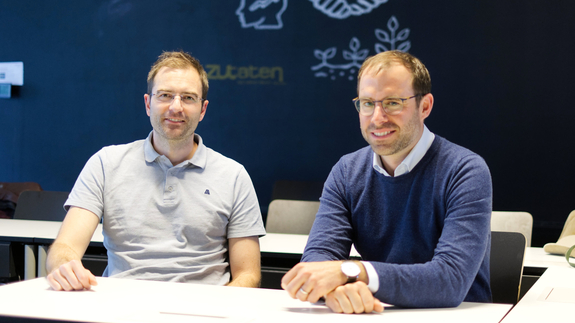
Zeppelin University is introducing a compulsory course for all new students from the fall semester of 2024, which will teach them how AI works. This is a big step, as there are very few compulsory courses at ZU. A conversation with the two initiators on why it must be compulsory to understand AI.
Mr. Eckhard, Mr. Weiss, you have campaigned for a compulsory basic course in artificial intelligence at ZU. Is dealing with AI a new cultural technique that needs to be mastered?
Matthias Weiss: Whether dealing with AI is already a cultural technique is a question of definition. What is certain, however, is that AI is a technology that needs to be mastered. It requires skills in dealing with AI. Blind application, as is often the case at present, is dangerous. Because many decisions are already being made on the basis of AI that have an impact on people. Avoiding AI is also dangerous. Because then wrong decisions cannot be prevented. I believe that the basic handling of this technology must be learned by everyone who has to deal with AI. And that ultimately applies to all of us. And it is especially true for young people, who will soon no longer know the world without AI.
Steffen Eckhard: AI is a technology that touches all areas: in our private lives as well as at work and in science. It is at odds with everything we do today, so to speak. And it is transformative. It will change everything we know: how we drive and how we make decisions, how we are productive, how companies are productive and how they create added value. Everything is connected to AI.

Artificial intelligence will affect us in all areas of life
If nobody can avoid AI anyway, why do we need a compulsory AI course?
Steffen Eckhard: AI is a kind of black box for most people. They have no idea what is going on in it. We need to enable our students to understand what AI is. We need to give them a look under the hood, so to speak. There are different statistical models and probability calculations that underlie AI. To understand how AI works, you have to understand how these calculation models work. And for this, a fairly superficial approach is often sufficient, for which no special mathematical knowledge is required. If you want to assess the results that AI produces, you need to understand how they are achieved. Especially when important decisions are based on them - such as doctors' treatment plans.
Matthias Weiss: ZU offered a general studies course on AI. We saw that there is an enormous need for information in this area. We consider the compulsory course to be necessary because our students need to be well prepared for their future careers and will no longer be able to do without AI. But it's not just the new students who need to learn this. Everyone else does too. That's why we also offer additional courses for current students.
Things come and go on the internet. But AI seems to be here to stay, doesn't it?
Steffen Eckhard: It will influence us in all areas of life - at work and at home - be it at the doctor's, in the workshop, in our hobbies or in our retirement planning. That's why I think it's crucial that our students systematically examine the opportunities and risks associated with AI. This has to do with the data on which AI is based and the way in which AI evaluates this data. It is also often the case that several methods are linked together. Distortions can arise when they are combined, which can be recognized. Experts need to understand this, but so do laypeople, at least to some extent. Because as a layperson, you might want to have a say in the diagnoses that the doctor makes. You don't have to be an expert or programmer to understand AI. Anyone can acquire the basic knowledge. You just have to do it.
Matthias Weiss: Even if this is a new quality that AI brings with it. Parallels can be drawn with the internet. Our students also need to learn how to use knowledge databases like Wikipedia, for example. They need to understand how the information in them comes together. Who enters it and how and whether the information is checked. Not everything in Wikipedia is automatically correct. The information is not only written by relevant scientists. Errors can creep in or be deliberately incorporated, i.e. falsified. You also have to be able to evaluate the information you are dealing with there. And if in doubt, there is no getting around additional research. The same applies to social networks. You need to understand where information comes from and how it is disseminated. Otherwise you can get a completely wrong understanding of reality. The world is not just made up of like-minded people and we don't all have the same opinion, as the bubbles we move around in would have us believe. At worst, people will otherwise become radicalized. So, I don't believe that education is a panacea, but it's definitely always the first step on the right path.
Steffen Eckhard: When you start looking into the subject, you realize that there have long been hundreds of applications. For example, I work with AI in public administration. And there are now the first chatbots that accept customer inquiries. There are youth welfare offices that use AI to help make decisions when it comes to assessing whether children are at risk. There is a whole range of applications that are already available. And when you talk to the employees who use AI, you quickly realize that there is a lack of understanding of exactly what AI does. And this is exactly where our idea comes in: We want to ensure that there is better interaction between artificial and human intelligence - so that better decisions can be made.
What actually prompted you to develop the basic AI course?
Steffen Eckhard: Zeppelin University has a Development Day. Students and lecturers come together to think about how ZU can be developed further. Last year, the question arose as to how we actually want to deal with ChatGPT at the university: Should it be allowed in class? Should you be allowed to use it to write assignments? We discussed this intensively and then laid down rules. In the meantime, we have also anchored the use of ChatGPT in the examination regulations. But then we went even further. First, we developed training in the basics and methods of AI and now we have reached the point where we consider it necessary to introduce this basic course as a compulsory course. You have to understand what is behind AI. Then, by the way, AI also becomes a little less enchanting. And you understand better what really works and what doesn't, what is helpful and what is not.
Matthias Weiss : The rapid development in the field of AI is a challenge in its own right. New start-ups and technologies are constantly emerging that need to be tracked. But the fundamental principles of AI do not change despite this rapid change. So instead of jumping on every new development, it makes sense to first gain an understanding of the core principles. With the basic course, we create a foundation of knowledge that enables us to keep pace with AI developments in the long term without having to constantly acquire new knowledge.
More articles
 08/15/2023Science
How artificial intelligence helps to process customer complaints
Dr. Simon Behrendt completed his doctorate at Zeppelin University. Today he is responsible for artificial intelligence as Manager AI & Data Analytics at Porsche Consulting. 11/25/2025ScienceDigital technologies in communication
Trust is about understanding
PD Dr. Martin R. Herbers explains how the digital transformation is challenging our democracy and how communication science can meet this challenge. 04/29/2025ScienceTransport policy
What happens to the special infrastructure assets?
The next government has put together a 500 billion package. What will be left of this for the transport infrastructure? asks Alexander Eisenkopf. 09/21/2026ScienceThree Questions for Simon Koschut
Security. Europe. Responsibility.
How Europe's security order is changing, what role transatlantic relations play in this process, and what responsibilities academia and universities bear in a new security landscape.