What good is buckling up when missiles are coming? How a ZU student experiences life in Ukraine
Matthias Eckmann traveled to Ukraine with a Häfler aid organization to hand over urgently needed relief supplies. On site, he developed a new perspective on the conflict.
Mr. Eckmann, you made a challenging trip to Ukraine to hand over relief supplies. How did this trip come about?
Eckmann: After the start of the war, the Friedrichshafen municipal council decided that we wanted a solidarity partner city in Ukraine. This is below the rank of a town twinning, but it can have the rank of a town twinning. This is how Friedrichshafen currently handles it. The wish was to find a city with which Friedrichshafen already has links. The choice fell on Horishni Plavni in central Ukraine, which is about a four-hour drive east of Kyiv on the Dnepr River. There is the largest ore mine in Europe, with a huge hole - significantly larger than Garzweiler - and Zeppelin has a site there because all the machines that are used there are sold and serviced by Zeppelin.
As a result of the solidarity partnership, Wolfgang Sigg and Werner Nuber then founded the "Bridge to Horishni Plavni" association. It organizes the transports, and this was the association's third trip there. However, the aid trips had already started earlier, at the beginning of the war, when Werner Nuber began transporting relief supplies to the Polish-Ukrainian border. The association is now continuing this project with greater reach and power.
Are you the only ZU student who took part in the trip? How did your fellow students react when they found out about it?
Eckmann: Many people asked me beforehand whether I was afraid to go and how I could take on such an adventure. After I shared various stories on social media and came back, some people asked me about it and said they could imagine going with me next time. Simply to help the people there because they see what's happening in the media.
I have to say from my own experience that it's quite different when you've actually been there. I could definitely use some help in the future, especially as the journey is quite long. Anyone interested is therefore always welcome to get in touch.
What was your first impression of this country?
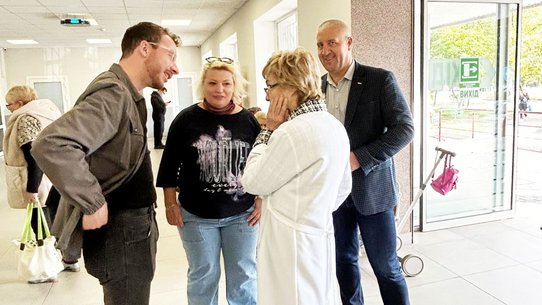
Eckmann: Well, first of all, it was a country of contrasts, I really noticed that. The gap between rich and poor is very clear. We drove a really long way across the country on these roads, which are not always ideal. You see horse-drawn carriages as well as large SUVs. It is a country where the Soviet Union is still present. A lot of buildings from back then have been preserved or are still in use, as well as vehicles from back then. At some point, there was a shift towards modernity. And now modernity and its digitalization are coming together with history. Super old buildings on the outside with state-of-the-art technology on the inside. It left me speechless at times.
Humor helps to cope with the uncertainty in Ukraine
What about security? Were you not worried about attacks?
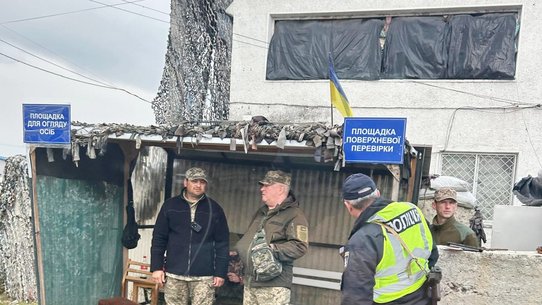
Eckmann: Yes, you constantly have the pressing feeling that something could happen. There were repeated air alerts. Fortunately, the Ukrainians have apps that keep them very well informed about attacks and provide precise and early information about where missiles are hitting. So everyday life goes on as normal.
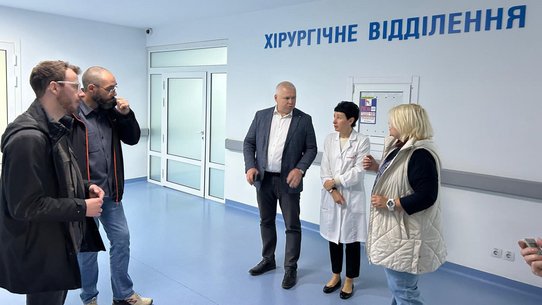
So life was flourishing in Kiev. And in Horishni Plavni, too, I think people were very relaxed - considering that this threat situation has been going on for three and a half years. But maybe you get used to it a bit after a while. We didn't notice any fighting. Horishni Plavni is 150 kilometers from the front. But we visited a hospital and met soldiers there who had been wounded. That was very emotional.
The Ukrainians have also developed a dark sense of humor to deal with the situation. They didn't need air defense, they already had their churches. That has spilled over to us. We said we didn't need to fasten our seatbelts because that wouldn't help against the missiles.
How did what you experienced influence your perspective on Ukraine?
Eckmann : There was a moment that put our visit in a different light. At a dinner, one of the mayors there, Ivan Pavlenko, gave a speech about September 29, 1943, the day the region was liberated from the Nazis. At that time, the town of Horishni Plavni did not yet exist. But the region celebrates this day as the day on which the Russians liberated it from the Germans. On that day, September 29, 2025, it was the other way around: the Germans were sitting at the table as friends, bringing relief supplies, while many Ukrainian families fled to Germany, and now it is the Russians who are shooting at them. Ivan said that it was a strange feeling how the situation had turned around after 80 years. In the middle of the speech, the app reported an air alarm. We Germans looked at it and were relieved to see it: That's 30 kilometers away, and then it went on.
Basically, after I saw everything that was coming down - North Korean missiles or drones, and where it was coming down - I thought to myself: Wow, that's very clearly an attack on the civilian population, who can't do anything about the Russian aggression.
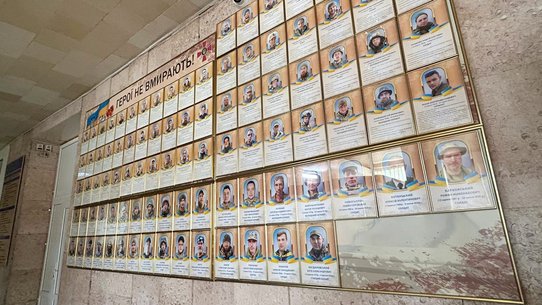
It certainly confirmed my basic attitude to the war. I was also moved by the many pictures of the fallen hanging everywhere. Flags everywhere, memorial plaques with the victims since 2014. The Ukrainians don't talk about three and a half years of war, but about the war that has been going on since 2014, since the protests on the Maidan. The story wasn't there for me on the surface. And when I saw it all, I thought to myself that you can't be that deeply involved in every conflict that is happening in the world right now. We - as Europeans - should have looked much earlier and intervened accordingly.
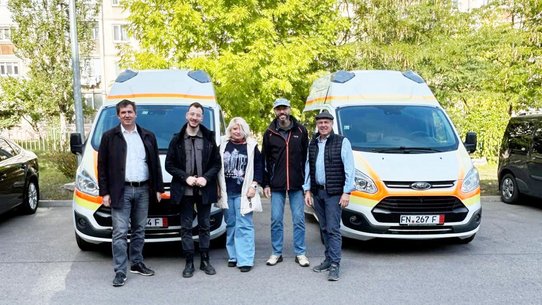
What kind of group was it? Who were the fellow travelers?
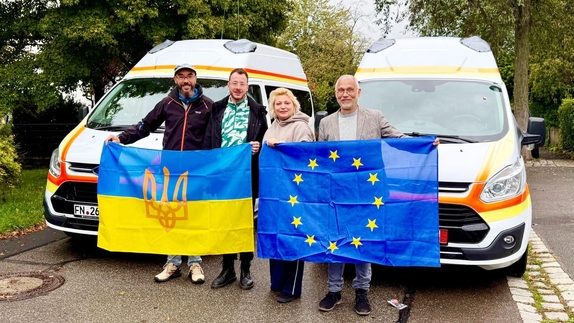
Eckmann: Well, I was by far the youngest. The others were all 40 plus, and some of them had been to Ukraine several times before. Jürgen Schipek, for example, had already been there six or seven times. His motivation is also to take a close look at the cities and think about how the country can be rebuilt at some point. An enormous amount of building fabric has been destroyed. How can we make sure that everyone has a roof over their heads again? There is currently no thinking in terms of: How do we build communal living space? Either you have something or you don't. And he is already thinking about the future. And Marie Sidorschuk is Ukrainian herself. For her, it was a matter of course that she would go along. It sounds strange, but many of the 1500 Ukrainian women in Friedrichshafen are also on vacation or visiting their families in Ukraine, some of whom have not fled because they can't or don't want to.
One Ukrainian woman, who has been in Friedrichshafen since the beginning of the war, was probably in Odessa recently for two weeks, where fighting is taking place. The circumstances for a visit are correspondingly difficult, but they are all very proud of the defense and their soldiers. They all know that if they don't defend themselves, Ukraine will cease to exist. Werner Nuber, chairman of the association, and two of Werner's friends, Volker and Hubert, were also there.
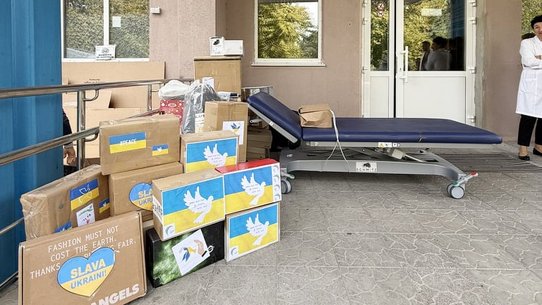
Association "Bridge to Horishni Plavni" will organize even more transports
Would you like to explain what you actually brought there?
Eckmann : The two ambulances were particularly important. We knew that they had major problems getting people who couldn't simply get into a car from the surrounding area to hospital. The gratitude was overwhelming, they couldn't believe that we were providing them with two new vehicles. We also brought a height-adjustable hospital bed for rehabilitation measures. We had asked about their needs beforehand so that we could bring what they needed. Smaller things too, of course, such as medication. Sometimes clothes too. We also packed parcels for soldiers at the front. Small things like wet wipes or coffee. Things you might need that you don't necessarily get from the military. Chocolate, sweets, things like that.
But we also managed to get an electricity generator there. The Rotary Club managed to get a power generator as a gift from a public utility company on the lake. It now supplies an air raid shelter with electricity. But I have realized for myself that we need to help a lot more. This will certainly not be the last trip. And of course we are very happy about any support and especially about donations, which we always implement directly and organize the necessary goods as required.
Bridge to Horishni Plavni on Instagram
More articles
 12/11/2025PeoplePioneer of the month
Yelyzaveta Rudnieva: Reaching the goal through detours
Attracted by the scholarship for Ukrainian refugees, Yelyzaveta Rudnieva's path led her to ZU. Here she has new hope and is pursuing a new dream.- 09/30/2026PeoplePioneer of the Month
Ferhat Cicek: With Foresight into the Wide World
With an inquisitive nature and an extensive network, Ferhat Cicek set out from Lake Constance into the wider world—to Singapore, Doha, Istanbul, New York, and Washington, D.C.  08/26/2026PeoplePioneer of the month
Hannah Hartenstein: In Tune with a Culture of Empowerment
For years, Hannah Hartenstein worked behind the counter at the student café “Beton & Bohne”. At the same time, a unique interest began to take shape: an interest in the economic side of the healthcare system. 07/15/2026PeoplePioneer of the month
Leon Löchle: Life in a Highly Frequented Area
For Leon Löchle, getting involved is as much a part of life as the air he breathes. It means a great deal to him to stand up for others or to help them have a good time.