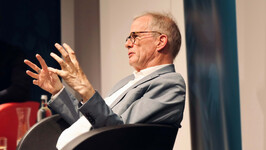
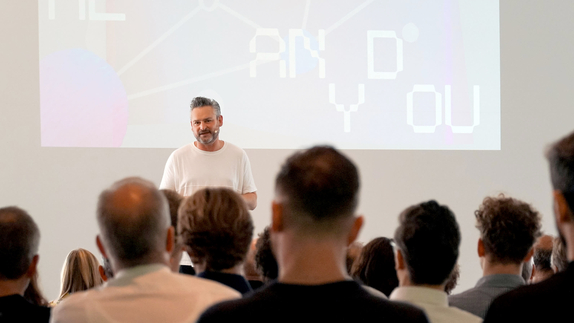
Google professional Frederik Pferdt in his keynote speech at the BIC annual meeting: How "impossible" becomes "possible"
At Google, he has trained tens of thousands of employees worldwide. Now Frederik Pferdt, who was born in Ravensburg, was at Zeppelin University. And he brought the positive future with him.
"Tomorrow is what we have to look at!" said Dr. Frederik G. Pferdt, who has trained and accompanied tens of thousands of employees worldwide for the search engine giant Google over the past twelve and a half years. He called on visitors to the annual meeting of the Lake Constance Innovation Cluster to be "radically optimistic" rather than just thinking: "The glass is half full".
It is more important to ask yourself what future you want to shape and not what the future will bring. In other words, it is up to each and every one of us to decide how life turns out and it is therefore sometimes better to throw in a "maybe" than to block new opportunities by clearly defining a "yes" or "no".
The author, who was born in Ravensburg, now lives with his family not far from Silicon Valley and also revealed during his appearance that his doors are always open. This means that anyone who wants to visit him in the States is welcome at any time. This in turn prompted Maks Giordano, who explained that such an invitation would certainly be gladly accepted in Swabia.
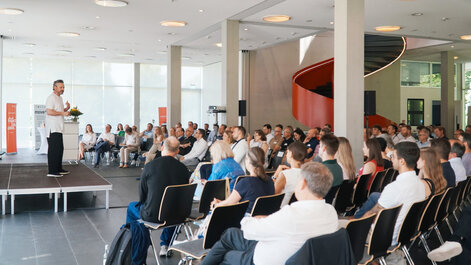
Insight, indulgence and joy at the BIC's annual conference
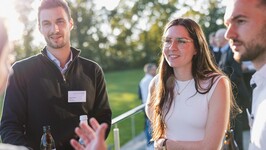
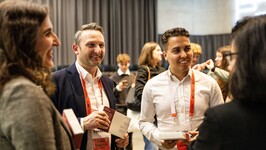
The annual conference of the Lake Constance Innovation Cluster - BIC for short - took an exciting look into the future in the foyer of Zeppelin University's SeeCampus. The keynote speakers' presentations and a panel discussion were followed by many lively discussions among the guests during the breaks. Because everyone has their own vision of the future.
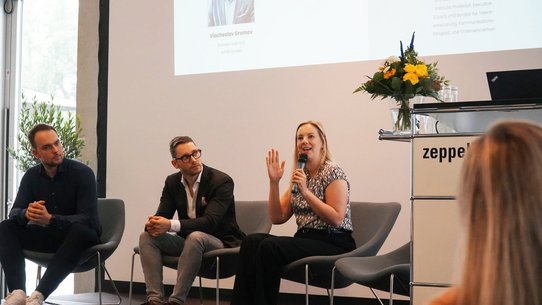
"I wish us all much insight, forbearance and the joy of action," said Professor Josef Wieland in his welcoming address. And the guests from near and far undoubtedly had this "joy of doing". Be it in the keynote speeches by Dr. Frederik G. Pferdt, Fabian Binöder and Viacheslav Gromov, which called for participation, or in the three workshops in smaller groups.
How Frederik Pferdt turns "impossible" into "possible"
Google expert Pferdt also encouraged the guests at the BIC to imagine the future and asked directly how the audience imagined it. "The future is...?" was his introductory sentence, which was supplemented with all kinds of adjectives from the audience. Terms such as "female", "beautiful" and "now" were mentioned, along with many others.
From this, Pferdt developed the sentence "The future I create is...?" in his keynote. And here, too, the cheers from the audience could not have been more varied. A little later, Pferdt explained how "just do nothing" and "it is impossible" can become "just do it" and "nothing is impossible" if you change yourself and your view of the future.
Short discussions broke out among the participants before continuing with individual workshops and finally a concluding panel discussion. This was just one of many aspects of how and where artificial intelligence can be applied and supported. However, the pitfalls that still exist were not left unmentioned.
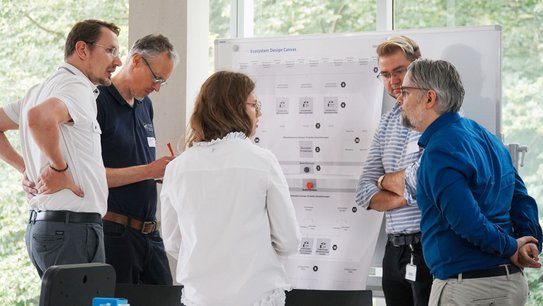
And if Elisabeth Lindt, who moderated the day, had not repeatedly pointed out that time was already limited, the participants and speakers at the Seemooser Horn would certainly still be discussing what the future had in store for them. Everyone involved can then expand on what they have learned at the next BIC event.
More articles
 08/17/2026LifeInvestor Summit Bodensee
Why Good Ideas Need the Right Connections
For founders seeking funding, the Investor Summit Bodensee is about much more than just a pitch on stage. After all, the most valuable connections are made afterward. 08/03/2026LifeGlobal Talk with Andreas Kruse
How Young and Old Come Together
In a Global Talk, gerontologist Andreas Kruse explains how the generational conflict can be resolved and how society can be strengthened through interaction and collaboration.- 05/15/2026LifeSEEQUENZ Festival 2026
Through the night and through the city
Between dance beats, backyards and gas pumps: For three days, SEEQUENZ brings together music, art and the people of Friedrichshafen. - 05/11/2026Lifezu|taten 2026
How a special kind of career fair introduces real questions about the professional world
Workshops, job interviews, panel discussions: students, alumni and companies meet directly at the student-organized career event zu|taten.