Party leaders on the campaign trail: Critical questions are also part of it
The CIP brings election campaigning to the ZU: shortly before the state election in Baden-Württemberg, the federal chairwoman is campaigning for the Green course - and has to show in conversation how resilient her narrative really is.
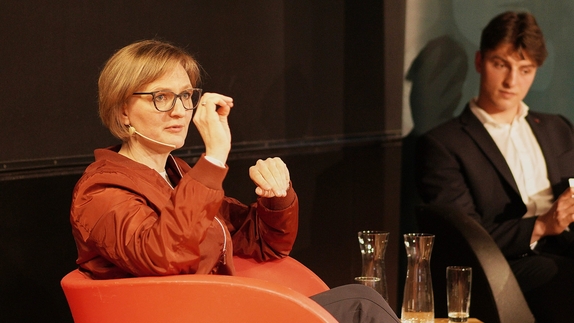
Right at the beginning, Brantner makes it clear what she is aiming for in this election campaign: the election should not be a duel of "AfD versus democrats", but a "duel between two democratic players". She sees the fact that the election campaign has recently shifted to exactly that - Cem Özdemir against CDU candidate Manuel Hagel - as a "partial success". Brantner therefore already sees it as a political gain that the AfD is no longer playing a leading role in this election campaign.
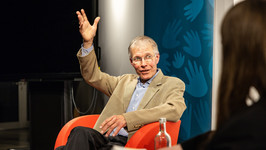
Moderator Vinzenz Spannagel, Chairman of the Board of the Club of International Politics, uses the appropriate figures: As recently as late fall, polls would have seen the Greens in third place. Since then, the Greens have gained four percent and the AfD has lost one percent. In the wake of this, Brantner speaks of a "joint show of strength" by the state and federal Greens.
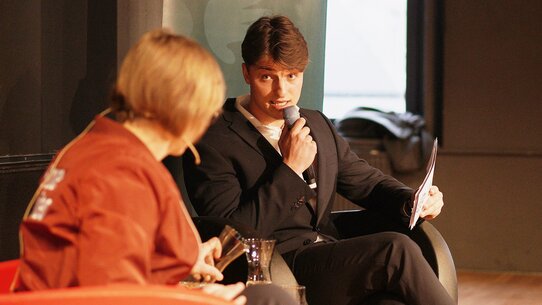
Franziska Brantner was born in Lörrach in 1979 and was Parliamentary State Secretary in the Ministry of Economic Affairs and Climate from 2021 to 2025. Since 2024, she has led the Bündnis 90/Die Grünen party as national chairwoman. When she enters the ZU campus on the afternoon of this political Ash Wednesday, she already has a full day of campaigning behind her with tightly scheduled appointments. The pace of the talk is correspondingly fast - and ensures one thing above all: clear words.
The "CSU of the Greens" - Cem Özdemir at the center
Spannagel then heads towards a well-known issue in Baden-Württemberg: the state Greens and the national party are "worlds apart in terms of content", election posters focus on the person, not the brand. The Greens in Baden-Württemberg are "the CSU of the Greens", he adds. The audience laughs, Brantner also smiles.
She takes the template and turns it into an argument: personalization is nothing unusual; those seeking orientation in times of upheaval cling to reliable people. In her presentation, Özdemir becomes the anchor of trust on which the Green Party's ability to govern in the southwest can be based - which is why he is at the center of this election campaign as a person.
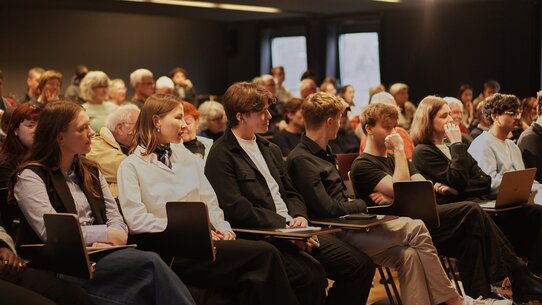
Nor does she brush aside the typical contrast between state and federal government. On the contrary, she admits that "ranting about Berlin" always works quite well in the political south - and is "often the right thing to do". However, the fact that the difference between federal and state polls is currently smaller "than it has been for the last 20 years" is also important. She tries to make it clear that the state association should not be seen as an exception to the Green course, but as a credible and honest part of it.
Economy: speed instead of reverse gear
When it comes to the economy, Brantner is particularly clear: transformation, e-mobility, climate-friendly technologies - these are not just climate policy issues, but above all labor market policy issues. She calls the attempt to hold on to the combustion engine a "dangerous strategy for our jobs". The fundamental question is whether we believe in the future of the combustion engine - or that the car of the future will be climate-neutral, electric and perhaps even autonomous.
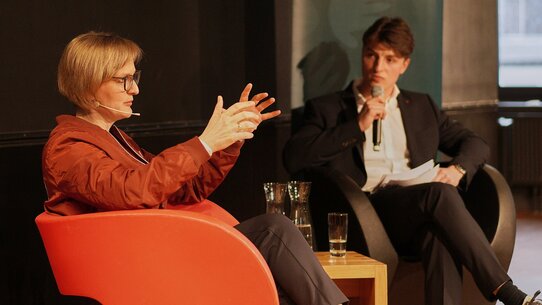
Brantner talks about the slowdown in progress and becomes audibly more emotional: "It makes me angry when I see what is being held up." According to her, this applies not only to e-mobility, but also to a general "backward-looking policy" - she mentions, for example, the debates surrounding the Heating Act and heat pumps and warns of a new dependency on gas. Baden-Württemberg in particular cannot afford this, she emphasizes: As an industrial state, the south-west must "step on the gas" when it comes to conversion, otherwise it will quickly lose its position in international competition.
Spannagel uses Brantner's argument for a strong economy and brings the topic of Mercosur to the table. He confronts Brantner with the Green voting behavior in the EU Parliament - and addresses her accusation that the Greens are putting the brakes on an agreement that could benefit export-strong regions such as Baden-Württemberg in particular.
Brantner goes on the offensive: "Do you know who negotiated this for Germany? Me." She had been to South America several times for this purpose and, according to her argument, there had been no federal government that had brought forward more trade agreements in three years than the traffic light government. The Greens were clearly in favor of Mercosur - but an agreement would only be politically feasible if other large EU states, such as France and Poland, joined in. The latter had recently voiced massive criticism of Mercosur - France voted against the agreement.
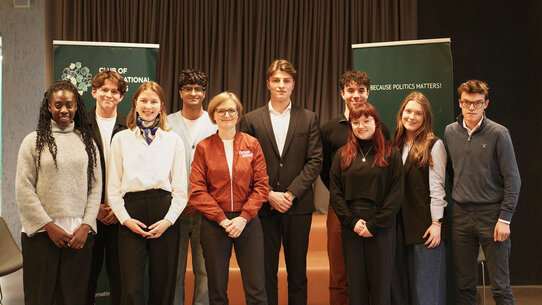
For the party leader, defending green politics is not just about the economy, but also about setting boundaries: against the far right and against polarizing debates. This is most evident when it comes to the AfD: Brantner clearly advocates a party ban. Her reasoning: The Basic Law recognizes this possibility "for good reason". A ban would affect the party's structures, resources and state funding. The political task of winning back voters would of course remain. Nevertheless, she emphasizes: "The danger should be banned."
Brantner sees this as a protective measure: democracy rarely dies with a "bang", but rather gradually. Brantner therefore also warns against a political culture that is increasingly driven by outrage, escalation and camp logic - a dynamic in which the extremes are the main beneficiaries in the end. "I don't want to be part of the polarized society in which we sometimes find ourselves," she says.
The CIP talk shows election campaigning in real time: Brantner presents her record with speed and a clear line - the critical questions force her to justify and defend her narrative at key points. The election on March 8 will decide whether this course will be successful in Baden-Württemberg.
More articles
 02/17/2026LifeClub of International Politics
Military economist Marcus Keupp on Russia's world view and Europe's strength
Russia's war is not just a border conflict, but an expression of imperial thinking. Anyone who wants to counter the threat must understand this logic. 10/23/2025LifeClub of International Politics
UN expert Dr. Ekkehard Griep defends the role of the United Nations
The world order is tottering and the question of cooperation is more open than ever. At the CIP Talk at ZU, Griep addresses the question: Is the world still finding solutions? 09/09/2025LifeClub of International Politics
Media change: "It's easy to have an opinion. It's hard to justify them"
Kirsten Ludowig, Deputy Editor-in-Chief of Handelsblatt, and Oliver Köhr, Editor-in-Chief of ARD, talk about the dangers of media change at Zeppelin University. The problem is clear, but the answers are not. 05/23/2024LifeClub of International Politics
Committed to no parties, but only to the American people: US Consul General Norman Thatcher Scharpf
How does US diplomacy work beyond party politics? Norman Thatcher Scharpf, Consul General of the US Consulate in Frankfurt, told us in a CIP talk at ZU. And that he believes that cooperation is often the solution.