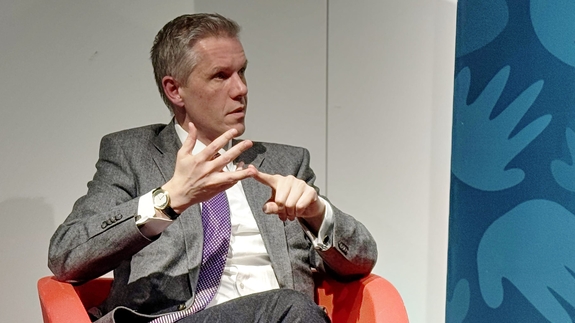
Military economist Marcus Keupp on Russia's world view and Europe's strength
At the CIP talk, military economist Marcus Keupp shows that Russia's war is not just a border conflict, but an expression of imperial thinking. Anyone who wants to counter the threat must understand this logic - only then will it become clear what Europe can do.
"Will the Westphalian principle of state equality still apply in the future - or are we back to imperial superpowers?" Dr. Marcus Keupp sets the tone for the evening with this question. For him, Russia's war against Ukraine is not just a conflict over borders, but an attack on the idea that states are fundamentally equal and can decide for themselves how they live and with whom they ally themselves. It is a question of whether "the big ones" will once again determine what "the small ones" are allowed to do.
According to Keupp, Russia is once again dividing the world into zones of influence. A neighboring country is then not an equal partner, but a sphere of influence. This also gives rise to propaganda that denies Ukraine's right to exist - along the lines of: there is an area that has declared itself independent, but actually belongs to "us".
Keupp, born in 1977, is a private lecturer in military economics at the ETH Zurich Military Academy. As a military economist, he emphasizes, he doesn't just look at who is where in a war or how quickly a front shifts. Instead, he is interested in how the war is paid for, how long a country can sustain it and what resources are consumed in the process. Anyone who only sees war as a military event does not understand it.
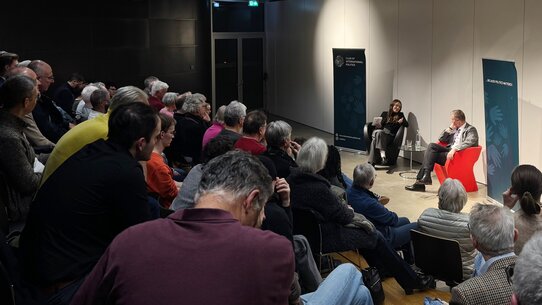
Russia often appears stronger than it really is
The perception of Russia often reminds him of the "Wizard of Oz", says Keupp - a comparison that causes laughter in the hall. In the film, the wizard first appears as a huge, terrifying figure. In the end, however, he turns out to be a small man behind a machine who only feigns his power with light, noise and effects.
This is exactly how Russia is often seen in the West: as a superpower that cannot be defeated anyway. In reality, the country is much less powerful militarily and economically than many believe. However, this does not make Russia harmless. The great danger lies in the uncompromising imperial objective: Russia is prepared to accept very high costs in order to expand its sphere of influence. "In the end, all that matters is that the Russian flag flies there," says Keupp, to put Putin's way of thinking in a nutshell.
"War is peace": Russia's economy becomes a war machine
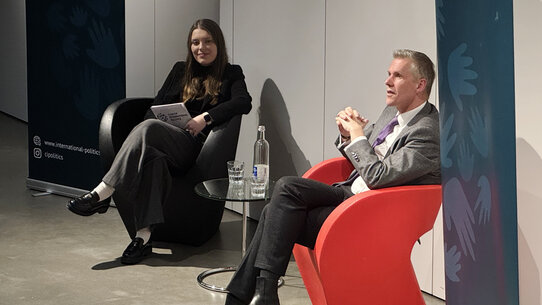
Presenter Michelle Bleichner takes up the economic dimension of the war. Keupp impressively describes the Russian war economy. The state pools almost all available resources in the military apparatus, while the civilian economy is increasingly falling into recession.
War is no longer a state of emergency for Russia. On the contrary: "War is peace," Keupp puts it pointedly. The permanent war stabilizes Putin's political system. Even a military defeat would do little to change this: Russia would not collapse, but relapse into an increasingly primitive war economy.
Keupp therefore warns against the idea that Putin will stop at some point because the "price will be too high". "Anyone who portrays him as stupid has not understood the man," says Keupp. The Russian president acts with ideological conviction, supported by an imperial view of history. Keupp clearly summarizes what works against this: "The only thing this kind of person respects is resistance. Tough resistance."
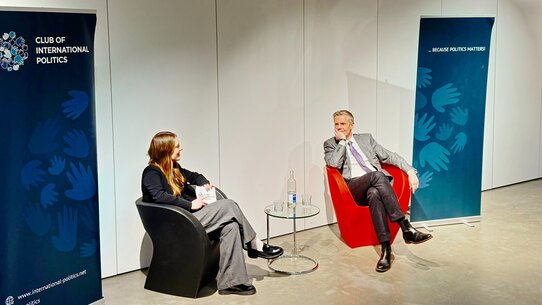
Bleichner asks about the strategic consequences: "What is Germany's role in this new world?" Keupp is clear: for decades, security policy relied on the protection of the USA - a situation he described as "learned helplessness". This attitude is no longer sustainable today.
At the same time, he remains confident: Europe has enormous economic, technological and social resources at its disposal. What is lacking is not so much ability as political determination. Germany is a clear example of this: special assets, industry and financial strength are available. However, the will to use these consistently remains too hesitant.
His appeal: Europe must learn to actively and confidently represent its own interests in the world again. Strength is a prerequisite for stability, including in negotiations. Keupp does not see arms deliveries to Ukraine as an escalation, but as a necessary defense of Europe.
Europe's role: less hesitation, more determination
The nuclear threat comes up in the Q&A session. Keupp answers soberly: the real risk of nuclear war is "zero". Nuclear threats are first and foremost a propaganda tool. "Whoever shoots first, dies second," he reminds us, referring to the logic of the Cold War. Nuclear deterrence therefore remains the foundation of global security.
Despite all the seriousness, the evening does not end in a feeling of powerlessness. Keupp warns urgently against Russia's imperial logic, but this warning is consistently accompanied by confidence. The West is not weak. Europe can act. His principle: the threat is real - and so is Europe's strength.
The evening of the Club of International Politics thus becomes much more than just a geopolitical analysis: a call for strategic and decisive action in a world in which power politics has returned - and the ability to act is becoming all the more important.
More articles
 02/24/2026LifeClub of International Politics
Party leaders on the campaign trail: Critical questions are also part of it
The CIP brings election campaigning to the ZU: shortly before the state elections, the federal chairwoman has to show how resilient green perspectives are. 10/23/2025LifeClub of International Politics
UN expert Dr. Ekkehard Griep defends the role of the United Nations
The world order is tottering and the question of cooperation is more open than ever. At the CIP Talk at ZU, Griep addresses the question: Is the world still finding solutions? 09/09/2025LifeClub of International Politics
Media change: "It's easy to have an opinion. It's hard to justify them"
Kirsten Ludowig, Deputy Editor-in-Chief of Handelsblatt, and Oliver Köhr, Editor-in-Chief of ARD, talk about the dangers of media change at Zeppelin University. The problem is clear, but the answers are not. 05/23/2024LifeClub of International Politics
Committed to no parties, but only to the American people: US Consul General Norman Thatcher Scharpf
How does US diplomacy work beyond party politics? Norman Thatcher Scharpf, Consul General of the US Consulate in Frankfurt, told us in a CIP talk at ZU. And that he believes that cooperation is often the solution.